Introduction
By Year 7, the words Australian students are expected to spell look nothing like primary school. Multi-syllabic academic terms, Greek and Latin roots, and subject-specific vocabulary from Science, History, and English all arrive at once — often within the first few weeks of secondary school.
For many students, NAPLAN Language Conventions arrives before they've had time to adjust to these new demands. The spelling component in particular catches families off guard.
This guide serves two purposes. First, it explains what Year 7 spelling actually looks like under the Australian Curriculum v9.0. Second, it prepares students and parents for the NAPLAN Language Conventions spelling component — including the audio-first format many families don't realise exists until test day.
Inside, you'll find the key spelling patterns Year 7 students need to know, a categorised practice word list, how NAPLAN spelling works in practice, the most common traps, and targeted strategies for building confidence before test day.
Key Takeaways
- Year 7 spelling focuses on word origins, Greek/Latin roots, prefixes, suffixes, and academic vocabulary — not basic phonics
- NAPLAN spelling uses an audio-first format — students hear the word spoken aloud, then type it
- Australian English conventions matter — -ise, -our, and -re endings are standard
- Confusable pairs (affect/effect, principal/principle) require understanding meaning, not just memorisation
- Wide reading across multiple text types is one of the strongest spelling strategies at secondary level
What Year 7 Spelling Looks Like Under the Australian Curriculum
The Shift from Primary to Secondary Spelling Demands
By Year 7, Australian Curriculum v9.0 assumes students have moved beyond foundational phonics. The sub-strand is now called "Word Knowledge" precisely because, as the Australian Curriculum v9.0 English overview explains, students have "progressed beyond phonic development."
Phonics knowledge doesn't disappear at this stage. Instead, spelling now requires understanding how words are built: their origins, their base forms, how prefixes and suffixes shift meaning.
That shift matters beyond English class. Teachers in Science, HASS, and Geography expect correctly spelled technical terms in written assessments — misspelling hypothesis or chronology in an essay can cost marks across multiple subjects.
Key Spelling Features Year 7 Students Are Expected to Master
Curriculum descriptor AC9E7LY08 sets out the specific expectations clearly: students should use "spelling rules and word origins; for example, Greek and Latin roots, base words, suffixes, prefixes and spelling patterns to learn new words and how to spell them."
A companion descriptor, AC9E7LA08, extends this further — students must also investigate vocabulary that builds "specialist and technical knowledge, including terms that have both everyday and technical meanings." In other words, knowing that culture means something different in Biology than in everyday conversation is part of Year 7 spelling work.
In practice, this means Year 7 students are expected to spell:
- Words built from Greek and Latin roots (biology, archaeology, chronology)
- Australian English -ise endings (analyse, organise, recognise)
- Academic vocabulary used across subjects (evidence, coherent, hypothesis)
- Words where meaning connections reveal spelling (sign → signal, muscle → muscular)
Australian English conventions are the standard throughout schooling. The Australian Government Style Manual and the Macquarie Dictionary — Australia's national dictionary — both recognise Australian spelling preferences, including colour over color, organise over organize, and centre over center. These conventions apply in formal written work and in NAPLAN.
Year 7 Spelling Word List: Organised by Pattern
The 75+ words below are grouped by spelling pattern. Studying by category is more effective than memorising a random list — patterns give you a transferable rule, not just an isolated word to memorise.
Note: This is a suggested practice list based on Australian Curriculum v9.0 spelling expectations. There is no official ACARA or NAPLAN published word list for Year 7.
-ise Endings (Australian English)
These words appear frequently in Year 7 English tasks and formal writing. The -ise ending is Australian English standard.
| Word | Word | Word |
|---|---|---|
| analyse | organise | recognise |
| apologise | specialise | realise |
| emphasise | supervise | advertise |
| criticise | summarise | prioritise |
Academic and Analytical Vocabulary
Drawn from English analytical and cross-subject vocabulary — the words students write repeatedly in essays and assessments.
| Word | Word | Word |
|---|---|---|
| narrative | persuasive | evidence |
| argument | conclusion | coherent |
| evaluate | interpret | contrast |
| structure | paragraph | technique |
| context | audience | relevant |
| accurate | compare | hypothesis |
| significant | fundamental |
Commonly Misspelled Words
These words trip up Year 7 students consistently. Most involve double letters, silent letters, or patterns that don't match pronunciation.
| Word | Word | Word |
|---|---|---|
| accommodate | embarrassed | necessary |
| privilege | mischievous | government |
| committee | recommend | occasion |
| vehicle | separate | definite |
| existence | immediately | rhythm |
Confusable Pairs and Stretch Vocabulary
Confusable pairs — these require understanding meaning to choose correctly:
| Pair | Pair |
|---|---|
| principal / principle | stationery / stationary |
| complement / compliment | affect / effect |
| conscience / conscious |
Stretch vocabulary — Greek and Latin root words from upper primary and Year 7 cross-subject study:
| Word | Word | Word |
|---|---|---|
| archaeology | parliament | perseverance |
| phenomenon | miscellaneous | extraordinary |
| simultaneous | hierarchy | conscientious |
| indigenous |
What to Expect in Year 7 NAPLAN Spelling
How NAPLAN Spelling Is Structured
NAPLAN tests four domains: Reading, Writing, Conventions of Language, and Numeracy. Spelling sits within Conventions of Language — not the Writing task. ACARA maintains two separate scales for this domain: one for spelling, one for grammar and punctuation.
The Language Conventions test runs for 45 minutes in Year 7, compared to 40 minutes in Year 5.
The Audio-First Format
This is the detail that catches many families off guard. According to NAP's guidance on online assessment, online Conventions of Language tests include spelling questions delivered via audio dictation. Students hear a word read aloud within a sentence — then must type the correct spelling from memory.
There are no multiple-choice options. The word is not displayed on screen.
The 2014 NAPLAN Online spelling development report documented this format in detail: dictated words were delivered through individual sound files at the student's own pace.
Two Types of Spelling Questions
Based on official NAPLAN example tests, students encounter two formats:
Type 1 — Correct the highlighted error: A sentence is shown with a misspelled word indicated. Students write the correct spelling. Example: "The scientist recorded the particals carefully." → particles
Type 2 — Identify and correct without highlighting: A sentence contains one misspelled word, but nothing is marked. Students must find and fix it themselves. Example: "The comittee met on Thursday to review the proposal." → committee
Year 7 vs. Year 5 Difficulty
Year 7 words are noticeably harder than Year 5. Public example answers show the jump clearly:
| Year 5 Examples | Year 7 Examples |
|---|---|
| because | particles |
| thought | advertisement |
| dangerous | sensitive |
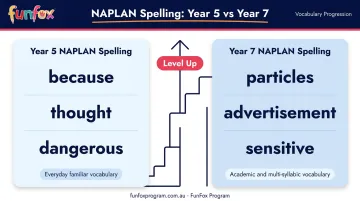
By Year 7, the words draw on academic and subject-specific vocabulary that phonics rules alone can't unlock. A student who has never encountered phenomenon in reading will struggle to spell it under timed conditions — even with strong letter-pattern knowledge.
Common Spelling Traps for Year 7 Students
Most Year 7 spelling errors fall into four categories.
1. Double-letter patterns
These words have double letters in unexpected places:
- accommodate — double c, double m
- committee — double m, double t, double e
- necessary — one c, double s
- embarrassed — double r, double s
The most reliable fix is to learn these word-by-word rather than trying to apply a rule that doesn't exist.
2. Silent letters
Several high-frequency words contain letters that don't appear in pronunciation:
- rhythm — no vowel in the first syllable
- government — the middle 'n' is dropped in speech
- vehicle — silent 'h'
- parliament — the 'ia' combination sounds nothing like it looks
Saying these words in an exaggerated, phonetic way during practice (gov-ern-ment) helps lock in the correct spelling.
3. The Australian English trap
Students who consume a lot of American content (YouTube, streaming, games) or use American spell-check tools can drift toward American spellings without realising it. On NAPLAN and in formal Australian schooling, these would be marked wrong:
| ❌ American | ✅ Australian |
|---|---|
| organize | organise |
| color | colour |
| center | centre |
| recognize | recognise |
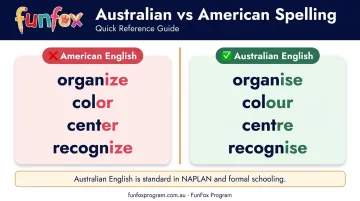
Switching spell-check language settings to Australian English is a simple, immediate fix.
4. Confusable pairs
Affect/effect, complement/compliment, stationary/stationery, principal/principle: these can't be memorised by spelling pattern alone. The correct choice depends on meaning in context. Wide reading builds this instinct far faster than rote drills — which means regular exposure to varied texts matters as much as any word list.
How to Help Your Year 7 Child Improve Their Spelling
Practice Strategies That Work
Audio-first home practice mirrors exactly what NAPLAN tests. Read a word aloud in a sentence — just as NAPLAN does — then ask your child to write it without looking. This trains the exact skill the test requires. A simple session of 10 words per night, read in context, builds spelling memory more effectively than a silent written list.
Look, Say, Cover, Write, Check is a practical home routine that works well for pattern-based word sets:
- Look at the word carefully
- Say it aloud
- Cover it
- Write it from memory
- Uncover and check
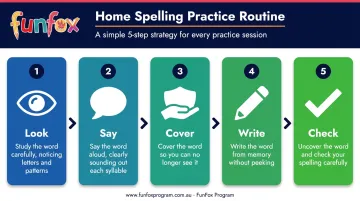
This routine works best when words are grouped by pattern rather than studied as random lists of 20. Tackling the -ise endings as a group, for example, reinforces the rule alongside the individual words.
Morphology study pays dividends because AC9E7LY08 explicitly names Greek and Latin roots, prefixes, and suffixes — and understanding how words are built transfers to unfamiliar words. A student who knows that chron means time can spell chronology, chronological, and synchronise with much more confidence.
The Role of Wide Reading
Wide reading across fiction, non-fiction, news articles, and subject-specific texts becomes load-bearing at secondary level. Research by Ricketts et al. (2020), studying vocabulary development in adolescents aged 12–14, confirms the direct link between print exposure, vocabulary growth, and spelling accuracy.
Students who read regularly encounter academic words in context. They don't just know how to spell phenomenon — they know how to use it. That contextual knowledge is what makes confusable word pairs manageable.
Structured Support
For families wanting structured support through the secondary transition, the FunFox Program offers term-based reading and writing classes aligned to the Australian curriculum. Small groups of no more than six students mean teachers give personalised feedback on actual written work — so spelling accuracy develops through real writing, not rote drills.
Frequently Asked Questions
What words should a Year 7 student be able to spell in Australia?
Year 7 students are expected to spell multi-syllabic academic vocabulary, words with Greek and Latin roots, Australian English -ise endings, and commonly confused word pairs. These expectations come from Australian Curriculum v9.0 descriptors AC9E7LY08 and AC9E7LA08, which cover word origins, technical vocabulary, and specialist knowledge across subjects.
How is spelling tested in Year 7 NAPLAN?
Spelling falls within the Language Conventions component, not the Writing task. Students hear each word read aloud within a sentence and must type the correct spelling — there's no printed word on screen and no multiple-choice options. Audio-first home practice directly mirrors this format.
Is Year 7 NAPLAN spelling harder than Year 5?
Yes, by a clear margin. Year 7 introduces subject-specific and multi-syllabic vocabulary that phonics rules can't decode. Words like particles, advertisement, and sensitive appear in Year 7 examples — a clear step up from the Year 5 examples of because and thought.
What are the most commonly misspelled words for Year 7 students?
Words like accommodate, embarrassed, necessary, mischievous, privilege, rhythm, and government are consistently problematic. They involve unexpected double letters, silent consonants, or pronunciations that give no reliable spelling clue.
How can I help my Year 7 child with spelling at home?
Read words aloud in sentences (mirroring NAPLAN's audio format), use Look/Say/Cover/Write/Check for pattern-based word groups, and encourage regular reading across fiction and non-fiction. Setting device spell-check to Australian English also removes a common source of confusion.
Does NAPLAN show the word on screen or only read it aloud?
NAPLAN reads the word aloud without displaying it. Students recall and type the spelling from memory. This is why practising from a written list alone is insufficient — students need regular experience hearing words before writing them.