Introduction
Picture this: your child spends one weekend crafting a spooky mystery story about a missing school trophy, and the next writing a heartfelt poem about their dog. That kind of creative range doesn't happen by accident — it comes from understanding that different writing tasks call for different approaches, structures, and skills.
For Australian primary school students, genre literacy matters more than many parents realise. The Australian Curriculum requires children to write across imaginative, informative, and persuasive purposes from as early as Year 1 — and children who can shift comfortably between those modes tend to outperform peers when writing tasks shift mid-term or under exam pressure.
This guide walks through the major writing genres primary students encounter — from narratives and poetry to persuasive essays and reports — what makes each one distinctive, and practical ways parents can support genre exploration at home.
Key Takeaways
- Writing genres are categories defined by shared purpose, tone, and structure — not just fiction vs. non-fiction
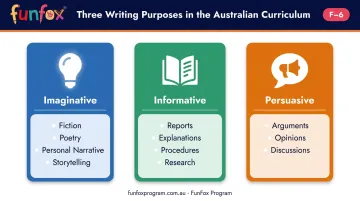
- The Australian Curriculum groups primary writing into three broad purposes: imaginative, informative, and persuasive
- Each genre builds distinct skills: narrative develops sequencing, persuasive develops reasoning, descriptive sharpens word choice
- Exploring a range of genres keeps children engaged and prevents the frustration that comes from staying in one mode too long
- Structured programs that sequence genres deliberately help students apply skills across writing tasks — including NAPLAN
What Are Writing Genres?
The NSW Department of Education defines genre as grouping text types by their similarities in form and function. Genre describes the type of writing and its purpose — who it's for and what it's trying to do.
The Two Broad Branches
Most writing falls into one of two branches:
- Creative/literary writing — fiction, poetry, personal narrative; focuses on imagination, expression, and storytelling
- Practical/functional writing — informational, persuasive, procedural; focuses on informing, convincing, or instructing a reader
The Australian Curriculum v9 uses three recurring categories across F–6 English: imaginative, informative, and persuasive. These aren't separate school subjects — they're overlapping writing purposes that children practise throughout every year of primary school.
Genre vs. Form: A Common Confusion
Understanding those purposes becomes easier once you separate two terms that often get mixed up — genre and form:
- Genre = the content type and purpose (adventure, persuasive, mystery)
- Form = the structure used to deliver it (short story, essay, comic strip, diary entry)
A child can write an adventure story (genre) as a diary entry or comic strip (form). Once students grasp this, they stop treating genres as fixed templates and start making deliberate choices about how to tell their story.
Fiction Writing Genres for Young Writers
Fiction means invented, imaginative storytelling. It's one of the most common starting points for young writers because it offers creative freedom while building foundational skills: narrative structure, character development, cause and effect, and plot sequencing.
Narrative and Realistic Fiction
Realistic fiction is set in the real world with believable characters and events. The core structure — a relatable protagonist, a problem, a resolution — is the same framework NAPLAN uses to assess narrative writing in Years 3 and 5, with markers looking at orientation, complication, and resolution.
This is often the first genre formally taught in primary school, and for good reason: it draws on experiences children already have. A story about a friendship argument at school or a competition gone wrong requires no research and no invented world.
Just honest observation and a willingness to follow the character through to the end.
Fantasy and Science Fiction
Fantasy involves imagined worlds, magical elements, or impossible events. Science fiction grounds those impossibilities in science or technology. Both genres require something realistic fiction doesn't: world-building — the writer has to establish internal rules for how their invented world works.
World-building stretches both creative and logical thinking simultaneously — students must be inventive and internally consistent at the same time. The NSW Premier's Reading Challenge 2026 lists recognised examples like Rowan of Rin under Fantasy for Years 5–6 — a useful reference when looking for Australian-recognised texts to read alongside genre writing.
Mystery and Adventure
Mystery stories revolve around a puzzle, secret, or crime — clues, red herrings, and a final reveal. Adventure focuses on exciting journeys, physical challenges, and action sequences.
Both genres are particularly effective for reluctant writers because they're plot-driven and fast-paced, with a clear next scene always waiting to be written. Structurally, they build:
- Sequencing (what happens first, next, as a result)
- Tension (how to keep a reader guessing)
- Cause and effect (how actions lead to consequences)
Genre-blending is common and encouraged. A fantasy mystery — say, a young wizard who needs to solve a disappearance — shows children that genre conventions are tools to use, not boundaries to stay inside.
Non-Fiction Writing Genres: Sharing Real-World Ideas
Non-fiction covers writing based on facts, real events, or genuine opinions. It's not just "boring reports" — it includes some of the most compelling and practically useful writing children will produce throughout their schooling and adult lives.
The Australian National Literacy Learning Progression identifies two broad non-fiction purposes:
- Informative texts: explanations, information reports, procedures, investigation reports
- Persuasive texts: arguments, responses, discussions
Both appear from Year 1. Non-fiction isn't a secondary school concern.
Persuasive and Opinion Writing
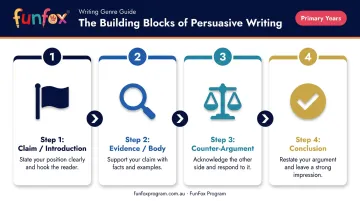
Persuasive writing asks the reader to agree with a point of view or take action. The typical structure: claim → evidence → counter-argument → conclusion.
This genre directly supports critical thinking and communication skills. NAPLAN's persuasive writing marking focuses on introduction, argument body, conclusion, and persuasive devices. Good entry-level prompts for young writers include:
- "Should schools have longer lunch breaks?"
- "Why all children should read for 20 minutes a day"
- "Convince your family to adopt a pet"
Informational and Expository Writing
Informational writing explains, describes, or teaches. The goal is to inform, not convince. Key features include clear structure, factual accuracy, topic sentences, and subject-specific vocabulary.
This genre underpins the reports, essays, and explanations children face from Year 3 onwards. It's also not one form: it covers how-to texts, information reports, explanations of how things work, and research summaries.
Descriptive Writing
Descriptive writing uses sensory language and vivid detail to bring a person, place, or object to life. It appears in both fiction and non-fiction, but many classrooms teach it as its own focus because it builds observation and word choice — two skills that strengthen every other genre they attempt.
A child who can write "the gym bag had been in the locker so long it smelled like last week's lunch and something worse" is a more capable writer in every genre that follows. That precision with detail translates directly into stronger arguments, more vivid reports, and more convincing narratives.
Poetry and Other Creative Writing Forms
Poetry prioritises rhythm, imagery, sound, and emotional resonance over conventional narrative structure. For children, it doesn't require strict rules — free verse, haiku, acrostic poems, and limericks are all legitimate entry points that teachers commonly use in Australian classrooms.
The Australian Curriculum v9 includes poems in Year 2 writing expectations. The National Council of Teachers of English puts it well: poetry lets children celebrate who they are, what they care about, and what they wonder about.
What makes poetry particularly valuable for young writers:
- Forces attention to word choice (every word has to earn its place)
- Teaches condensed expression — more meaning in fewer words
- Encourages emotional honesty without requiring a long plot
- Offers a low-stakes entry point for children who find prose intimidating
Personal narrative (or autobiographical recount, in Australian curriculum terms) sits at the intersection of creative and functional writing. The writer draws on real experiences but uses literary techniques — scene-setting, dialogue, reflection — to shape those experiences into compelling reading.
It's closely aligned with journal and recount writing taught across primary school, making it one of the most effective genres for building a child's distinctive writing voice.
Scripts, comics, and letters round out the creative writing toolkit. These forms blur genre boundaries in productive ways — a child writing a script is simultaneously practising dialogue, narrative structure, and audience awareness. Trying out these hybrid forms often reveals which genres a young writer gravitates toward most.
How to Help Children Explore Different Writing Genres
Read Widely Across Genres
The research is clear on this one. A longitudinal study of students in Grades 3–6 found strong correlations between reading and writing ability, with word-level reading and spelling showing correlations of .73 to .80. Children who read broadly — not just fiction — develop an instinctive feel for how different genres sound and what they demand.
Practical action for parents: include non-fiction, poetry collections, and opinion pieces alongside novels. A child who only reads fantasy will struggle when they first encounter persuasive writing tasks at school.
Use Low-Stakes, Genre-Specific Prompts
Blank pages intimidate most young writers. Short, targeted prompts remove that barrier. Try these:
- Mystery: "Someone left a mysterious note in your lunchbox. It says: 'Meet me at the big tree at 3pm. Come alone.'"
- Descriptive: "Describe your bedroom to someone who has never seen it, using only your senses."
- Persuasive: "Write a letter convincing your family to get a dog."
- Poetry: "Write a haiku about your favourite food."
- Informative: "Explain how to make your favourite sandwich, step by step."
These don't need to be long. A paragraph of mystery writing or a five-line poem is enough to get a child comfortable with a genre's feel.
Avoid Forcing Mastery Before Moving On
Children benefit from dipping in and out of genres, returning to favourites and revisiting challenging ones over time. Variety keeps motivation high and lets different strengths surface — some children thrive in structured expository writing while others come alive in imaginative fiction. Neither preference is wrong; both need developing.
Consider Structured Genre Programs
When both creative and analytical writing need developing, a structured external program can provide the clear sequence that school alone doesn't always offer.
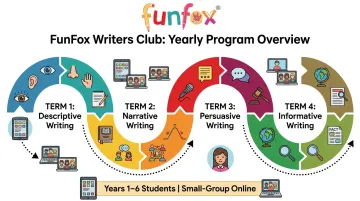
FunFox's Writers Club, for example, guides primary school students (Years 1–6) through a four-genre yearly arc: Descriptive Writing (Term 1), Narrative Writing (Term 2), Persuasive Writing (Term 3), and Informative Writing (Term 4). Each session runs 60 minutes weekly in a small group of no more than six students.
The program delivers personalised teacher feedback via Seesaw after every homework worksheet and aligns to the Australian Curriculum — building both genre-specific skills and a genuine love of writing.
Frequently Asked Questions
What are the different genres of writing?
The main categories are fiction (narrative, fantasy, mystery, adventure), non-fiction (informational, persuasive, descriptive), and creative forms like poetry and personal narrative. Genre describes the type and purpose of writing — the Australian Curriculum groups these broadly into imaginative, informative, and persuasive purposes.
Can you write in multiple genres?
Yes — and young writers should. Each genre builds different skills, and versatility makes for stronger, more confident writers over time. Jumping between genres is part of how children discover what kind of writer they are.
What is the easiest genre to write for beginners?
Narrative and realistic fiction are typically the most accessible starting points, as they draw on experiences children already have. Personal narrative (writing about real events in your own life) is equally approachable for the same reason — no research or world-building required.
How is genre different from form in writing?
Genre refers to the content type and purpose — adventure, persuasive, mystery. Form refers to the structure used to deliver it — short story, essay, poem, script. A writer can mix and match: an adventure story told as a series of diary entries, for instance.
Why should my child learn to write in different genres?
Exposure to multiple genres builds critical thinking, communication, and creativity — and the Australian Curriculum requires competency across both creative and functional writing forms from Year 1. Children who only write in one genre are underprepared for school assessments and everyday communication tasks.