Introduction
Picture a child sitting at the kitchen table, pencil in hand, staring at a blank page. They have ideas — plenty of them — but the moment they try to write, everything gets tangled. Where do they start? What comes next? How do they know when they're done?
This is one of the most common struggles young writers face. The problem usually isn't a shortage of ideas. Most of the time, they simply lack a framework for organising what they already know.
Writing structure is that framework — the scaffold that holds ideas in place and guides the reader from one thought to the next. With a clear structure, the writing process feels manageable rather than overwhelming.
This guide walks through the practical steps any primary school student can follow: how to plan before writing a single word, how to build strong paragraphs, and how to connect ideas so the finished piece reads smoothly from start to finish.
Key Takeaways
- Good structure reduces stalling and helps ideas reach the reader clearly
- Planning before drafting makes the writing process far easier
- Introductions, body paragraphs, and conclusions each serve a distinct purpose
- Strong paragraphs develop one idea with evidence and explanation
- Transitions and linking words are what make writing feel smooth
Why Writing Structure Matters
Think about what it feels like to follow directions without a map versus with one. The destination might be the same, but one journey is frustrating and the other is straightforward. Structure does exactly that for a reader: it shows readers where they're headed before they lose the thread.
For the writer, the benefit is just as real. Planning a clear path before drafting reduces the urge to include everything at once, cuts down on repetition, and makes it easier to identify when an idea doesn't belong.
The research backs this up. Graham and Perin's Writing Next report found that explicitly teaching writing strategies — planning, organising, and revising — produced a weighted effect size of 0.82, one of the strongest results across all writing interventions studied.
The need for structured writing support is visible in Australian data too. 2025 NAPLAN results show a notable gender gap in writing: 71.1% of Year 7 female students reached the Strong or Exceeding level, compared to just 57.0% of Year 7 male students. Structured writing instruction is one evidence-aligned way to close gaps like this.
Structure is a skill — and like any skill, it can be taught, practised, and improved.
Start With a Plan: Outline Your Writing Before You Begin
An outline maps out what to write before the writing begins. Without one, it's easy to start strong, lose the thread halfway through, and end up restructuring everything from scratch.
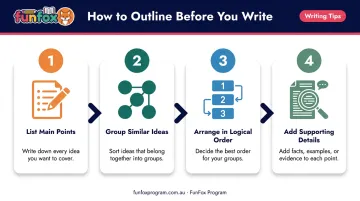
A Simple Four-Step Outlining Method
- List the main points or ideas — just words or phrases, not full sentences yet
- Group similar ideas together — cluster points that belong in the same section
- Arrange them in a logical order — ask which idea needs to come before the next one makes sense
- Decide what evidence or detail supports each point — facts, examples, quotes
Most writers can complete this in under ten minutes — and it saves far more time once the actual writing starts.
Choosing the Right Planning Tool
Different learners plan differently, and that's fine. The three most common approaches:
- Mind maps — good for visual thinkers who want to see connections between ideas
- Bullet lists — quick and flexible, easy to rearrange
- Numbered outlines — useful for writers who prefer a clear sequence from the start
Trying more than one approach is worth it. Many children find that mind maps work well for stories but bullet lists suit reports better.
The General-to-Specific Principle
Whatever tool a writer uses, the same principle applies: broader ideas come first, with details and examples following. This mirrors how readers naturally process information — they need the big picture before the fine print makes sense.
In FunFox's Writers Club, children practise this pre-writing process within weekly 60-minute live sessions — so planning becomes a habit, not an afterthought. By the time students put pen to paper, they already know where they're headed.
The Three-Part Framework: Introduction, Body, and Conclusion
Nearly every type of writing — essays, stories, reports, arguments — is built on a beginning, middle, and end. The classic three-part structure gives young writers a reliable starting point regardless of genre or subject. Each part has a distinct job, and understanding all three is what makes writing feel purposeful rather than aimless.
Crafting an Introduction That Sets the Scene
An introduction has three jobs:
- Hook the reader with an interesting opening
- Introduce the topic or main idea
- Signal the direction of the piece
For young writers, the hook doesn't need to be elaborate. A surprising fact, a question, or a vivid image all work well — as long as it's short and direct. One or two sentences is enough.
Writing a Body That Builds Logically
The body is where the writing does its real work. Each paragraph develops one main point, and those points follow each other in a logical sequence — not jumping back and forth.
A quick test for every body paragraph:
- Does this idea directly support the main topic? If not, it probably doesn't belong — no matter how interesting it seems.
- Does it connect to the paragraph before it? Each point should feel like the next logical step, not a sudden detour.
- Is it doing only one job? Paragraphs that try to cover two ideas at once tend to lose the reader.
Staying disciplined about these checks keeps writing focused and avoids the common trap of trying to include too much.
Writing a Conclusion That Wraps Up Cleanly
Where the introduction opened with a hook and narrowed to a main point, the conclusion works in reverse — briefly summarising the key points and pulling back to leave the reader with a final thought. A strong closing sentence might connect the topic to something broader, pose a reflective question, or simply land the piece with confidence.
One firm rule: a conclusion never introduces brand-new ideas. New information at the end confuses readers and undermines the structure built in the body.
How to Write Strong Paragraphs
Each paragraph should carry one main idea. If a paragraph is trying to do two things at once, the solution is almost always to split it into two.
Introducing the PEEL Method
PEEL is a paragraph scaffold used widely in Australian teaching resources. It gives young writers a reliable structure for developing ideas fully rather than stopping too soon.
| Component | What It Does |
|---|---|
| P — Point | States the main idea of the paragraph |
| E — Evidence | Facts, examples, or quotes that back up the point |
| E — Explanation | Analyses why the evidence matters to the argument |
| L — Link | Connects the paragraph to the next point or back to the main question |
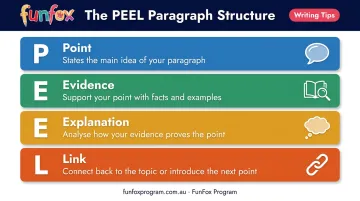
A quick example: if a student is writing about why libraries are important, the Point might be "Libraries give students access to books they couldn't afford to buy." The Evidence might be a fact about library loans. The Explanation connects that fact to the argument. The Link might lead into the next point about quiet study spaces.
PEEL is a scaffold, not a rule — it's a starting framework that younger writers can adapt as their confidence grows. NSW Department of Education resources describe it as a structure for writing clear, focused paragraphs. Victorian teaching materials reference it alongside TEEL for the same reason: it keeps writing on track without locking students into a rigid formula.
Getting Paragraph Length Right
There's no fixed word count a paragraph must reach. What matters is whether the idea is fully developed — whether the evidence is there, the explanation follows, and nothing feels rushed.
Two common mistakes to avoid:
- Stops too early — the point is stated but the evidence or explanation never arrives
- Runs too long — multiple ideas get crammed in and the paragraph loses focus
A good test: if you can spot two separate arguments in one paragraph, it's ready to be split.
Connecting Ideas: Transitions and Cohesion
Cohesion is what separates writing that flows from writing that feels choppy. It guides readers from one idea to the next, making the connections visible rather than leaving them to figure it out alone.
The Australian Curriculum: English v9 explicitly includes cohesion as a content area, with Year 4 students learning how texts use linking devices — including text connectives and pronoun reference — to sequence and connect ideas.
Transition Words by Purpose
Young writers can build a bank of transitions organised by what they need to do:
- Adding information: also, in addition, furthermore, another reason
- Showing contrast: however, on the other hand, although, despite this
- Cause and effect: therefore, as a result, because, consequently
- Giving examples: for instance, such as, for example, one case is
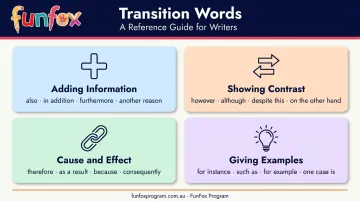
The goal is to guide the reader forward naturally. Transitions work best when they're chosen for meaning, not sprinkled in to make the writing look more polished. A sentence that reads "Therefore, libraries are useful" only works if the cause-and-effect relationship is actually there.
Individual linking words are only part of the picture. Sentence structure, paragraph organisation, and how each paragraph opens to signal what's coming all work together to create writing that holds together as a whole.
Frequently Asked Questions
How do you structure your writing?
Start by planning your main points, then organise them into an introduction, body paragraphs, and conclusion. Each body paragraph should focus on one clear idea, with evidence and explanation to develop it fully.
What are the 7 C's of writing?
The 7 C's are Clear, Concise, Concrete, Correct, Coherent, Complete, and Courteous. They apply equally to a school essay or a single paragraph, making them a practical checklist before submitting any piece of writing.
What is the PEEL method in writing?
PEEL stands for Point, Evidence, Explanation, and Link. It's a paragraph structure commonly used in Australian classrooms to help young writers stay focused and develop their ideas fully.
Why is structure important in writing?
Structure makes writing easier for the reader to follow and easier for the writer to produce. It helps ideas flow logically from one point to the next, reducing repetition and keeping the piece on track.
How do you write a good introduction for primary school students?
A good introduction starts with an engaging hook — a question, a surprising fact, or a vivid image — then introduces the topic clearly and gives the reader a brief sense of what's ahead. Keep it short and direct; two to four sentences is usually enough.