Introduction
Most children start telling stories before they can write a single word. Yet somewhere between "once upon a time" and a blank lined page, something gets lost. Parents watch their kids stare at a writing prompt with nothing to say, or produce flat, rushed stories that list events without any real life in them.
That gap between knowing a story and writing one well is real. The good news is it's also teachable.
According to ACARA's 2024 National Report on Schooling, 76.8% of Year 3 students reached or exceeded the Strong proficiency standard in writing. That means roughly one in four students is still working to get there — and for many, narrative writing is where the struggle is most visible.
If your child is in that group, this article is a practical starting point. It covers what narrative writing is, the five core elements that make it work, and five distinct examples across different styles — each annotated so you can see the techniques in action. Practical exercises for home are included too.
Key Takeaways
- Narrative writing spans fiction and non-fiction — any story with characters, events, and emotional drive counts
- Five elements underpin every strong narrative: character, setting, plot, conflict, and theme
- Sensory detail, consistent voice, and forward momentum are what separate memorable stories from flat ones
- Read widely and write regularly — these two habits build narrative skill faster than anything else
- Structured feedback builds both confidence and craft in young writers
What Is Narrative Writing?
Narrative writing is any writing that tells a story. That story can be real, imagined, or somewhere in between. What matters is that it moves — through time, through a character's choices — and leaves the reader feeling something.
The NSW Department of Education defines narrative texts as involving characters, settings, complications, events, and resolutions. This applies whether the writing is a fictional short story, a personal recount, or a narrative essay.
Why It Matters for Primary Students
Narrative writing isn't just a creative outlet — it quietly develops skills that matter across every subject. It builds:
- Stronger vocabulary, as students search for precise words for feelings, places, and actions
- Sequencing skills, as events must unfold in a logical, purposeful order
- Emotional intelligence, developed through perspective-taking and character experience
- Academic writing foundations — the organisation and cohesion that carry into expository and analytical work later
Narrative vs. Descriptive Writing
These two often get confused, but the difference comes down to movement. Descriptive writing paints a detailed picture of a person, place, or thing. Narrative writing uses description as one tool among many — the story must still move through character choices, complications, and change.
A paragraph describing a stormy beach in beautiful detail is descriptive. That same paragraph, where a character notices the storm and decides to run or stay, becomes narrative.
The Building Blocks of Effective Narrative Writing
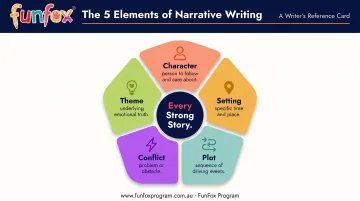
Before looking at examples, it helps to know what strong narrative writing is actually made of. Every effective story — regardless of length — relies on five elements working together.
The Five Core Elements
| Element | What It Does |
|---|---|
| Character | Gives the reader someone to follow and care about |
| Setting | Grounds the story in a specific time and place |
| Plot | The sequence of events that drives the story forward |
| Conflict | The problem, tension, or obstacle the character must face |
| Theme | The underlying idea or emotional truth the story explores |
Narrative Structure: The Five-Part Arc
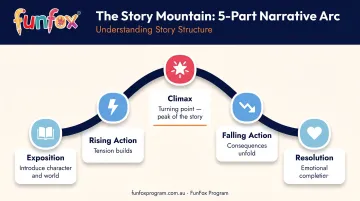
Stories of all lengths follow a recognisable shape. The NSW curriculum frames this as orientation, complication, events, climax, and resolution. In broader literacy teaching, this maps onto:
- Exposition — introduce the character and world
- Rising action — build tension as the problem develops
- Climax — the turning point or peak moment
- Falling action — consequences unfold
- Resolution — the story reaches emotional completion
Children who understand this arc can plan before they write — which consistently improves the quality of the finished piece.
Two Craft Principles That Elevate Stories
Show, don't tell means using action, dialogue, and sensory detail instead of stating emotions directly.
- ❌ She was sad.
- ✅ Her shoulders dropped. She stared at the floor and said nothing.
Vivid language means choosing specific words over vague ones. "Darted" instead of "moved." "Crumbled" instead of "broke." Specific language makes scenes feel real.
Strong openings and satisfying endings carry particular weight. A good opening hooks the reader through action, a striking detail, or an unexpected question. A good ending provides emotional resolution — it doesn't just stop. The examples ahead show exactly what this looks like on the page.
5 Narrative Writing Examples
Example 1: Personal Narrative
The Example:
The morning I started Year Three, my stomach felt like it was full of cold water. I clutched my new pencil case and walked through the school gate, searching for a familiar face. The corridor smelled like fresh paint and something like someone's lunch already. When the bell rang, I found a seat near the window, and the girl next to me smiled and asked if I liked drawing. By the end of the day, I had a new friend and an entire sketchbook page filled with our made-up animals. I walked home thinking that sometimes the thing you dread the most turns out to be the start of something good.
What Makes It Work:
- First-person voice creates immediacy — the reader experiences the moment alongside the narrator, not watching from outside
- Sensory detail ("stomach felt like cold water," "fresh paint") grounds the emotion in physical experience rather than simply naming it
- The reflective closing line lifts the moment beyond the event itself — this is what separates a recount from a personal narrative
When This Type Appears in Schools:
Personal narratives are a regular task in Australian primary classrooms, particularly in Years 3 to 5. They give children a low-pressure entry point into narrative writing because the material comes from real experience — they don't have to invent anything. Starting with real experience builds the descriptive and structural habits that fiction writing later depends on.
Example 2: Fictional Adventure Narrative
The Example:
The letter had no stamp, no return address, and my name spelled wrong — Elia instead of Elijah. I stared at it for a long moment before tearing it open. Inside was a single sentence: Go back to the shed. Don't tell anyone. My heart knocked hard against my ribs. I looked over my shoulder at the empty backyard, then at the shed door, which was now very slightly open — even though I had definitely locked it myself that morning.
What Makes It Work:
- The "sizzling start" technique — used widely in Australian schools and popularised by Seven Steps to Writing Success — drops the reader directly into a moment of tension rather than building slowly toward it
- Short, punchy sentences ("My heart knocked hard against my ribs") speed up the pace at the right moment
- The unanswered question at the end creates forward momentum — the reader needs to know what's in the shed
Fictional narratives are where children develop their own voice most freely. One of the most effective early techniques is experimenting with different types of openings: action, dialogue, a single striking sound, or a question. Trying all four with the same story idea makes the influence of the opening concrete — and memorable.
Example 3: Descriptive Narrative
The Example:
The Saturday market hummed and clattered around her. Stalls overflowed with pyramids of bright fruit, and somewhere behind her a vendor called prices into the crowd like a song. She crept between the narrow gaps, breathing in cinnamon and something frying, her fingers trailing over bolts of fabric that felt like cool water. Then, at the far end of the row, a flash of orange caught her eye — a small fox carved from wood, sitting alone on an otherwise empty table.
What Makes It Work:
- Active, specific verbs — "hummed," "crept," "overflowed" — carry the scene forward rather than slowing it with adjectives
- Multi-sensory layering moves through sound, sight, smell, and touch in natural sequence, building immersion without listing
- Figurative language ("called prices like a song," "felt like cool water") creates atmosphere efficiently
- The ending image — the fox — turns a description into a narrative: something has been found, which means something is about to happen
That distinction is what makes this a descriptive narrative rather than pure description: the setting moves the character somewhere, and with her, the story.
Example 4: Dialogue-Driven Narrative
The Example:
"You said you'd wait for me," Priya said, not looking up from her shoes.
Callum crossed his arms. "I waited for ages."
"Ten minutes isn't ages."
"It felt like it." He kicked at a stone. "Look, I'm here now, aren't I?"
Priya finally looked at him. Something in his voice had changed — not quite sorry, but close. "Fine," she said. "But next time you actually wait."
What Makes It Work:
- Word choice reveals character without description — Callum is defensive, Priya is precise. We know this entirely from what they say and how they say it
- Action beats ("crossed his arms," "kicked at a stone") replace adverb-heavy dialogue tags — they're more specific and more visual
- The shift in Priya's response creates micro-conflict and resolution, giving the exchange a shape
Many young writers either avoid dialogue entirely or write pages of it with no surrounding narrative. The goal is balance: dialogue should feel earned. It reveals something — character, conflict, or a change in the relationship — that prose description alone couldn't show as well.
Example 5: Narrative with a Clear Story Arc
The Example:
Marcus had walked past the list three times without looking at it. He knew his name wouldn't be on it — not after what happened at tryouts. But on the fourth pass, something made him stop. His finger moved down the column slowly. There it was. Third from the bottom. Marcus Chen. His chest went tight and strange. He turned around and spotted Darius watching from across the hall, the same Darius who had tripped him at tryouts, now looking away quickly. Marcus paused. Then he walked over. "Good luck," he said. Darius blinked. "You too." It wasn't friendship. But it was a start.
What Makes It Work — Mapped to the Arc:
| Story Beat | Where It Appears |
|---|---|
| Exposition | Marcus avoids the list; we sense his fear of failure |
| Rising action | He checks the list; finds his name; tension builds |
| Climax | He sees Darius — the conflict becomes human |
| Resolution | He chooses to speak; the gesture is small but meaningful |
This type of example is the most important model for classroom and exam writing tasks. NAPLAN assesses narrative writing on structure, character, ideas, and cohesion — and the marking guide rewards writing that shapes a complete story. A six-sentence arc that has a genuine resolution scores better than a longer story that simply runs out of time.
What These Examples Reveal About the Craft
These five examples don't just illustrate good writing — they reveal the habits behind it. Three patterns show up every time.
Specificity Over Vagueness
Every example uses concrete detail rather than general description. "Cold water in the stomach" instead of "nervous." "Third from the bottom" instead of "his name." Specific detail is what makes a reader believe what they're reading.
One Moment, Not the Whole Story
None of the examples try to cover a full day, a whole friendship, or an entire adventure. Each one picks one small, precise moment and goes deep. This is one of the most useful habits parents can encourage. Rather than asking a child to write about their whole holiday, ask them to write about one moment from it: the best one, the strangest one, the one they keep thinking about.
Forward Momentum
Every sentence in a strong narrative does at least one of three things: moves the plot forward, reveals character, or deepens the reader's sense of place. Sentences that do none of these can usually be cut.
Reading plays a direct role in building this instinct. Research from the Carnegie Corporation identifies writing about texts children have read as one of the strongest evidence-based practices for improving both writing quality and reading comprehension. Asking "what did this writer do here?" — even with a picture book — builds the kind of craft awareness that transfers directly into a child's own writing.
How to Help Your Child Apply These Techniques
Three exercises that work well at home:
The one-sentence rewrite — take a bland sentence ("The dog ran away") and practise making it vivid. Try five different versions. The goal isn't the best version; it's the habit of reaching for more.
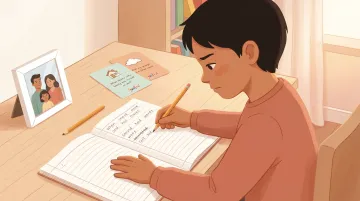
Story from a photo — pick a family photo and write a short narrative about that exact moment. Not the whole day — the moment. What do you see? What do you smell? What happens next?
Steal the start — copy the opening sentence structure from one of the examples above and write a completely new story from it. This is a legitimate writing technique, not cheating. Published authors do it all the time.
When reviewing a child's writing, point to one specific thing that worked before suggesting an improvement. Not "good job" — something precise: "I really felt what it was like to walk through that market." That kind of specific feedback builds craft awareness without undermining confidence.
For children who want that kind of support more regularly, FunFox's Writers Club runs weekly live online sessions for Years 2 to 6. Classes are kept to no more than six students, teachers are trained in giving specific written feedback via Seesaw, and the program is aligned to Australian curriculum expectations.
Frequently Asked Questions
What is an example of narrative writing?
A child's first-person account of their first day at school — describing what they saw, felt, and discovered — is narrative writing. Narrative can be fictional or real, short or long; what makes it narrative is the presence of characters, events, and an emotional thread that moves the reader through time.
What are the 5 types of narrative writing?
The five common types taught in schools are: personal narrative, fictional narrative, descriptive narrative, narrative essay, and adventure or quest narrative. Each serves a different purpose, but all share the same core elements — character, setting, plot, conflict, and theme.
What makes a good narrative writing piece?
A strong narrative needs a hook that pulls the reader in from the first line, specific vivid details that make the story feel real rather than generic, and a resolution that gives the reader a sense of emotional completion rather than simply stopping.
How do you start a narrative writing piece?
Four strong options: drop into the middle of action, open with a line of dialogue, begin with a striking sensory detail, or pose an unexpected question. Avoid starting too far back in time or summarising what is about to happen.
What is the difference between narrative and descriptive writing?
Descriptive writing creates a detailed picture of a person, place, or thing. Narrative writing uses description as one tool within a story that moves through time, involving character choices, complications, and change. Description can stand alone; in narrative, it serves the story.
How can children improve their narrative writing skills?
Read widely and notice what writers do. Write regularly with short, specific prompts rather than open-ended tasks. Seek feedback from a teacher who can identify both what's working and what to develop next.