Fourth grade is when persuasive writing gets serious. Under Common Core W.4.1, students must state an opinion and back it with actual reasons and evidence, not just "because I said so." The Australian Curriculum expects something similar, asking Year 4 students to plan and publish persuasive texts with clearly linked ideas.
This guide gives you ready-to-use 4th grade persuasive writing samples, a simple structure kids can follow every time, and prompts sorted by category so reluctant writers can actually find a topic they care about.
Key Takeaways
- Persuasive writing needs just three parts: opinion, evidence-backed reasons, and a conclusion (counterpoints are optional)
- Annotated samples teach structure faster than instructions alone
- Categorised prompts help kids find topics they're actually excited to write about
- Regular practice and structured feedback speed up improvement more than occasional homework help
What Is Persuasive Writing and Why It Matters in 4th Grade
Persuasive writing means convincing someone to agree with your opinion using reasons, facts, and examples. It's different from narrative writing (telling a story) and informative writing (explaining facts without pushing a viewpoint).
Here's the shift that happens in 4th grade (Year 4 in Australia): younger kids might write "I like dogs because they're fun." Fourth graders must go further, with specific reasons tied to evidence.
In the US, Common Core's W.4.1 standard breaks this down into four parts:
- Introduce a topic and state an opinion clearly
- Provide reasons supported by facts and details
- Link ideas using transition words like "for instance" or "in addition"
- End with a conclusion related to the opinion
Closer to home, the Australian Curriculum's AC9E4LY06 asks Year 4 students to plan, edit, and publish persuasive texts using linked ideas, complex sentences, and paragraph structure. Different wording, same goal: move kids from stating an opinion to defending one.
This isn't just a school exercise. Advertising, classroom debates, persuasive letters to a principal, even convincing a sibling to trade toys—it's all persuasive writing in disguise. Mastering the structure now makes high school essays far less intimidating later.
The Simple 4-Part Structure Every 4th Grader Should Know
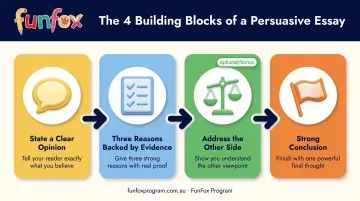
Most 4th grade persuasive pieces work well with four building blocks:
- A clear opinion statement
- Three reasons, each backed by evidence
- An optional acknowledgment of the other side
- A strong conclusion
That third part is worth flagging early: it's not required by the Australian Curriculum, but Australia's NAPLAN persuasive writing marking guide notes that addressing the other side is one way stronger writers elaborate their ideas. Think of it as a bonus skill, not a mandatory box to check.
Step 1: State a Clear Opinion
A weak opinion sounds like "Dogs are okay, I guess." A strong one takes a stand: "Dogs make better pets than cats because they're loyal, trainable, and great for exercise."
The difference? Specificity. A vague opinion gives the reader nothing to argue with—or agree with.
Step 2: Give Three Reasons Backed by Evidence
Each reason needs a fact, example, or detail attached. "Dogs are loyal" isn't convincing on its own. "Dogs are loyal, following their owners from room to room and even sensing when someone is sad" gives the reader something concrete.
Useful transition words for this stage:
- First, another reason, most importantly
- In addition, for instance, because of this
- Furthermore, as an example
Step 3: Briefly Address the Other Side
One sentence is enough: "Some people say cats are easier to care for, but dogs offer companionship that's worth the extra effort." This single line often separates advanced 4th grade writers from the pack, and it shows up in higher-scoring writing rubrics.
Step 4: Write a Strong Conclusion
The conclusion restates the opinion in new words and ends with a call to action or final thought: "For loyalty, fun, and friendship, a dog is the clear choice for any family."
4th Grade Persuasive Writing Samples (With Breakdown)
Seeing the structure labelled inside a full piece helps kids understand how each part connects, before they try writing one themselves.
Sample 1: The Classic Opinion Essay (Cat vs. Dog)
Opinion: Dogs make better pets than cats because they are loyal, trainable, and great companions for exercise.
Reason 1: First, dogs are extremely loyal. They greet their owners at the door and stay close by, showing they truly care.
Reason 2: Another reason is that dogs are easy to train. With treats and patience, dogs can learn to sit, stay, and even fetch the newspaper.
Reason 3: Most importantly, dogs love to be active. Going for walks or playing fetch keeps both the dog and its owner healthy.
Conclusion: For loyalty, trainability, and fitness, dogs are the better choice for any family looking for a furry friend.
Sample 2: A Short Persuasive Paragraph
Homework should be limited to 20 minutes a night. First, students already spend six hours at school learning. Second, shorter homework gives kids time for sports, hobbies, and family. Finally, less homework means less stress and better sleep. Schools should cut homework time so students can enjoy their evenings and still succeed.
Sample 3: A Persuasive Letter Format
Dear Principal Davis,
I am writing to ask you to add ten more minutes to recess. First, students focus better in class after moving around outside. Second, longer recess gives kids more time to play games and make friends. Most importantly, exercise keeps students healthy and happy.
Please consider extending recess. It would make a big difference for every student at our school.
Sincerely, A Concerned Student
Letters swap the typical essay opening for a greeting, and end with a sign-off instead of a plain conclusion sentence—otherwise, the same four-part structure applies underneath.
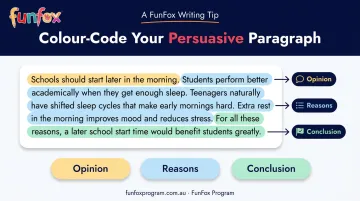
Tip: Have your child colour-code these same parts in their own draft (opinion in yellow, reasons in blue, conclusion in green). Seeing the structure visually makes it click faster than reading about it.
4th Grade Persuasive Writing Prompts by Category
Grouping prompts by theme makes it easier to match a topic to what your child already cares about. Kids invest more effort, and produce better writing, when a topic genuinely interests them.
School Life Prompts
- Should schools assign less homework?
- Should students wear school uniforms?
- Should recess be longer?
- Should classrooms use more technology?
- Would students benefit from choosing their own seats?
Home and Family Prompts
- Should kids get to choose a family pet?
- Should screen time be limited on school nights?
- Should bedtime be later on weekends?
- Do kids deserve payment for doing chores?
- Should siblings share a bedroom or have their own?
Environment and Community Prompts
- Should plastic bags be banned in stores?
- Should every neighbourhood have a recycling programme?
- Should zoos keep wild animals in cages?
- Should littering carry a bigger fine?
- Would planting more trees benefit local communities?
Fun and Opinion-Based Prompts
- What's the best pet: a cat or a dog?
- What's the best season of the year?
- What's the best school lunch option?
- Which is better: books or movies?
These lighter prompts work well as warm-ups for reluctant writers who freeze up on bigger issues.
Tips to Help Your 4th Grader Strengthen Persuasive Writing at Home
Small, consistent habits build this skill faster than occasional worksheet sessions.
- Read short opinion pieces or ads together. Discuss what makes them convincing. Even a cereal box claim ("Now with more fibre!") sparks a two-minute conversation about evidence.
- Use a simple checklist every time they write: opinion stated, three reasons with evidence, conclusion. Sticking this on the fridge or desk removes the guesswork.
- Talk through both sides of everyday debates, like whether dessert should come before dinner. It's low-stakes practice for acknowledging a counterpoint.
Some kids also benefit from structured, small-group coaching rather than relying purely on parent-led homework help. FunFox Program's Writers Club, aligned to the Australian Curriculum, pairs students with trained teachers in groups of six or fewer for consistent practice and personalised feedback on their writing drafts each week.

That kind of regular, expert input is difficult to replicate at the kitchen table alone.
Frequently Asked Questions
What is the best structure for a 4th grade persuasive essay?
The ideal structure is an opinion statement, three supporting reasons with evidence, and a conclusion. A brief counterpoint is a nice bonus for stronger writers, but it's not required.
What are some good persuasive writing topics for 4th graders?
Relatable categories work best: school rules, pets, screen time, and environmental issues. Check the categorised prompt list above for specific ideas.
How long should a 4th grade persuasive essay be?
Most run 3-5 paragraphs, roughly 150-300 words, though this varies by assignment and student ability. There's no official fixed word count in the Australian Curriculum, so length expectations vary by school and teacher.
What's the difference between persuasive writing and opinion writing?
Opinion writing simply states a viewpoint. Persuasive writing takes that opinion further, building it up with evidence and techniques specifically designed to convince the reader.
How can I help my child improve their persuasive writing skills at home?
Reading samples together, discussing both sides of everyday debates, and using a consistent structure checklist are the most effective at-home strategies.
What transition words should 4th graders use in persuasive writing?
Useful ones include "firstly," "another reason," "most importantly," "in addition," and "in conclusion." These link ideas smoothly and align with the persuasive text requirements in the Australian Curriculum's English strand.