Introduction
Picture this: your child reads every word on the page without stumbling. They finish the chapter, close the book. You ask what happened — and they stare blankly.
This isn't a decoding problem. Your child can read the words perfectly well. What's missing is language comprehension — the ability to make meaning from those words.
According to the Simple View of Reading, reading comprehension is the product of two equal pillars: word recognition (decoding) and language comprehension. A child who is strong in one but weak in the other will hit a ceiling, often without anyone realising why.
This guide covers the five key skills that make up language comprehension, why they matter for your child's reading success, and what you can do to support them at home and through targeted practice.
Key Takeaways
- Language comprehension is the ability to understand spoken and written language — not just sound out words.
- Five interconnected skills make it up: background knowledge, vocabulary, language structures, text structure, and critical thinking strategies.
- These skills don't develop automatically — they require deliberate practice, not passive exposure.
- A child can be a fluent decoder and still struggle to understand what they read.
- Parents can build all five skills through everyday conversations, reading routines, and focused practice.
What Is Language Comprehension?
Language comprehension is the ability to understand the meaning of spoken and written language — to grasp not just what individual words say, but what they mean together.
The Simple View of Reading (Gough & Tunmer, 1986) frames this as: Reading = Decoding × Language Comprehension. Both sides of the equation matter equally. When one side is weak, reading breaks down entirely:
- A child who decodes fluently but lacks language comprehension can read the words aloud — but can't tell you what they mean.
- A child with rich language comprehension but weak decoding can't access the words in the first place.
What many parents don't realise is that language comprehension begins developing long before school: through conversation, storytelling, listening to books, and imaginative play. But early exposure alone isn't enough. The skills needed for academic reading require deliberate instruction as texts become more complex through primary school and beyond.
Why Language Comprehension Matters for Reading
In the early primary years, decoding is the main driver of reading success. But that changes as children move through school.
Research tracking students from Grade 1 to Grade 10 found that decoding's contribution to reading comprehension declined significantly over time — from a beta of 0.38 in Grade 3 to just 0.06 in Grade 10 — while linguistic comprehension rose from 0.59 to 0.89. In other words, the older a child gets, the more their reading success depends on language comprehension.
The "Word Caller" Problem
When language comprehension lags, a recognisable profile emerges. Researchers call these children "poor comprehenders": they read words accurately but cannot:
- Retell what they just read
- Answer questions that go beyond literal detail
- Make inferences or draw conclusions
- Summarise or explain the main idea
Catts, Adlof, and Weismer's research confirmed that poor comprehenders have language-comprehension deficits despite normal phonological processing. These children are often overlooked — their fluent oral reading hides the gap entirely.
The good news: language comprehension is not fixed. It is teachable at every stage — and knowing which of the five components needs attention is the first step toward doing something about it.
The 5 Key Skills of Language Comprehension
Language comprehension is not a single ability — it's a set of five interconnected skills. Each one contributes to a child's capacity to understand language and text, and none works in isolation.
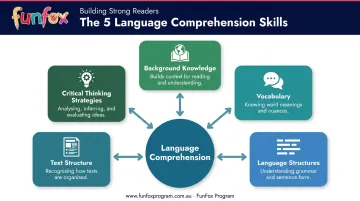
Skill 1: Background Knowledge
Background knowledge is everything a child already knows about the world — facts, experiences, subject knowledge, and cultural context — that they bring to a text.
The classic demonstration of this is Recht and Leslie's 1988 "baseball study", which found that children with high prior knowledge of baseball recalled and summarised a passage about it far better than children with low prior knowledge — regardless of their general reading ability. Topic knowledge can override reading level.
What this means in practice:
- Reading around topics and themes (rather than randomly) builds richer knowledge over time
- Read-alouds expose children to ideas well beyond their independent reading level
- Connecting new texts to what a child already knows activates comprehension before they even begin
Skill 2: Vocabulary
Vocabulary is one of the strongest predictors of reading comprehension. Knowing more words — and knowing them deeply — means understanding more of what you read.
The gap between children can be significant. Biemiller and Slonim's research estimated that by Grade 2, children in the lowest vocabulary quartile already had 4,100 fewer root words than those in the highest quartile. That gap doesn't close on its own.
Effective vocabulary development isn't about long word lists. It involves:
- Teaching fewer words deeply rather than many words superficially
- Returning to the same word across the week in conversation, reading, and writing
- Building word awareness through prefixes, roots, and suffixes so children can decode unfamiliar words independently
It's worth distinguishing between breadth (how many words a child knows) and depth (how well they understand each word's meaning and uses). Both matter — but depth is often undervalued.
Deep knowledge means a child can use a word flexibly across different contexts, not just recognise it on a page.
Skill 3: Language Structures
Language structures refer to the grammar and syntax that govern how sentences are built and how ideas connect — both within and across sentences.
A meta-analysis of 59 studies found that syntactic skills are strongly related to reading comprehension, with correlations around r = .54 across both English and Chinese readers.
As texts grow more complex in upper primary, the demands on this skill increase sharply. Children need to:
- Track who is doing what in multi-clause sentences
- Understand how connective words like although, as a result, and meanwhile signal relationships between ideas
- Follow pronoun references across paragraphs without losing the thread
A child with weak language structures will struggle even when the vocabulary is familiar. They can decode every word in a sentence and still miss what it means.
Skill 4: Text Structure
Text structure is the way authors organise information. Narrative texts follow patterns involving characters, setting, problem, and resolution. Informational texts use structures like compare/contrast, cause/effect, problem/solution, and sequence.
When children recognise the pattern of a text, they can follow it more efficiently and recall it more accurately. And teaching text structure explicitly works. A meta-analysis by Bogaerds-Hazenberg and colleagues found that text-structure instruction produced positive effects on summarisation (g = 0.57) and recall (g = 0.37).
In practice, this means teaching children to:
- Identify story grammar elements in fiction (goal, obstacle, resolution)
- Notice signal words in nonfiction — "however," "because," "first," "as a result"
- Use their knowledge of text patterns to predict, organise, and retain information
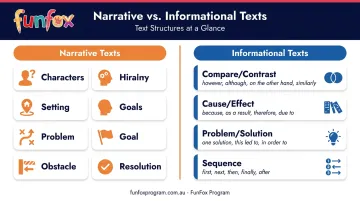
A bonus: children who understand text structure also write better. Knowing how a text is built helps them build their own.
Skill 5: Critical Thinking Strategies
Most children can retell what happened in a text. Fewer can explain why a character made a choice, or question whether an author's argument holds up. That's the gap critical thinking strategies address. These include:
- Inferencing — combining text clues with background knowledge to reach conclusions the author implies but doesn't state
- Comprehension monitoring — noticing when understanding breaks down and doing something about it
- Evaluating — questioning the author's purpose, viewpoint, or argument
- Applying — taking ideas from a text and connecting them to new situations
Cain and Oakhill's research confirmed that inference ability is not just a by-product of good comprehension — it actively contributes to it. Poor comprehenders specifically struggle to make inferences, even when vocabulary and decoding are adequate.
These strategies are teachable — and the research is clear that explicit instruction makes a real difference. Children shown how to infer, monitor their understanding, and ask evaluative questions become more capable, resilient readers than those left to work it out alone.
How to Build Language Comprehension Skills at Home
Parents don't need a formal curriculum to make a real difference. The most powerful tools are already part of daily life — they just need to be used intentionally.
Everyday Conversations
Have wide-ranging conversations that go beyond daily logistics. Talk about how things work, why events happened, what animals do, how places differ. This builds background knowledge and vocabulary simultaneously. Ask questions that require explanation — "Why do you think that happened?" lands very differently from "Did you like it?"
Use precise language naturally. When you name a specific word — reluctant instead of didn't want to, evaporate instead of disappear — you expand your child's vocabulary without it feeling like a lesson.
Daily Read-Alouds
Read aloud to your child even after they can read independently. Read-alouds expose children to complex texts, rich vocabulary, and varied sentence structures that sit above their decoding level.
Research by Demir-Lira and colleagues found that the quantity of early parent-child book reading predicted later receptive vocabulary, reading comprehension, and reading motivation. Don't just read — stop to discuss, predict, and connect ideas. The conversation around the book is as valuable as the reading itself.
Vocabulary Habits That Stick
Read-alouds naturally surface new words — but deliberate habits help those words stick long-term.
- Notice interesting words when you encounter them in books or conversation
- Revisit the same word across several days in different contexts
- Encourage your child to use new words when they speak and write
- Play with word parts — what does un- do to a word? What about -tion?
Structured Learning Support
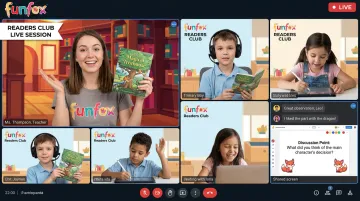
For children who need more targeted support, structured small-group programs designed specifically around language comprehension can build these skills faster than home practice alone. FunFox's Readers Club — developed in line with the Australian Curriculum and delivered in groups of no more than six students — explicitly targets inferencing, text analysis, and critical thinking strategies across Years 3 to 8.
With three to six students per live session, teachers can tailor instruction in real time, give process-based feedback to each child, and draw every student into the kind of deeper text discussion that builds comprehension — the type of interaction that isn't possible in a whole-class setting.
Signs Your Child May Need Extra Support
Language comprehension difficulties are often invisible — especially when a child reads fluently aloud. Watch for these patterns:
- Reads words accurately but cannot retell what they just read
- Answers questions with literal detail only, struggles to infer or reason
- Vocabulary feels noticeably limited compared to peers
- Becomes confused or disengaged as texts grow more complex in upper primary
- Cannot summarise a passage or explain what a character's motivation was
These patterns don't reflect a child's intelligence or effort. They often indicate that specific language comprehension skills haven't been explicitly taught or practised enough.
Without targeted support, this gap tends to widen rather than close on its own. Cain and Oakhill found that 22 of 23 children identified as poor comprehenders at age 8 remained poor comprehenders at age 11. That's a strong case for acting early — not waiting to see if things improve.
If you spot these patterns, the next step is to seek support that specifically targets language comprehension — not just fluency or phonics practice. A program like FunFox's Readers Club, for example, focuses on exactly these skills: inference, vocabulary, and comprehension strategy, in a structured small-group setting aligned to the Australian curriculum.
Conclusion
Language comprehension is made up of five teachable, interconnected skills: background knowledge, vocabulary, language structures, text structure, and critical thinking strategies. Understanding these gives parents a clear lens — not just for spotting where a child struggles, but for knowing what to do next.
Building these skills doesn't require formal expertise or expensive resources. Consistent conversation, purposeful reading routines, and deliberate attention to words and ideas can make a genuine difference through the primary years and into high school. Where more targeted support helps, FunFox's small-group reading programs are built directly around these skills and aligned to the Australian Curriculum, giving students the structured practice to turn comprehension weaknesses into strengths.
Frequently Asked Questions
What are the five subcomponent skills involved in language comprehension?
The five skills are background knowledge, vocabulary, language structures, text structure, and critical thinking strategies. Each contributes to a child's ability to understand language and text, and they reinforce one another throughout development.
What is the difference between language comprehension and reading comprehension?
Reading comprehension is the combined result of word recognition (decoding) and language comprehension, as described by the Simple View of Reading. Language comprehension is the understanding of meaning; word recognition is the ability to identify the words. A child needs both to read and understand a text independently.
At what age should children start developing language comprehension skills?
Language comprehension begins developing from infancy through listening, conversation, and storytelling — well before formal schooling starts. Targeted teaching across all five skill areas becomes increasingly important throughout primary school as texts grow more complex.
How can parents tell if their child struggles with language comprehension?
Key signs include reading words accurately but being unable to retell or answer questions about them, difficulty making inferences, limited vocabulary compared to peers, and confusion when texts become more demanding in upper primary.
Can language comprehension be taught, or does it develop naturally?
Some language develops naturally through everyday exposure, but the five skills of language comprehension benefit significantly from explicit instruction. Vocabulary, text structure, and inferencing all improve measurably with direct, deliberate teaching — waiting for natural development alone isn't a reliable strategy.
How is vocabulary connected to the other language comprehension skills?
Vocabulary underpins all other language comprehension skills — a child cannot understand language structures, engage with background knowledge, or make inferences without the words to do so. It is consistently one of the strongest predictors of overall reading comprehension across all year levels.