It's a familiar scene for many Australian parents — and the good news is that narrative writing isn't some mysterious gift certain children are born with. It's a craft built on learnable elements that, once understood, give children a genuine framework to work from.
Narrative writing simply means any text that tells a story — real or imagined — with the goal of taking a reader on a journey. From picture books to NAPLAN prompts, the same foundational elements apply.
This post walks through three layers of strong narrative writing: the structural backbone that organises events, the core elements that give a story its substance, and the language features that make it memorable. Understanding these helps you support your child's writing development with confidence.
Key Takeaways
- Strong narratives follow a clear structure: orientation, complication, rising action, climax, and resolution.
- Every narrative is built from five core elements: character, setting, plot, conflict, and theme.
- Language features like descriptive language, dialogue, and sentence variety separate an adequate story from a compelling one.
- Narrative skills develop progressively across primary school, with the most critical window spanning Foundation to Year 6.
- Parents who recognise these elements can give targeted, meaningful feedback on their child's writing at home.
The Core Structure of a Strong Narrative
Structure is what separates a collection of events from an actual story. Without it, a narrative feels like a list — things happen, then more things happen, and the reader never quite cares about any of it.
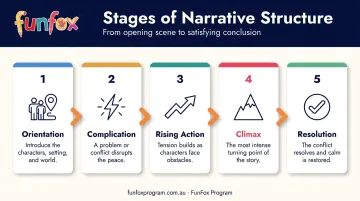
Australian schools, including the Australian Curriculum, use consistent terminology for narrative structure: orientation, complication, and resolution form the backbone, with rising action and climax filling out the middle. Here's what each stage does.
At a glance, the five structural stages work like this:
- Orientation — introduces characters, setting, and the world of the story
- Complication — presents the problem or conflict that drives the plot
- Rising action — builds tension through attempts, setbacks, and escalating stakes
- Climax — the moment of highest tension before things turn
- Resolution — shows how the problem is resolved and what has changed
Orientation
The orientation is the story's opening move. It establishes who the characters are, where and when the story takes place, and — above all — draws the reader in. A weak orientation loses the reader before the story even begins. A strong one creates an immediate reason to keep reading.
Complication
The complication is the central conflict or disruption that sets everything in motion. Without it, there is no story. A genuine complication creates tension, and tension is what compels a reader to turn the page.
Rising Action and Climax
Rising action is the series of events where the character grapples with the complication — attempts, setbacks, and stakes that keep rising. The climax is the turning point: the moment of highest tension before things begin to resolve.
The most common mistake primary students make? Jumping straight from problem to solution, skipping the tension-building entirely. A story that resolves too quickly feels hollow — the reader never had a chance to worry.
Resolution
The resolution shows how the problem is ultimately addressed and what the character has learned or how they've changed. A satisfying resolution earns its ending: it connects back to the complication and gives the story meaning beyond "things worked out."
The Five Essential Elements Every Narrative Needs
Structure tells us how a story is arranged. These five elements tell us what it's made of. The NSW Department of Education identifies character, setting, and plot as inseparable from narrative itself — and conflict and theme complete the picture.
Character
Characters are the engine of any story. They drive the plot through their decisions, reactions, and internal experiences — and readers connect with stories through them, not through events.
Strong characters have:
- Clear motivations (what do they want?)
- Genuine emotional responses (how do they feel about what's happening?)
- Real personality that shows through action and dialogue
Flat characters exist on the page but leave no impression. Characters who face genuine struggle — not just easy success — tend to be the ones readers remember.
Setting
Setting is more than location. It includes time period, atmosphere, and the full sensory world the reader inhabits. A well-crafted setting grounds the reader and actively shapes mood: a deserted warehouse at midnight feels nothing like a sunny beach at noon, even if the same events unfold in both.
Young writers often think of setting as just "where." Strong narrative writing asks them to also consider:
- When — the time period or moment in the story
- Atmosphere — what it feels and sounds like to be there
Plot
Plot is the sequence of events that make up the story. The key distinction is whether those events are causally connected or merely sequential.
A weak plot sounds like: "X happened, then Y happened, then Z happened."
A strong plot sounds like: "X happened, so Y happened, which caused Z."
Causal connection means character choices have consequences — and that's what makes plot feel purposeful rather than accidental.
Conflict
Conflict creates the emotional stakes that make readers care about the outcome. It can be:
- External — character vs. another character, vs. nature, vs. society
- Internal — character vs. their own fears, doubts, or moral choices
Consider The Sound of Music: remove the threat of the Nazis, and the story loses all its urgency. The conflict doesn't just create tension — it gives the resolution its meaning.
Theme
Theme is the deeper message the story communicates — often a universal truth about courage, belonging, loss, or love. Theme is distinct from plot: plot is what happens; theme is what it means.
Theme rarely needs to be stated explicitly. It emerges through what characters learn, how they change, and how the story resolves. When a child's story about a lost dog is really about trusting others, that's theme at work.
Language Features That Make Narratives Come Alive
Two stories can share identical structure and elements and still feel completely different. Language features are what create voice, atmosphere, and emotional impact — they're how a writer shows rather than simply tells.
Descriptive and Sensory Language
Rather than stating an emotion outright, strong narrative writers show it through physical detail. Compare:
- She was scared.
- Her hands trembled as she reached for the door handle.
The second version puts the reader inside the moment. The NAPLAN narrative marking guide explicitly assesses this — vocabulary, setting development, and vivid imagery are all scored criteria. Sensory language across all five senses (sight, sound, smell, touch, taste) makes scenes feel immediate and real.
It's also one of the skills that improves most noticeably when children read widely — exposure to strong writing builds an instinct for it.
Figurative Language
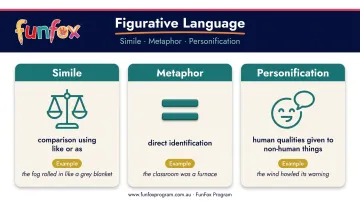
Figurative language gives readers vivid comparisons that help them visualise or feel what the writer describes. The key forms children learn in primary school:
- Similes — a direct comparison using "like" or "as" (the fog rolled in like a grey blanket)
- Metaphors — a direct identification (the classroom was a furnace)
- Personification — giving human qualities to non-human things (the wind howled its warning)
A note on use: one well-placed metaphor does more than five clumsy ones. The goal is purposeful, well-chosen figurative language — not a checklist ticked off every few sentences.
Dialogue
Dialogue serves two purposes in a strong narrative: it reveals character personality and voice, and it advances the plot.
Effective dialogue sounds natural and does narrative work — it creates conflict, shows relationships, or reveals information that matters to the story. Consider the difference: "Hi." "Hi." "How are you?" "Good." is filler — it takes up space without moving anything forward. "You promised you wouldn't tell." "I had to. You know I had to." carries conflict, stakes, and character voice in two lines.
Formatting still matters — quotation marks, new speaker on a new line — but the bigger question is always whether the dialogue is doing real work in the story.
Vocabulary and Sentence Variety
Strong verb choices do powerful work. "Sprinted" says more than "ran quickly." "Whispered" tells us more than "said quietly." Precise word selection creates pace and detail without extra words.
Sentence variety controls rhythm. Short sentences create tension. Longer sentences with multiple clauses and building detail create a sense of expansion — and mixing both holds a reader's attention in a way that uniform length never does.
This is where reading directly feeds writing. Children absorb rhythm and vocabulary through the texts they encounter, often without realising it.
How Children Develop Narrative Writing Skills Through Primary School
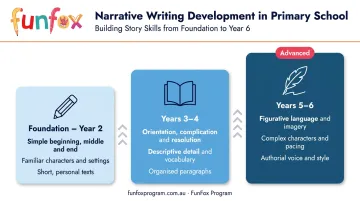
Narrative writing develops gradually across the primary years, and what's expected at Year 2 looks very different from Year 6.
Research confirms that children around 6–7 years old begin producing what researchers call "true narratives" — stories that follow a logical progression of events with character reactions and consequences. By ages 8–10, most children can manage structural components and begin to adapt their storytelling for an audience.
Here's a rough developmental picture:
| Year Level | What's Typically Expected |
|---|---|
| Foundation–Year 2 | Simple beginning-middle-end structures; familiar characters; short imaginative texts |
| Years 3–4 | Orientation, complication, resolution with descriptive detail; organised paragraphs |
| Years 5–6 | Figurative language, controlled pacing, complex characters, clear authorial voice |
This is a scaffolded process — each year level builds on the last. Children who fall behind in the early stages often struggle to layer in complexity later, which is why consistent practice and explicit teaching during the primary years matter.
Growth at any year level depends on three things:
- Regular writing practice (not just occasional assignments)
- Meaningful, specific feedback that names what's working and what isn't
- Exposure to quality mentor texts that show how skilled authors handle structure and voice
Programs like FunFox's Writers Club support this by running narrative writing sessions in online groups of no more than six students — small enough that each child gets the individual feedback needed to internalise these elements over time.
Why Narrative Writing Matters Beyond the Classroom
The NAPLAN Connection
For Australian families, the NAPLAN writing test is a concrete reason to take narrative skills seriously. Students in Years 3, 5, 7, and 9 sit the NAPLAN writing task — and as the NAPLAN writing FAQ confirms, children may be asked to write either a narrative or a persuasive text, with the genre not disclosed in advance.
The official NAPLAN narrative marking criteria include:
- Audience, text structure, and ideas
- Character and setting development
- Vocabulary, cohesion, and paragraphing
- Sentence structure, punctuation, and spelling
A child who understands narrative elements doesn't just write a better story — they write to the criteria.
Skills That Transfer
Beyond assessment, strong narrative writing develops skills that travel across subjects and into adult life:
- Constructs cause-and-effect reasoning through plot (critical thinking)
- Builds empathy by inhabiting a character's perspective and emotional experience
- Sharpens communication by organising and expressing ideas coherently
- Expands vocabulary, which strengthens reading comprehension across all subjects
Research exploring how educators use narrative fiction with children finds that reading and writing narratives supports not just literacy skills but also sociomoral development. Children learn about the world, relationships, and consequences through story.
These benefits don't happen by accident — they come from understanding the specific elements that make a narrative work, which is exactly what the rest of this guide covers.
How Parents Can Support Narrative Writing at Home
You don't need to be an English teacher to help your child develop as a writer. These approaches make a real difference.
Use Books and Films as Mentor Texts
Read aloud together and discuss story elements in conversation: Who's the main character? What was their problem? How did it get solved? Did the ending feel satisfying? This is one of the most effective ways for children to internalise narrative structure without formal instruction, and research confirms that reading aloud benefits literacy well beyond the point where children can read independently.
Ask Questions, Don't Edit
When your child writes at home, resist the urge to correct the work first. Instead, ask questions that develop the story:
- "What does your character want most?"
- "What's stopping them from getting it?"
- "How do they feel about that?"
Questions open up the story. Corrections, at least at the drafting stage, tend to close it down.
Try Low-Pressure Practice
Children who resist writing often engage more readily with shorter, focused tasks:
- Tell a story together at dinner — no paper, no pressure
- Take turns adding sentences to a shared story
- Use a photo or image as a starting point
- Write just one moment from a story, not a whole narrative

Even five minutes of this kind of practice, done regularly, builds the storytelling instincts that carry into formal writing tasks at school.
Frequently Asked Questions
What are the elements of strong narrative writing?
Strong narrative writing contains five core elements — character, setting, plot, conflict, and theme — working alongside a clear structure (orientation through resolution) and deliberate language choices. Together, these three layers create a complete, engaging story rather than a sequence of events.
What is the difference between narrative writing and a recount?
A narrative is an imaginative story built around a complication that creates tension and drives toward a resolution. A recount simply retells real events in chronological order. The key difference is stakes: recounts describe what happened; narratives make the reader care about what happens next.
At what age should children start learning narrative writing elements?
Children begin creating simple stories from Foundation (around age 5), with formal structure — orientation, complication, resolution — typically introduced in Year 2. Complexity increases through to Year 6, making the primary school years the critical window for building strong narrative foundations.
How does narrative writing relate to NAPLAN?
Narrative writing is one of two text types assessed in NAPLAN (alongside persuasive writing), with the genre not revealed in advance. Assessors score structure, character, ideas, and vocabulary, so a solid grasp of narrative elements directly affects a student's result.
What is the most important element in a strong narrative?
Most writing educators point to the complication as the structural core. Without a genuine conflict creating real tension, the resolution carries no weight and the reader has no reason to keep reading.