Introduction
Picture this: your child wants to stay up an extra hour on a school night. Instead of pleading or whining, they calmly say, "Mum, research shows kids who wind down with a book sleep better — and I've already finished my homework." That's persuasion. And whether they know it or not, children attempt it every single day.
The difference between a child who tries to persuade and one who succeeds comes down to skill — and it's a skill that can be taught.
Persuasive communication is a core part of the Australian primary school English curriculum, from opinion writing in Year 1 to structured arguments and debates in upper primary.
NAPLAN Writing assessments for Years 3, 5, 7, and 9 include persuasive writing tasks — which means children face formal assessment of these skills earlier than many parents realise.
This article breaks down what persuasion actually involves, the three principles behind every effective argument, practical techniques for writing and speaking, and how to build these skills at home.
Key Takeaways
- Persuasion builds on three pillars: ethos (credibility), pathos (emotion), and logos (logic)
- Writing and speaking use the same persuasive foundations, but each calls for different techniques
- Strong persuasive pieces follow a clear structure: hook, supported arguments, and a call to action
- Children who practise persuasion develop stronger critical thinking and greater confidence across all subjects
- Parents can support skill-building through everyday conversations and low-stakes practice activities
What Is Persuasion and Why Does It Matter for Kids?
Persuasion is the ability to use words — spoken or written — to share a point of view and move someone to think or act differently. That distinction matters: persuasion isn't the same as manipulation. Genuine persuasion relies on honesty, evidence, and respect for the other person's perspective. A child who can argue their case well isn't being tricky — they're communicating clearly.
When Does It Start in the Australian Curriculum?
Earlier than most parents expect. The Australian Curriculum v9 English introduces opinion and persuasive language progressively across the primary years:
- Year 1: Students create short written texts to express an opinion and give reasons for likes, dislikes, and preferences
- Years 3–4: Students identify persuasive text features and begin presenting and justifying points of view
- Years 5–6: Students evaluate arguments, take account of differing perspectives, and use persuasive language in spoken and written presentations
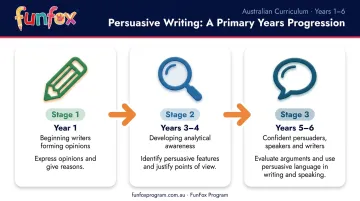
NAPLAN Writing, sat in Years 3 and 5 (as well as Years 7 and 9), includes persuasive writing tasks. The official NAPLAN sample prompt asks students to take a position, write to convince a reader, and structure their response with an introduction, supported opinions, and a conclusion.
Why It Matters Beyond School
Children who develop persuasion skills early are better at:
- Articulating ideas clearly in group discussions and class presentations
- Engaging in respectful disagreement without shutting down
- Thinking critically about the arguments they encounter — in advertising, media, and everyday conversation
- Building confidence in settings where their voice needs to be heard
A child who learns to argue a position at age nine is far better equipped for a job interview, a team disagreement, or a difficult conversation at twenty-five.
The Three Pillars of Persuasion: Ethos, Pathos, and Logos
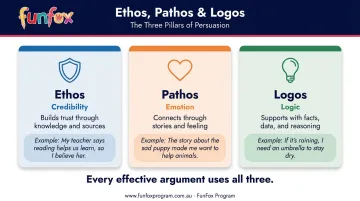
Every effective argument — whether it's a Year 4 opinion essay or a speech that changed history — draws on three principles first identified by Aristotle over 2,000 years ago. Understanding them gives children a framework for building any persuasive piece, written or spoken.
Ethos: Building Credibility
Ethos is about being believable. An audience is far more likely to accept an argument from someone who clearly knows their topic.
For children, building ethos looks like:
- Using specific examples and details, not vague generalisations
- Citing sources in writing ("According to…")
- Speaking with preparation and confidence in presentations
A simple example: if a student wants to argue that dogs make better pets than cats, mentioning specific facts about care requirements, exercise needs, and companionship studies makes them sound credible. Simply saying "dogs are more fun" does not.
Pathos: Making an Emotional Connection
Facts alone rarely move people. Pathos — connecting with how the audience feels — is often what tips someone from passive agreement to genuine conviction.
In writing, pathos comes through word choice, personal anecdotes, and vivid descriptions. In speaking, it's tone, pace, and the willingness to share a relatable story.
Martin Luther King Jr.'s "I Have a Dream" speech works not because it lists civil rights statistics, but because its imagery and moral urgency make the audience feel the injustice being described. For children, the simplest entry point into pathos: "Imagine what it would be like if…" — inviting the reader or listener to step into the argument emotionally.
Logos: Using Logic and Evidence
Logos means supporting a position with facts, data, examples, or clear cause-and-effect reasoning. For primary school students, this translates to:
- Finding one or two strong statistics or facts that support their claim
- Using examples that are concrete and specific (not "some people think...")
- Showing the logical connection between their evidence and their argument ("This matters because…")
Logos provides the backbone of an argument, but it rarely wins on its own. A well-reasoned case that never connects emotionally tends to inform rather than persuade. The most effective communicators — from Year 5 opinion writers to NAPLAN persuasive tasks — use all three pillars in combination, which is exactly why teaching children the why behind each one matters so much.
Persuasive Writing Techniques for Primary School Students
Strong persuasive writing doesn't happen by instinct. It follows a structure, and once children understand that structure, they can apply it consistently.
Start with a Clear Position Statement
The first sentence of a persuasive piece should state the writer's view directly. Not hint at it. State it outright.
Vague opening: "There are many things to think about when it comes to school uniforms." Strong opening: "School uniforms should be compulsory in all Australian primary schools."
The second version gives the reader an immediate, clear position. Everything that follows exists to support it.
Organise Arguments Logically
Aim for two or three supporting points, each in its own paragraph. Each paragraph works best with:
- A topic sentence that states the point clearly
- Supporting evidence — a fact, example, or reason
- A link back to the main argument ("This shows why…")
More than three arguments often weakens a piece. Each point gets less space to develop, and the writing feels rushed. Two or three well-developed arguments are more persuasive than six thin ones.
Use Persuasive Language Devices
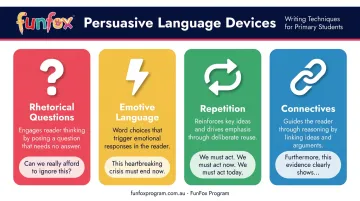
The NAPLAN Persuasive Writing marking guide explicitly assesses persuasive devices as a criterion. Common devices primary students can learn and apply:
- Rhetorical questions — engage the reader by inviting them to think ("Wouldn't you want…?")
- Emotive language — word choices that trigger feeling ("devastating," "heartwarming," "urgent")
- Repetition — reinforcing a key idea for emphasis ("Every child deserves. Every child.")
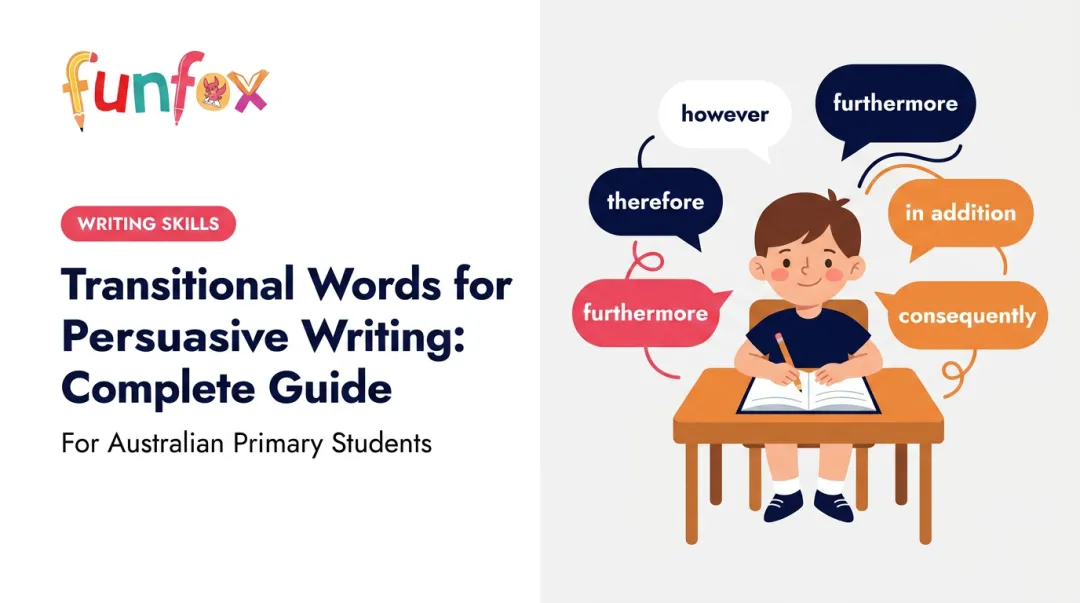
- Connectives — guiding the reader through reasoning ("Furthermore," "However," "As a result")
Address the Other Side
Strong persuasive writing acknowledges the opposing view, then refutes it. This shows maturity and pre-empts the reader's likely objections.
A simple template that works well for primary students:
"Some people believe [opposing view]. However, this overlooks the fact that [your counter-point and evidence]."
End with a Call to Action
The conclusion is the final push. Restate the main argument, briefly summarise the key points, and leave the reader with something to think about or do. A strong conclusion doesn't just summarise — it sends the reader away with a clear reason to act or agree.
FunFox's Writers Club works with students in Years 2–6 through weekly small-group live sessions (maximum six students per class). Children practise these persuasive text structures with direct teacher guidance and personalised feedback delivered through the Seesaw platform.
Persuasive Speaking Techniques for Children
Written persuasion lives on the page. Spoken persuasion has to work in real time, which means delivery matters as much as content.
Confident Delivery
The Victorian Curriculum English descriptor VCELY175 requires students to deliver oral presentations using appropriate voice levels, articulation, body language, gestures, and eye contact. These aren't extras — they're part of the assessment.
Children should practise:
- Standing tall with relaxed, open posture
- Making steady (not staring) eye contact with the audience
- Speaking at a measured pace — fast delivery signals nerves; slow delivery loses attention
Vocal Variety
A monotone delivery is the fastest way to lose an audience. Varying tone, volume, and pace signals real conviction, and that energy is contagious. Teach children to slow down on key points for emphasis, use a slight pause before an important statement, and raise energy when they want the audience to feel something.
The Hook
Every persuasive speech needs an opening that immediately grabs attention. For primary-aged audiences, the most effective hooks are:
- A short, relatable story
- A surprising "what if" scenario
- A question that invites the audience to think
Statistics and formal quotes often fall flat as speech openers for young audiences — a vivid story works far better. Save the data for the body of the speech, where it supports a point the audience already cares about.
Know the Audience
A speech written for classmates should use different language, examples, and tone than one addressed to parents or teachers. Tailoring the message to the audience is what separates a generic speech from a genuinely persuasive one. Ask children: "What does this audience already believe? What do they care about? What would make them change their mind?"
How to Structure a Persuasive Argument (Step-by-Step)
The same three-part structure applies to both persuasive writing and speaking.
1. Introduction
- State your position clearly and immediately
- Hook the audience with a question, story, or striking statement
- Preview what your arguments will be (briefly)
2. Body
- Present two to three well-evidenced arguments
- Each argument should answer the "so what?" for the audience
- Use connectives in writing ("Furthermore," "In contrast") and verbal signposts in speaking ("My second reason is…," "To give you an example…")
3. Conclusion
- Restate your position (in fresh words, not verbatim)
- Briefly summarise your key points
- End with a memorable call to action — something the audience can think about or do
Transitions Hold the Structure Together
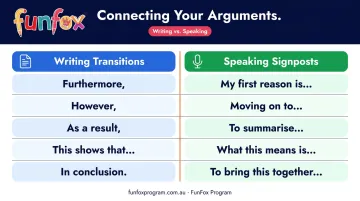
Each of those three sections only works if they connect smoothly. Without clear transitions, even a well-argued piece can feel choppy and hard to follow. Useful connecting phrases for primary students:
| Writing | Speaking |
|---|---|
| Furthermore, | My first reason is… |
| However, | Moving on to… |
| As a result, | To summarise… |
| This shows that… | What this means is… |
| In conclusion, | To bring this together… |
The "Three Is Enough" Principle
The most common structural mistake children make is trying to cover too many arguments. Three well-supported points that genuinely connect with the audience beat six shallow ones every time. Help children pick their strongest three arguments and develop each one fully.
Helping Your Child Build Persuasion Skills at Home
Persuasion practice doesn't have to feel like homework. The most effective at-home activities are low-stakes, conversational, and fun.
Everyday Persuasion Activities
- The Family Decision Debate: When a family choice comes up — where to eat, what to watch, where to go on holidays — challenge your child to argue for their preference using at least one reason and one piece of supporting evidence. Keep it playful.
- The Other Side: After your child makes an argument, gently ask them to argue the opposing view. This builds the ability to consider differing perspectives — a skill explicitly valued in the upper-primary Australian curriculum.
- "Convince Me" Writing: Ask your child to write a short paragraph convincing you of something they feel strongly about — school rules, a favourite sport, why a pet would be good for the family. Any topic where they have genuine investment works.
Read and Watch Persuasive Content Together
Opinion pieces in children's magazines, class debate videos, or age-appropriate speeches give children real examples to analyse. After watching or reading, ask:
- "What made that argument convincing?"
- "How did the writer make you feel — and why?"
- "Was there anything that didn't work? What would you change?"
This builds analytical thinking alongside persuasion skills — two things that reinforce each other.
Make Feedback Normal
Improvement in persuasion comes from writing, getting feedback, and writing again. Encourage your child to revise a paragraph after you've discussed it together — not to get it "right," but to practise the process of refining an argument. The goal isn't a perfect paragraph — it's building the habit of rethinking and improving.
Frequently Asked Questions
What is the art of speaking and writing persuasively?
Persuasive speaking and writing use well-structured arguments, emotional connection, and credible evidence to influence how others think, feel, or act. These are learnable skills built through practice — not talents some children are simply born with.
What are the three main elements of persuasive communication?
Ethos (credibility), pathos (emotional appeal), and logos (logical evidence). Ethos makes the audience trust you, pathos makes them care, and logos gives them a rational reason to agree. The most effective persuaders balance all three.
At what age can children start learning persuasion techniques?
Children as young as Year 1 can begin exploring simple opinion language, with more structured argument writing and speaking from Year 3 onwards. This aligns with the Australian Curriculum v9, which includes expressing an opinion explicitly from Year 1.
How is persuasive writing different from persuasive speaking?
Persuasive writing relies on word choice, structure, and language devices on the page. Persuasive speaking also involves delivery — voice, body language, eye contact, and pacing. Both share the same underlying principles of ethos, pathos, and logos.
What are some good persuasive writing topics for primary school students?
Topics children feel genuinely passionate about work best — school rules, animal welfare, environmental issues, technology use, or whether homework should be abolished. Personal investment makes arguments more authentic — and more convincing.
How can parents help their children practise persuasion at home?
Encourage structured everyday debates on low-stakes decisions, read and discuss opinion pieces together, and prompt short written paragraphs on topics your child cares about. Making it a normal part of conversation — rather than a school task — makes it stick.