Rhetorical questions are one of the most commonly taught persuasive writing tools in Australian primary schools, yet many students either avoid them entirely or scatter them through an essay without purpose. The result? Writing that feels flat rather than convincing.
This guide covers everything young writers (and the parents supporting them) need to know: what rhetorical questions actually are, the three distinct types, why they work, and a clear four-step process for using them confidently in school essays.
Key Takeaways
- Rhetorical questions are asked for effect, not to receive an answer
- Three types exist: anthypophora (ask and answer), erotesis (obvious answer), and epiplexis (challenge)
- NAPLAN assesses rhetorical questions directly under its persuasive devices criterion
- Placement matters — hooks, transitions, and conclusions each serve different purposes
- One or two per essay is enough; quality beats quantity
What Is a Rhetorical Question?
A rhetorical question is asked for effect rather than to receive a genuine answer. Its purpose is to make a point, provoke thought, or guide the reader toward a conclusion the writer already has in mind.
Silva Rhetoricae at Brigham Young University defines it as "any question asked for a purpose other than to obtain the information the question asks" — which is the clearest distinction from an ordinary question. A regular question genuinely seeks information. A rhetorical question already implies its answer or is intentionally unanswerable.
What This Looks Like in Practice
Consider these examples a primary school student would recognise:
- "Isn't it everyone's responsibility to take care of the environment?" — implies "yes"
- "Who would want to live in a world without clean air?" — implies "no one"
- "Can we really afford to keep ignoring climate change?" — implies "no, we can't"
None of these need a spoken reply. The implied answer does the persuasive work the moment the reader processes the question. That's by design — ACARA's NAPLAN persuasive writing marking guide describes it precisely: rhetorical questions "implicitly contain their own answer."
This is what separates them from ordinary questions — and what makes them a deliberate persuasive tool rather than a request for information.
The 3 Types of Rhetorical Questions Explained
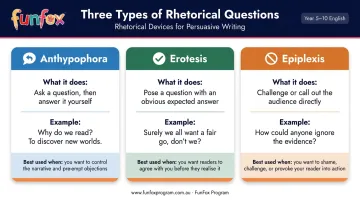
Not all rhetorical questions work the same way. There are three main types, each designed to create a specific effect. Knowing which to use gives young writers far more control over their writing.
Anthypophora (Ask and Answer)
Anthypophora — sometimes called hypophora — is when the writer immediately provides their own answer to the question they've just posed. According to Silva Rhetoricae, it can also raise and settle imaginary objections — which makes it a reliable tool in structured argument.
Example: "Why should we recycle? Because every small action adds up to a healthier planet."
This technique signals confidence. Rather than leaving the reader to fill in the answer, the writer controls the response entirely, steering the argument step by step. In a persuasive essay, that kind of deliberate control keeps the reader on track — and on side.
Erotesis (Obvious Answer Expected)
Erotesis is a rhetorical question where the answer is so clear that no reply is needed. The question creates strong emphasis and rallies the reader's agreement without asking them to think too hard.
Example: "Is a clean environment worth fighting for?"
The obvious answer is yes — and the reader knows it immediately. That shared understanding creates a sense of alignment between writer and audience, which is exactly what persuasive writing needs.
Epiplexis (Challenge or Call Out)
Epiplexis is used to challenge an opposing view or call out a flawed idea. It carries a tone of disbelief or urgency and works well when the writer wants to dismantle a counterargument.
Example: "Can we really afford to keep ignoring climate change?"
The question itself becomes the rebuttal — continuing the opposing behaviour looks not just wrong, but indefensible. Use epiplexis when the goal is to dismantle a counterargument rather than simply state a position.
Why Rhetorical Questions Are Powerful in Persuasive Writing
They Create Dialogue, Not Lectures
When a writer states a fact, the reader receives it passively. When a writer poses a question, the reader's brain automatically begins to respond. This shifts the dynamic from one-way delivery to something that feels more like a conversation.
BBC Bitesize notes that rhetorical questions "hook a reader's interest" and make readers think about their own response — which is why they work so well in opinion pieces and school persuasive tasks where keeping the reader engaged is everything.
They Connect to the Classical Appeals
Rhetorical questions can draw on all three of Aristotle's classical appeals, giving writers more than one way to move an audience:
- Pathos (emotion): "How many more animals must suffer before we act?" stirs feeling and urgency
- Ethos (credibility): A thoughtful question shows the writer has considered the topic seriously
- Logos (logic): Implied-answer questions reinforce reasoning without stating it bluntly
Placement Amplifies Impact
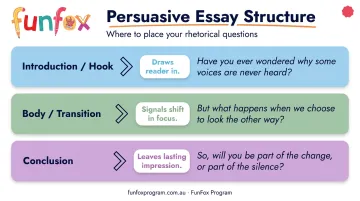
Where a rhetorical question sits in an essay matters as much as what it says:
- Introduction (as a hook): "Who decides which children deserve a good education?" — draws the reader in immediately
- Mid-essay (at a transition): "But what happens when schools run out of funding?" — signals a shift in focus
- Conclusion (call to reflection): "If not us, then who?" — leaves a lasting impression
NAPLAN and the Australian Curriculum
For Australian families, this is directly relevant. NAPLAN's persuasive writing marking guide explicitly lists rhetorical questions under its "Persuasive devices" criterion, defining them as devices that "enhance the writer's position and persuade the reader." High-scoring responses demonstrate sustained, effective use of a range of persuasive devices. That means students need to practise using rhetorical questions deliberately — varying their placement and purpose across an essay, not just dropping one into the introduction.
Rhetorical Questions in Action: Examples from Literature and Speeches
Seeing rhetorical questions in professional writing helps students understand what good usage actually looks like.
From Literature
Shakespeare's Romeo and Juliet (Act 2, Scene 2): Juliet asks "What's in a name?" — then immediately answers with the rose analogy. This is anthypophora in action: the question opens a door, and the argument walks through it.
Shakespeare's The Merchant of Venice (Act 3, Scene 1): Shylock's sequence — "Hath not a Jew eyes? If you prick us, do we not bleed?" — combines erotesis and epiplexis. Each question implies "yes," building a cumulative case for shared humanity. The questions are never truly left unanswered; each one is surrounded by evidence.
From Famous Speeches
Sojourner Truth, 1851: The repeated refrain "Ain't I a woman?" at the Women's Rights Convention in Akron, Ohio challenged racist and sexist assumptions about womanhood through epiplexis. Each repetition built pressure and demanded reflection.
Emma Watson, UN HeForShe Speech (2014): Watson used rhetorical questions including "How can we affect change in the world when only half of it is invited or feel welcome to participate in the conversation?" and "If not me, who? If not now, when?" The short, stacked final pair works differently from the longer question — it creates urgency rather than analysis, showing students that rhetorical questions can shift pace as well as perspective.
The Pattern Students Should Notice
In every example above, the rhetorical question is followed by evidence or expanded argument. No question is left floating — each one is anchored by reasoning, evidence, or a concrete example. That's the standard students should hold themselves to: never ask a rhetorical question without being ready to answer it.
How to Use Rhetorical Questions in Your Child's Persuasive Writing
Step 1: Identify the Core Point
Before writing a rhetorical question, the student needs to know what they most want the reader to agree with. Ask: "What is the one thing I want my reader to believe by the end of this essay?" The rhetorical question should grow directly from that answer.
Step 2: Flip the Statement into a Question
Take the core argument and convert it into a question that implies the same conclusion:
| Statement | Rhetorical Question |
|---|---|
| Everyone deserves access to education | Doesn't every child deserve the chance to learn? |
| Plastic pollution harms ocean life | Can we keep pretending the ocean can absorb our waste? |
| Animals shouldn't be kept in small cages | Is a cage any kind of life for a wild animal? |
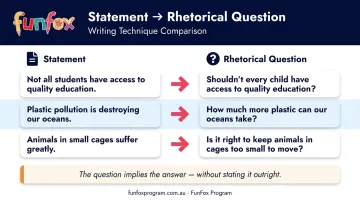
The question implies the answer the writer wants — without stating it outright.
Step 3: Choose the Right Placement
- Hook (introduction): Opens the essay with a question that pulls the reader in before the argument begins
- Transition: Marks the shift from one key point to the next, keeping momentum going
- Conclusion: Closes on a question the reader keeps turning over after the last line
Placement isn't decorative. Each position serves a different persuasive function, and choosing deliberately makes the essay feel structured and purposeful.
Step 4: Follow It with Evidence
A rhetorical question should never float alone. Immediately after posing it, the student must provide the reasoning or evidence that gives the question its weight. For example, after asking "Can we keep pretending the ocean can absorb our waste?", the next sentence should cite a statistic or fact — not leave the reader hanging.
FunFox's Writers Club does precisely this: children in Years 2–6 practise persuasive techniques in small online groups of up to six students, with teachers giving personalised written feedback on each draft.
Common Mistakes Young Writers Should Avoid
Overusing Rhetorical Questions
One or two well-chosen rhetorical questions per essay is enough. When every paragraph opens with a question, the technique loses its power and the writing begins to feel uncertain rather than confident. The NAPLAN marking guide rewards sustained, effective use of a range of persuasive devices — not repetitive use of one.
Writing Vague or Confusing Questions
A rhetorical question must have a clear implied answer. If the reader can't immediately tell what point the question is making, it creates confusion.
- Vague: "What about the environment, though?" — unclear point, no implied answer
- Sharp: "Can we honestly say we've done enough to protect the environment?" — implies "no" and points directly at the argument
Using Questions Instead of Evidence
A rhetorical question is a persuasive opener, not an argument by itself. Students sometimes pose a powerful question and then move straight to the next point without ever substantiating it.The question invites the reader to agree; the evidence is what convinces them to stay there.
- Weak: "Shouldn't we all care about the future of our planet?" — then jumps straight to the next paragraph
- Stronger: "Shouldn't we all care about the future of our planet?" — followed by a statistic, example, or expert view that gives the reader a reason to say yes
Frequently Asked Questions
Can rhetorical questions be used in persuasive writing?
Yes, they're one of the most effective tools available. Rhetorical questions engage the reader directly, emphasise key points, and guide the audience toward the writer's position without stating the conclusion outright. NAPLAN explicitly recognises them as a persuasive device.
What are examples of rhetorical questions?
Common examples include: "Isn't it time we took action?" (student essay), "Ain't I a woman?" (Sojourner Truth's 1851 speech), and "Who would want to live in a world without clean air?" (everyday persuasive context). Each one implies its answer rather than expecting a spoken reply.
What are common rhetorical devices?
Rhetorical questions are one tool among many. Others include repetition, emotive language, the rule of three, alliteration, and anecdote. Effective persuasive writing typically uses a mix of these rather than relying on any single device.
What is the rhetorical situation?
The rhetorical situation is the context surrounding a piece of writing: the writer's purpose, the audience, the topic, and the setting. Understanding this context helps a writer decide whether a rhetorical question will land effectively or feel forced.
What are the different types of rhetorical questions?
The three main types are: anthypophora (ask and immediately answer — best for guiding the reader through an argument), erotesis (obvious answer expected — best for building agreement), and epiplexis (challenge or call out — best for addressing counterarguments).
How many rhetorical questions should you use in a persuasive essay?
One to two per essay, placed at moments of maximum impact. Overuse dilutes the effect — quality and placement matter far more than quantity.