Introduction
Picture this: your four-year-old sits down to draw, switches the crayon from hand to hand, scribbles a few lines, then pushes the paper away. Is that normal? Should you be concerned?
For most parents, pre-writing development is invisible until something feels off. Yet the physical, cognitive, and motor foundations children build between ages 2 and 7 directly determine how easily they'll pick up a pencil and form letters when formal schooling begins.
Pre-writing skills aren't just about crayons and tracing sheets. They encompass gross motor control, hand strength, visual perception, and spatial awareness — all working together long before a child writes a single letter.
According to a 2024 systematic review, fine motor skills are positively correlated with mathematics, reading, writing, and spelling outcomes across multiple studies.
If you're a parent of a child aged 2–7, this guide walks you through the building blocks of pre-writing development, age-by-age milestones, practical home activities, and the warning signs worth acting on.
Key Takeaways
- Pre-writing skills span gross motor, fine motor, visual-motor, and cognitive development — not just pencil grip
- Development follows a body-to-fingers sequence — core strength develops before finger control
- Milestones progress from vertical lines (~2 years) through triangles and name-writing (~5 years)
- Everyday play — sand, Play-Doh, climbing — directly builds writing readiness
- Seek an occupational therapist assessment if delays persist past expected age ranges
What Are Pre-Writing Skills and Why Do They Matter?
Pre-writing skills are the full set of physical, perceptual, and cognitive abilities a child must develop before formal letter writing becomes possible. The Royal Children's Hospital Melbourne defines them as the sensorimotor skills involved in learning to write — including holding and using a pencil, drawing, copying, and colouring.
Two broad categories work in tandem:
Physical and motor skills:
- Core and shoulder stability for sitting upright and controlling arm movements
- Hand and finger strength for gripping and manipulating tools
- Eye-hand coordination for directing marks accurately on a page
Cognitive and perceptual skills:
- Shape recognition and spatial direction (understanding "above," "below," "beside")
- Visual memory for recalling what a circle or cross looks like
- Visual-motor integration — connecting what the eyes see to what the hands do
Both categories must develop together. A child with strong hands but poor visual perception will still struggle to copy a shape accurately.
Pre-Writing vs. Handwriting — What's the Difference?
Pre-writing is the preparatory stage: building motor readiness, learning to make controlled strokes, and mastering shapes. Handwriting is the formal task of producing alphabet letters and words.
The distinction matters because rushing a child into letter formation before pre-writing readiness is established can entrench poor habits. The RCH notes that an awkward pencil grip, once habitual, becomes much harder to correct.
Australia's Early Years Learning Framework supports mark-making, drawing, and symbolic communication as valid early learning — formal letter formation begins in Foundation year, not preschool. That means the bulk of pre-writing development happens at home, driven by parents through everyday play and interaction between ages 2 and 5.
The Core Building Blocks of Pre-Writing Development
Pre-writing development follows a body-to-fingers sequence. Build the foundation wrong and everything above it wobbles — a child who can't sit stably at a desk can't focus on controlling a pencil.
Gross Motor and Core Strength
Core and shoulder stability are the starting point. Without a stable base, children hunch over their work, tire quickly, or grip a pencil far too tightly to compensate for poor posture. Research by Flatters et al. (2014) found a strong correlation between postural stability and fine manual control in children.
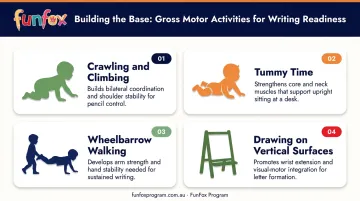
Activities that build this foundation:
- Crawling, rolling, and climbing (activates core and shoulder girdle)
- Tummy time for younger children (builds neck, back, and shoulder strength)
- Wheelbarrow walking and animal walks
- Drawing on vertical surfaces like easels or paper taped to a wall — this position naturally engages shoulder stability
Fine Motor Skills and Hand Strength
Fine motor skills involve the small muscles of the hands and fingers — specifically the pincer grasp, finger dexterity, and hand manipulation needed to control a pencil. The RCH recommends these activities for building hand and finger strength:
- Rolling, squeezing, and pinching Play-Doh or putty
- Using tweezers to pick up small objects
- Threading beads or lacing cards
- Clothes pegs and spray bottles (builds grip strength)
- Tearing and scrunching paper
Each of these activities targets the same small muscles that writing demands — which is why hand strength and eye-hand coordination develop together.
Visual Motor Integration
Visual motor integration (VMI) is the brain's ability to coordinate what the eyes see with what the hands do — it's what allows a child to look at a circle and reproduce it accurately on paper.
VMI delays can appear even when a child clearly understands what they're trying to draw. Common signs include:
- Inconsistent letter sizing across a page
- Difficulty staying within lines
- Shapes that look nothing like the model
Assessment tools like the Beery-Buktenica VMI test measure this capacity specifically, though VMI is best understood as one factor among many in writing readiness.
Crossing the Midline and Hand Dominance
Midline crossing — reaching across the body's centre line — supports hand dominance, left-to-right tracking when reading, and the coordinated two-handed tasks writing requires (one hand holds the pencil, the other steadies the paper).
Hand preference typically begins developing between ages 2 and 4, with a clear preference usually established by age 6 (RCH). A child still frequently switching hands during drawing tasks at age 5 or older is worth monitoring.
Signs of midline difficulty include:
- Swapping the crayon from hand to hand mid-drawing
- Rotating the whole body instead of reaching across it
- Avoiding tasks that require crossing to the other side
Pre-Writing Milestones: What to Expect at Each Age
Pre-writing shapes follow a predictable developmental sequence. Not every child hits these at exactly the same month — but the order is consistent, and significant delays are worth noting.
| Shape/Skill | Approximate Age |
|---|---|
| Vertical and horizontal lines | ~2–2.5 years |
| Copy a circle | ~3 years |
| Copy a cross (+) | ~4 years |
| Copy a square | ~4.5 years |
| Copy a triangle, print own name | ~5 years |
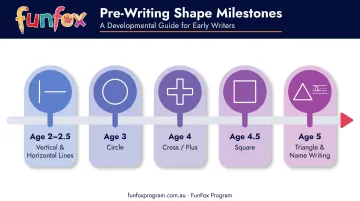
Sources: CDC Milestones (3 years), University of Washington Developmental Milestones Table, Raising Children Network.
Mastering these shapes is the gateway to letter formation — most uppercase and lowercase letters are combinations of the lines, curves, and angles in this list.
What Readiness for Formal Writing Looks Like
Around ages 5–6, a child ready for formal letter writing typically shows:
- Consistent use of one preferred hand
- Ability to copy basic shapes from a model without help
- Controlled, intentional mark-making (not just scribbling)
- Interest in letters, words, and their own name
- Ability to sit upright and maintain focus for a short tabletop task
Letter writing follows its own sequence: children first imitate letters (with a model right in front of them), then copy from a model, then reproduce from memory.
Letter writing should only begin once the pre-writing shapes are well established. Introducing letters too early — before the foundational strokes are secure — can lock in poor formation habits that are hard to undo.
Practical Activities to Build Pre-Writing Skills at Home
For Toddlers and Preschoolers (Ages 2–4)
These activities target the gross motor and sensory foundations that come first:
- Tape paper to a wall or use an easel for drawing — builds shoulder stability and wrist extension
- Draw in sand or shaving cream — sensory input helps children feel each stroke, reinforcing motor memory
- Dig and pour in a sandpit — strengthens wrists and shoulders through repetitive resistance
- Set up obstacle courses and climbing play — develops core strength and body awareness
- Finger paint freely — Raising Children Network notes this builds fine motor foundations needed for later writing in children aged 1–5
Once gross motor control is established, children are ready to work on finer hand strength and stroke precision.
For Preschoolers and Early School Age (Ages 4–6)
As children approach writing readiness, activities become more targeted:
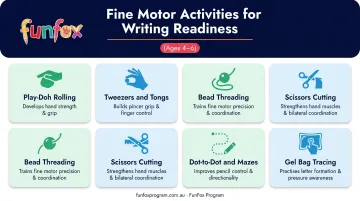
- Roll, press, and pinch Play-Doh — works all the small hand muscles in one activity
- Use tweezers or tongs to pick up pompoms or blocks — trains the pincer grip
- Thread beads and lace cards — builds eye-hand coordination and finger control
- Cut along lines with scissors — develops hand separation and bilateral coordination
- Complete dot-to-dot and maze activities — bridges free sensory play and directed mark-making
- Trace shapes inside a gel bag — a low-pressure, tactile way to practise stroke direction
When children have these physical foundations in place and are ready for guided writing practice, FunFox's Writers Club builds on them through structured, play-based sessions in small groups — giving early writers a supported environment to develop their skills step by step.
Signs Your Child May Need Extra Support
Normal variation in development is wide. But some patterns signal that a child may benefit from targeted assessment rather than just more time.
Red flags by age, based on Raising Children Network guidance:
- Age 2: Not scribbling or attempting to make marks
- Age 3: Not drawing simple shapes or scribbling
- Age 4: Unable to draw a circle or cross
- Age 5: Cannot draw a circle or square, or shows no interest in writing their name
Additional signs to watch for:
- Consistently switching hands during drawing tasks past age 4–5
- Very weak pencil or crayon grip, or complaining of hand pain when drawing
- Strong, persistent avoidance of all drawing or mark-making activities
- Inability to sit upright and maintain posture for a short tabletop task
Who to contact:
An occupational therapist (OT) is the primary professional for assessing fine and gross motor readiness. Raising Children Network recommends starting with a GP or classroom teacher, who can then refer on. Acting early and requesting a developmental screening — rather than waiting to see if concerns resolve — is generally the better approach.
Delayed pre-writing skills are not a measure of intelligence. Many children simply need more targeted exposure, a different sensory approach, or structured support.
A 2011 controlled study published in the American Journal of Occupational Therapy found that a targeted handwriting-readiness programme in a preschool setting produced measurably stronger outcomes than standard classroom exposure alone.
That evidence matters: early, structured support works. If something feels off, trust that instinct and seek a professional opinion sooner rather than later.
Frequently Asked Questions
How do you develop pre-writing skills?
Pre-writing skills develop through gross motor play (climbing, drawing on vertical surfaces), fine motor activities (Play-Doh, threading, tweezers), and sensory exploration (sand, finger painting). Unstructured play covers most of this before age 4; structured activities become more valuable from age 4 onwards.
What are the 5 steps of pre-writing?
The typical progression is: free scribbling → drawing basic lines and shapes → copying shapes from a model → tracing over letters and shapes → independently reproducing shapes and early letter forms from memory.
What are the 5 stages of writing development?
Broadly: drawing and scribbling, pre-phonemic writing (random letter-like marks), phonemic awareness writing (approximate letter sounds), transitional writing, and conventional fluent writing. Pre-writing skills underpin the first two stages entirely.
At what age should a child have pre-writing skills?
Most children are ready for formal letter writing around ages 5–6. Development starts around age 2 with basic lines, building through circles, crosses, and squares by age 4–5 — these shapes need to be reliably mastered first.
What are signs of pre-writing delays?
Key signs include inability to copy age-expected shapes, consistent hand-switching past age 4–5, very weak grip, or strong avoidance of drawing. If these persist beyond the expected age range, an OT assessment is worthwhile.
How does play help develop pre-writing skills?
Play builds the gross and fine motor foundations writing depends on. Digging strengthens wrists and shoulders; climbing builds core stability; craft activities develop finger dexterity and eye-hand coordination. Play isn't a detour around writing readiness. It's how writing readiness is built.