That's what powerful thunderstorm writing looks like — and it's exactly what young writers can learn to create. Storms are one of the richest settings in descriptive writing because they engage every sense at once: the bruised sky, the crack of thunder felt in the chest, the sharp electric smell before the first drop falls. For primary school students working on narrative and descriptive writing, a thunderstorm offers something even better than a dramatic setting — it offers a scene they've actually lived through, which makes the writing feel real.
This guide walks through sensory language for each stage of the storm, the literary devices that make descriptions come alive, worked examples showing the difference between weak and strong writing, and the common mistakes worth avoiding. Whether you're a student writing for class or a parent looking for ways to support your child's writing at home, there's something practical here.
Key Takeaways
- Vivid thunderstorm description engages all five senses — not just sight
- The build-up, peak, and aftermath each carry a distinct mood worth capturing separately
- Similes, metaphors, personification, and onomatopoeia are the most effective tools for storm writing
- Strong weather writing shows a character's physical and emotional response through action, not telling emotions
- Avoiding clichés like "it was a dark and stormy night" forces writers to find specific details readers can actually picture
Why Thunderstorms Are a Writer's Best Friend
A thunderstorm throws everything at you at once. Dramatic visuals, bone-deep sound, unfamiliar smells, physical sensations on the skin — few settings in fiction offer this kind of sensory density, which is exactly why storms appear so often in strong descriptive and narrative writing.
The emotional range is just as broad. The same storm can feel terrifying or thrilling depending on who's experiencing it. A child pressing against a wall as the windows flash white is having a completely different storm from someone standing on a verandah watching the sky turn green-grey with something close to delight. That shift in perspective — same weather, entirely different emotional register — is one of the most useful lessons in descriptive writing.
For primary school students, storms carry an extra advantage: they're familiar. Most children have sat through a summer thunderstorm, smelled the air before the rain arrived, or counted the seconds between lightning and thunder. According to NOAA, sound travels roughly 1 kilometre every 3 seconds — so that familiar counting game is actually measuring distance.
Writing from real sensory memory produces more authentic, specific detail than trying to invent it.
The Australian Curriculum (v9) explicitly includes imagery — simile, metaphor, and personification — as part of Year 5 English, and asks Year 3 students to create and edit imaginative texts using language features, settings, and ideas. A thunderstorm description gives students a concrete, memorable subject to practise all three techniques at once — which is why it works so well as a classroom writing prompt.
Setting the Scene: Describing the Build-Up Before the Storm
The build-up is where many student writers rush. They want to get to the lightning. But the tension before a storm hits is often the most powerful writing opportunity — the world holding its breath, something enormous on its way.
What the Sky Does
Skilled writers notice the visual shift before a storm arrives:
- The sky moves from clear blue to a heavy, bruised grey-green
- Clouds pile up like mountains being stacked on the horizon
- The sun doesn't just disappear — it gets swallowed
Try phrases like "fat, grey clouds swallowed the horizon" or "the sky curdled like old milk." These comparisons work because they're specific and slightly unsettling.
What the Air Feels Like
Before a storm, the air grows heavy and humid, pressing against the skin. Then, strangely, the wind drops to almost nothing — before it suddenly gusts. A line like "the air felt thick enough to bite through" captures that loaded stillness well.
The Smell That Signals Rain
Before rain arrives, the air carries a sharp, electric quality — ozone carried down from higher altitudes by storm downdrafts, according to Scientific American. Words like "electric," "mineral," or "sharp" capture this well. Once rain actually falls on dry ground, a different smell arrives — petrichor, the earthy scent released when raindrops hit porous soil surfaces.
Sound Before the Crack
Distant thunder in a build-up sounds nothing like thunder overhead. It's more like furniture being dragged across a ceiling far away — a low vibration rather than a sound. One effective example: "a drum rolled slowly across the sky, too far away to be frightening yet."
Short sentences — even fragments — create the suspended, loaded feeling of a world about to break. Long, flowing sentences belong to the aftermath. During the build-up, brevity does the work.
Describing the Storm at Its Peak: All Five Senses
Once the storm arrives, the writing can open up — but the strongest descriptions don't just pile on detail. They choose specific, well-observed moments across all five senses.
Sight
Lightning gives writers one of fiction's most dramatic visuals. According to the Exploratorium, a flash of light leaves a lingering afterimage — the shape burned briefly behind closed eyes. That's a detail worth using.
Strong sight descriptions:
- "Lightning tore a jagged seam across the dark sky"
- "The world flashed white, then plunged back into shadow"
- "A fork of light split the darkness and was gone before she could name its shape"
For rain, choose active verbs over long adjective strings: rain that hammers, lashes, sheets, or drums carries more force than "very heavy rain falling hard."
Picture drops bouncing off pavement like tiny explosions, silver rivers forming along the gutters, sheets of water driving sideways.
Sound
NOAA describes thunder as an acoustic shock wave — a sonic boom from lightning superheating the surrounding air. That physical reality is useful for writers: thunder isn't just loud, it's felt.
The difference between distant and close thunder matters:
- Distant thunder rolls low and slow — you feel it in the chest before you consciously hear it
- Close thunder arrives without warning: a single crack that stops the breath
Onomatopoeic words for thunder and rain: boom, crack, rumble, crash, roll, patter, drum, hiss, roar. The ACARA English glossary defines onomatopoeia as "a word that imitates a sound" — and for storm writing, these words trigger the sound in the reader's mind before they've consciously processed the sentence.
Smell, Touch, and Taste
- Smell: petrichor (rain on dry ground), wet soil, the sharp ozone scent after a strike
- Touch: cold rain on warm skin, wind snatching at hair and clothes, the low vibration of thunder through the soles of your feet
- Taste: subtle — the metallic edge of the air before a strike, or rainwater on the lips
One or two of these is enough. A single well-chosen sensory detail lands harder than five listed in a row.
Literary Devices That Bring a Thunderstorm to Life
Similes for Thunder and Lightning
Similes create instant pictures by connecting the unfamiliar (the storm's intensity) to something the reader already knows. Strong, child-appropriate examples that move past the obvious:
- "Thunder rolled like a giant tipping over a bookshelf in the room above"
- "Lightning cracked like a whip against the sky"
- "The storm growled like something enormous waking up underground"
- "Thunder rumbled across the hills like a bowling ball finding its lane"
- "The sky lit up like someone had switched on the lights of the world"
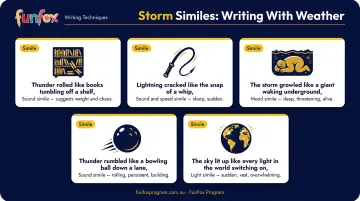
The strongest similes are specific. Not "like a loud noise" — but like a bookshelf, a bowling ball, the lights of the world. That specificity is what makes a reader see it.
Metaphors That Add Drama
Metaphors go further by treating the storm as if it is something else — giving it personality and intention:
- "The sky split open"
- "Thunder was the voice of something furious"
- "The storm swallowed the town whole"
When weather feels alive and deliberate, readers feel the tension differently. A storm that "raged" is a character with a will; a storm that was "very bad" is just a weather report.
Onomatopoeia and Personification
These two devices work well together. Onomatopoeia makes the reader hear the storm; personification makes them feel its intention.
Separately:
- Onomatopoeia: "The rain drummed against the window"
- Personification: "The storm raged through the night"
Combined: "The thunder roared and would not be ignored."
In FunFox's Writers Club, students in Years 2–6 practise exactly these techniques in weekly sessions with no more than six students per class — so they learn to use figurative language in their own writing, not just identify it on a worksheet.
Show Don't Tell in Weather Writing
Instead of writing "it was scary," show what the character experiences:
She pressed herself against the wall as the windows lit up white, counting under her breath before the crash hit — four, three, two—
The storm carries the emotional weight. The reader feels the fear without being told to. That's the difference between writing that stays with a reader and writing that just conveys information.
Putting It All Together: Thunderstorm Description Examples
Before and After
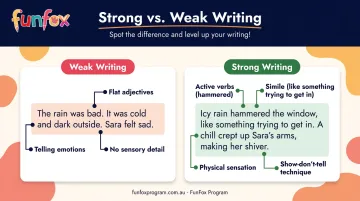
Weak version: It was raining heavily and the thunder was loud. Everything was wet. It was scary.
Stronger version: Rain hammered the roof like something trying to get in. Each time the sky turned white, she squeezed her eyes shut — but the afterimage stayed, jagged and bright, burning behind her eyelids. Then the crack hit, close enough that she felt it in her back teeth.
What changed: active verbs replaced flat adjectives, a simile ("like something trying to get in") created a specific image, a physical sensation grounded the emotion, and "show don't tell" replaced the word "scary" altogether.
Model Paragraph (Primary School Level)
The clouds arrived like a slow argument building overhead — grey turning to charcoal, charcoal turning to something almost green. The air went still. Then the first rumble rolled across the sky, low and long, like furniture shifting in a room far above. When the lightning came, it split the darkness clean open. Rain followed a second later, hammering the tin roof, pinging off the gutters, pooling in the cracks of the path below. She didn't move. She just counted.
Notice how the techniques don't announce themselves — the similes, the onomatopoeia, the sensory detail all sit inside the action. That's what keeps it accessible for primary school writers: the craft is there, but it never gets in the way of the story.
A Simple Writing Activity
The paragraph above was built from exactly the kind of layered observations you can practise yourself. Start small and work outward:
- Write three sentences using only sound — what does the storm sound like? Use at least one onomatopoeic word.
- Write three sentences using only sight — what does the sky, the lightning, the rain look like? Use one simile.
- Write one sentence about smell or touch — something specific, not general.

Read them back in order. You'll find the senses doing the work that adjectives like "scary" or "dark" never quite manage.
Common Mistakes to Avoid
Clichés That Tell Readers Nothing New
"It was a dark and stormy night" is so associated with overblown writing that San Jose State University ran a Bad Writing Contest since 1982 named after its author, Edward Bulwer-Lytton. Other offenders:
- Thunder "booming ominously"
- Lightning "striking fear into hearts"
- A storm "brewing on the horizon"
Clichés give readers exactly what they expect — which means they feel nothing. Ask: has anyone said it this way before? If yes, find a different angle.
Using Weather to Do the Emotional Work
Making it storm because a character is sad is a shortcut, not storytelling. Weather should create atmosphere and pressure — not name the emotion for the reader. The character's actions and physical reactions should carry the feeling. The storm is the backdrop, not the feeling itself.
Too Many Adjectives, Not Enough Verbs
This same impulse to over-explain through weather also shows up at the word level. "The huge, dark, terrifying, deafening thunderstorm" — each adjective weakens the one before it. Strong verbs carry more weight: the thunder split the sky, the rain hammered the roof, the lightning tore a seam through the clouds. When you find the right verb, you rarely need more than one adjective alongside it.
Frequently Asked Questions
How do you describe a thunderstorm?
Strong thunderstorm description engages all five senses — what it looks, sounds, smells, feels, and faintly tastes like. Use vivid figurative language (similes, metaphors, onomatopoeia) and specific action verbs to place the reader inside the moment rather than observing from a distance.
How do you describe the sound of thunder in writing?
Distant thunder is a low, rolling rumble felt more in the chest than the ears. Close thunder arrives as a sudden, ear-splitting crack with no warning. Useful onomatopoeic words: boom, crack, rumble, crash, and roll.
What are some good similes for lightning in creative writing?
Try: "Lightning cracked like a whip across the sky," "A fork of lightning split the darkness like a white-hot blade," or "The sky flared like someone had switched on the lights of the world." The more specific the comparison, the stronger the image.
What words can you use to describe rain during a thunderstorm?
Choose strong verbs: rain that hammers, lashes, sheets, drums, or pours. For visual detail, try "curtains of rain," "bouncing drops," or "silver rivers rushing along the gutters." Verbs carry more weight than adjectives here.
How do you write about a thunderstorm without using clichés?
Focus on fresh comparisons drawn from real sensory experience, use specific and precise verbs, and place the reader physically inside the scene. Avoid anything you've read before.
What literary devices are best for writing about weather?
Similes, metaphors, personification, and onomatopoeia are the four most effective tools. "Show don't tell" also matters: reveal a character's physical reaction to the storm rather than naming their emotion outright. That distinction separates strong descriptive writing from average work.