That's not a knowledge problem. It's a structure problem. And it's exactly what good informational writing instruction fixes.
Informational writing is one of the most accessible genres for primary school students, yet results vary widely depending on how it's taught. Sequence matters, scaffolding matters, and having a clear endpoint in mind before a single word is written makes an enormous difference to what lands on the page.
This article covers what informational writing actually is, what to sort out before you start teaching it, and a clear 6-step process you can follow to guide a child from blank page to finished piece — with confidence on both sides of the table.
Key Takeaways
- Informational writing lets children share factual knowledge without personal stories or arguments — a natural starting point for young writers.
- The strongest approach starts with the finished product in mind and works backwards through planning, organising, and drafting.
- Giving children genuine topic choice is one of the highest-leverage moves for improving both engagement and writing quality.
- Graphic organisers like Boxes & Bullets are essential scaffolds — they turn drafting from a guessing game into a translation exercise.
- Skipping planning and saving all feedback for the final draft are the two most common — and most avoidable — mistakes.
What Is Informational Writing (and Why Does It Work for Primary Students)?
Informational writing — sometimes called expository or informative writing — conveys factual knowledge about a topic without requiring the writer to tell a personal story or argue a position. That neutral ground is exactly what makes it a practical starting point for young writers.
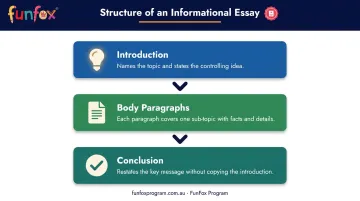
The basic structure children work toward is straightforward:
- An introduction that names the topic and gives the reader a controlling idea
- Body paragraphs each focused on one distinct sub-topic, supported with facts and details
- A conclusion that restates the key message without simply copying the introduction
A well-written 3-paragraph essay is a legitimate, worthwhile goal — not a stepping stone to rush past. The Australian Curriculum Year 3 content descriptor AC9E3LY06 explicitly expects students to plan, create, edit, and publish informative texts. By Year 5, students are using paragraphs to organise, develop, and link ideas with supporting detail.
What makes the genre genuinely click for primary students, though, is the expert dynamic. When a child chooses to write about sharks or volcanoes or the lifecycle of a frog, they become the authority in the room. That sense of ownership produces real voice — the kind where a Year 3 student writes "actually, sharks don't hunt humans on purpose" with the confidence of a documentary narrator.
What to Prepare Before You Start Teaching
A little preparation before the unit launches saves a lot of stalling mid-unit.
Know Your Endpoint
Decide upfront what students will produce — a 3-, 4-, or 5-paragraph informational essay — and how it will be assessed. A simple checklist or rubric aligned to your learning goals works well. That clarity keeps your feedback targeted and your teaching decisions consistent throughout the unit.
Gather Two or Three Mentor Texts
Strong mentor texts are nonfiction books or articles on high-interest topics that make genre features visible: clear headings, topic sentences, factual detail, domain vocabulary, and a satisfying ending. Reading Rockets recommends focused information-book read-alouds that draw attention to how authors organise and present information — weather books, animal books, and science texts all work well.
One practical shortcut: a text used during a recent reading unit can be repurposed for writing instruction, cutting your preparation time significantly.
Prepare Differentiation Supports in Advance
Have these ready before the unit starts:
- Sentence stems and sentence starters for students who need more scaffolding
- Graphic organiser templates
- A short topic list for students who freeze when asked to choose
- Extension prompts for more advanced writers (adding comparisons, statistics, or domain-specific vocabulary)
Prepared in advance, these supports let you respond to students in the moment rather than scrambling to create resources mid-lesson.
How to Teach Informational Writing in 6 Simple Steps
Step 1: Plan with the End in Mind
Before students write a word, you need a clear picture of what they're working toward. Decide:
- The specific product (3-, 4-, or 5-paragraph essay)
- Which writing skills the unit will address
- How growth will be recognised, not just perfection
Map out a rough unit calendar so each session has a clear teaching point. This keeps whole-class instruction, small-group conferences, and independent writing time anchored to specific goals — rather than drifting.
On topic choice: wherever possible, let students choose. The IES/What Works Clearinghouse elementary writing guide recommends giving students writing choices as an engagement strategy. Topic ownership increases motivation and tends to produce more authentic voice than an assigned subject.
Step 2: Launch with a Mentor Text
Read the chosen text once for comprehension, then read it a second time with a different question in mind: How did the author make this work?
During the second read, pause to notice:
- How the introduction names the topic and hooks the reader
- How each paragraph stays focused on one idea
- How headings (if present) signal what's coming
- How transitions carry the reader from one section to the next
- How the conclusion closes without just repeating the opening
Co-create an anchor chart of these features with students. Then keep the text visible throughout the unit — returning to it during drafting and revision helps children see the connection between reading like a writer and writing like a reader.
Step 3: Generate and Unpack Ideas
Before drafting begins, students need to surface what they actually know. Blank-page paralysis almost always comes from skipping this step.
Useful tools for this stage:
- Topic webs — the topic in the centre, sub-topics branching out
- "What I Know" lists — rapid-fire jotting without worrying about organisation
- Class or partner discussions — talking through ideas often surfaces knowledge students didn't realise they had
If students are working from a prompt rather than a free topic, teach them to unpack it first: identify the key words, determine what kind of information is being asked for, and settle on a controlling idea before anything else.
Step 4: Organise with Graphic Organisers
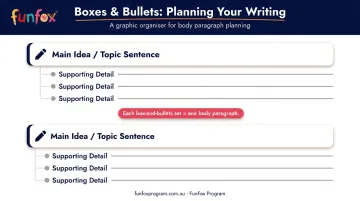
A graphic organiser like Boxes & Bullets gives the essay its skeleton before a single sentence is written. The "box" holds the main idea; the "bullets" list the supporting details that will develop it. Each box-and-bullets set maps directly to one body paragraph.
Graham et al.'s 2012 meta-analysis of elementary writing interventions found strong effects for strategy instruction (effect size 1.02) and text-structure instruction (effect size 0.59) — both of which explicit organiser use supports.
When the organiser is thorough, moving from plan to draft becomes straightforward. Students who put real thought into this stage often find the paragraphs come together quickly. Those who skip it tend to lose direction mid-draft.
Step 5: Draft, Revise, and Give Feedback
Teach drafting in sequential chunks — don't ask students to write the whole essay at once:
- Introduction first — practise opening "grabbers" (a surprising fact, a question, a vivid image)
- One body paragraph at a time — check for a clear topic sentence, supporting details, and a closing sentence before moving to the next
- Conclusion last — restate the controlling idea without copying it
Weave revision into the drafting process rather than saving it for the end. After each paragraph, prompt students to check against a short checklist: Does this paragraph have a topic sentence? Did I include at least two supporting details? Did I use any precise vocabulary?
For feedback, a mix of formats works best:
- Brief whole-class mini-lessons on patterns you're seeing across the group
- Small-group conferences targeting specific skills
- Structured peer review (one comment on content, one on organisation)
AITSL notes that high-quality feedback can improve student learning by as much as eight months — but only when it's timely, specific, and tells the student where to go next, not just what went wrong.
Step 6: Publish and Celebrate
A final editing pass — checking spelling, punctuation, and sentence clarity — leads into a simple published form: a typed document, a neat handwritten good copy, or a short presentation. Format matters far less than finishing something and sharing it.
Celebrate the finished writing with a real audience:
- A sharing circle where each student reads one paragraph aloud
- A gallery walk where classmates leave sticky-note responses
- A family reading night or a piece shared in the school newsletter
Research comparing Year 2 students writing for an internal versus external audience found that those writing for a real audience produced higher-quality work. Purpose and audience give students a genuine reason to get it right.
Common Mistakes to Avoid
Most problems in informational writing units trace back to a handful of the same errors. Watch for these:
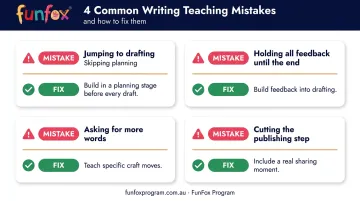
- Jumping straight to drafting — Children who skip the planning phase produce disorganised writing with weak topic sentences. Time spent in Steps 3 and 4 pays back directly in draft quality.
- Holding all feedback until the end — When students receive guidance only on a finished draft, revision feels like starting over. Building feedback into Step 5 makes it feel like progress instead.
- Asking for more words, not better ones — "Write more" without showing how produces padded, repetitive writing. Teach specific craft moves: add a fact, include a comparison, swap a vague word for a precise one.
- Cutting the publishing step — Removing the real-world audience removes the motivation that drove the writing in the first place. Even a brief sharing moment signals the work was worth the effort.
Conclusion
The 6-step sequence — plan with the end in mind, launch with a mentor text, generate ideas, organise with graphic organisers, draft and revise with embedded feedback, and publish for a real audience — works because it breaks a genuinely complex skill into stages that build confidence alongside technique. Each stage prepares students for the next, so skipping one leaves a gap that tends to show up in the final piece.
For parents who want their child to receive this kind of structured, stage-by-stage writing instruction, FunFox's Writers Club offers Term 4 classes dedicated entirely to informative writing. Trained teachers work in small groups of up to six students — aligned to the Australian curriculum — so every child gets personalised feedback and enough practice to produce a finished, polished piece.
Frequently Asked Questions
What is informative writing?
Informative (or expository) writing is non-fiction writing whose main purpose is to convey factual information clearly and without bias. It's distinct from narrative writing and persuasive writing, which argue a viewpoint or tell a personal story rather than present facts.
What are the 5 elements of informative writing?
The five key elements are: a clear topic or controlling idea, an organised structure (introduction, body, conclusion), factual supporting details, precise language, and logical transitions between ideas.
What are the 4 types of informative writing?
The most commonly referenced types are: descriptive, procedural/process, comparative, and problem-solution. At primary school level, most informational writing falls into the descriptive or process category.
What are 5 examples of informative writing?
Accessible examples for primary students include:
- A "how animals survive in winter" essay
- A report on a country's culture
- An explanation of a science experiment
- A biography of a historical figure
- A fact-based article about volcanoes or the water cycle
What is the difference between informational writing and narrative writing?
Informational writing presents facts and knowledge about a topic without a personal storyline. Narrative writing tells a story — fictional or from the writer's own experience — and typically includes characters, a sequence of events, and personal reflection.
At what age should children start learning informational writing?
Children can begin with simple informational writing as early as Foundation/Year 1 through "All About" books and labelled diagrams. More structured, paragraph-level informational writing is typically introduced from Year 2–3 onwards, as students develop the paragraph-writing skills to support it.