Introduction
Picture a child sitting at a desk, pencil in hand, staring at a blank page. They have a story somewhere inside them — they just don't know how to get it out. Sound familiar?
Creative writing can feel intimidating at first, whether you're six or sixty. It's one of the most learnable skills a person can develop. With the right tools, a blank page stops being scary and starts becoming an invitation.
This guide covers everything beginners need to know: the main forms creative writing takes, the core techniques that make writing vivid, a simple process framework, and how to build a real writing habit. It's designed with primary school children in mind, but the principles apply to any beginner.
Creative writing isn't reserved for people who were born storytelling. It's built through practice, curiosity, and a willingness to try.
Key Takeaways:
- Creative writing is a learnable skill — not a talent you either have or don't
- There are seven main forms, from fiction to poetry to journaling
- Five core techniques — including show, don't tell — give beginners an immediate toolkit
- The writing process follows a simple cycle: Brainstorm → Draft → Revise → Share
- Regular, low-pressure practice — even 10 minutes a day — builds real skill over time
What Is Creative Writing?
Creative writing is the art of using language to express ideas, emotions, and stories in imaginative ways. What separates it from a school report or a set of instructions is personal voice — the writer's own perspective, invention, and emotional truth on the page.
The Australian Curriculum frames it as students creating imaginative and literary texts using personal knowledge as a starting point. The UK's national curriculum adds that pupils should write "imaginatively" — not just accurately.
The Core Building Blocks
Almost every piece of creative writing contains four key elements:
- Voice: what makes your writing sound like you rather than anyone else
- Plot or narrative structure: the sequence of events that moves a reader from start to finish
- Theme: the underlying idea — courage, belonging, loss — that gives a story its meaning
- Character: who the story follows, what they want, and what stands in their way
Beginners don't need to master all four at once. Even a two-sentence story has a character doing something for a reason — that's enough to start.
Why Creative Writing Matters
Research from Hubert, Bonnardel and Frey (2025) found that daily creative writing practice gave children from disadvantaged backgrounds a meaningful advantage in verbal divergent thinking, imagination, and emotional stability. The NCTE also describes writing as a tool for thinking, reflecting, and communicating — not just a school subject.
For Australian students navigating NAPLAN and beyond, these skills compound: stronger writing builds stronger thinking, and stronger thinking shows up across every subject.
The 7 Types of Creative Writing
Creative writing takes many forms. Understanding these types helps beginners find the format that excites them most — think of this as an invitation to explore, not a rigid checklist.
No single curriculum publishes an official seven-type list, but the following forms are well established across Australian education frameworks — and they map closely to the writing genres students encounter from Year 1 onwards.
Storytelling and Short Fiction
Fiction — from short stories to longer narratives — is the most familiar form. It involves inventing characters, settings, and events that didn't happen (or didn't happen quite that way).
Even a two-paragraph story counts. A child who writes about a dog that discovers a secret tunnel has written fiction — and that's a genuine creative achievement worth building on.
Poetry, Personal Narrative, and Other Forms
| Form | What It Is | Best For |
|---|---|---|
| Poetry | Playing with rhythm, imagery, and emotion | Writers who love language and sound |
| Personal narrative | Drawing from real experiences and memories | Writers who want to tell their own story |
| Drama / scripts | Writing for performance, with dialogue and stage directions | Writers who enjoy conversation and action |
| Flash fiction | Very short stories — often under 500 words — with a twist | Writers who want a quick, satisfying challenge |
| Journaling | Reflective, low-stakes writing about thoughts and experiences | Any beginner — great as a daily habit |
| Descriptive writing | Painting a scene using rich sensory language | Writers building observation skills |
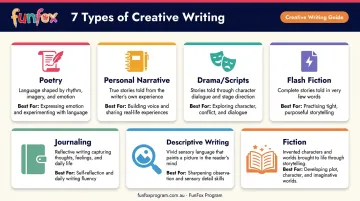
Each of these forms calls on slightly different skills, which is why the table above is a useful starting point for choosing where to begin. For younger primary school students (Years 2–4 in particular), descriptive writing and short narratives tend to be the most accessible entry points — they build observation and storytelling instincts before tackling more complex structures.
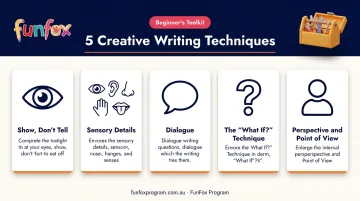
Key Creative Writing Techniques Every Beginner Should Know
Think of these as a toolbox. Beginners don't need every tool at once — trying one at a time is enough.
Show, Don't Tell
Instead of stating an emotion directly ("She was scared"), a writer creates a scene that lets the reader feel it.
Tell: She was scared. Show: Her hands wouldn't stop shaking. She pressed them flat against her thighs and counted her breaths — one, two — but her heart kept pounding anyway.
The second version doesn't use the word "scared" once, but the feeling is unmistakable. This technique asks writers to think in scenes rather than summaries.
Sensory Details
Writing becomes immersive when it engages more than just sight. The five senses — sight, sound, smell, touch, taste — give readers the feeling of being inside a scene.
Without sensory detail: The bakery smelled nice. With sensory detail: The warm, buttery smell hit her before she even opened the door — cinnamon and sugar and something yeasty, like fresh bread pulled straight from the oven.
Sensory detail is one of the easiest techniques for beginners to practise immediately. Ask: what would you see, hear, smell, feel, or taste in this moment?
Dialogue
Dialogue brings characters to life and breaks up description. One quick test: read it aloud. If it sounds like something an actual person would say, it's working. If it sounds stiff or formal, adjust it.
Tip: You don't need dialogue tags more complex than "said" or "asked." The dialogue itself should carry the emotion.
The "What If?" Technique
Asking "What if?" is one of the most reliable creative sparks a beginner can use. It pushes past the obvious and opens up imaginative territory fast.
Try these to get started:
- Your school is secretly run by robots — now what?
- What if you woke up one morning and could hear animals talking?
- The last person on Earth finds a letter under their door.
The best "What if?" questions create immediate problems that need solving — which is exactly what a story needs.
Perspective and Point of View
First person (I/me) puts the reader inside a character's head. Third person (he/she/they) creates a bit more distance. Shifting perspective can completely change a story's emotional impact.
A practical exercise: take a familiar fairy tale and rewrite one scene from a different character's viewpoint. What does the wolf think about Little Red Riding Hood? What does the stepmother actually want? The same events become a completely different story.
The 5 R's of Creative Writing
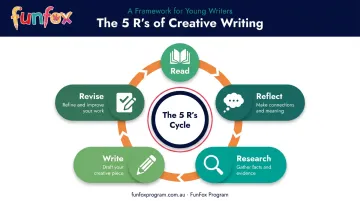
The 5 R's is a framework — originally developed by Lee Gutkind for creative nonfiction writing — that has been adapted broadly as a useful cycle for writers at any level. Each stage builds on the last: read, reflect, research, write, then revise.
Read
Reading widely is foundational. Writers who read encounter different voices, structures, rhythms, and styles — and absorb them without even realising it. Encourage beginners to read across genres and notice what they enjoy. What made that story exciting? How did the author describe that setting?
Reflect
Reflection means pausing before writing to think deeply about an experience, emotion, or observation. The details that make writing feel genuine and alive almost always come from real feelings and real moments. Ask: What do I actually remember? What did it feel like?
Research
Even fiction writers research. A story set in ancient Egypt needs accurate details. A character who is a baker should know what baking smells like. For young writers, "research" can be as simple as:
- Asking questions about an unfamiliar topic
- Observing their surroundings carefully
- Talking to someone with firsthand experience
Write
Write
Start. Imperfect first drafts are not just normal — they're necessary. A useful entry technique is freewriting: set a timer for 10 minutes and write without stopping, editing, or deleting. The goal isn't polish. The goal is to get ideas onto the page so there's something to work with.
Revise
Revision is where writing genuinely improves. Coming back to a draft with fresh eyes — checking for clarity, vivid language, and flow — turns a rough idea into something worth sharing.
It helps to keep two goals separate:
- Revising: rethinking the writing itself (structure, ideas, word choices)
- Proofreading: fixing surface errors (spelling, punctuation, grammar)
The Creative Writing Process: From Blank Page to Finished Piece
Creative writing follows a process: Brainstorm → Draft → Revise → Share. Most writers loop back — jumping from drafting to brainstorming or revising back to drafting again — and that's expected.
Brainstorm and Plan
Good brainstorming removes the pressure of the blank page. Try:
- Generating three "What if?" questions and picking the most interesting one
- Drawing a quick story map — just a beginning, middle, and end in rough boxes
- Listing five settings you find interesting and five characters you'd want to spend time with
- Writing down one strong memory and asking what it made you feel
None of this needs to be neat. Pick whatever sparks something and go from there.
Draft Without Fear
First drafts are meant to be imperfect. Set a timer for 10 minutes and write without stopping — don't delete, don't edit, don't judge. Just keep moving forward.
This is called a freewrite — one of the most reliable ways to break through when you're stuck. Most writers find that once they start, the ideas come faster than expected.
Revise and Get Feedback
Before revising, take a short break — even an hour helps you see your work more clearly. Then work through a simple checklist:
- Does the story have a clear beginning, middle, and end?
- Are there any sensory details?
- Does the dialogue sound natural if read aloud?
- Can a reader picture the setting?
- Is there a moment where the character faces a problem or decision?
Sharing work with a trusted reader — a parent, teacher, or friend — and asking specific questions ("Was there any part that confused you?" or "Which moment was your favourite?") gives much more useful feedback than a general "what do you think?"
How to Build a Regular Creative Writing Practice
Like any skill, creative writing improves with consistent, low-pressure practice. The habits don't need to be demanding to work.
Simple habits beginners can build:
- Keep a writing journal and add to it a few times a week
- Respond to one "What if?" prompt per day — just a paragraph is enough
- Describe one thing you observed using sensory language (a meal, a walk, a conversation)
- Reread something you wrote a week ago and change one thing you'd do differently
Reading and writing reinforce each other. The National Literacy Trust's survey of 39,411 students aged 8–18 found a meaningful positive relationship between reading and writing enjoyment — and found that 23.2% of students who enjoyed writing wrote above the expected level for their age, compared with just 3.2% of those who didn't enjoy writing.
Encouraging children to read widely across picture books, chapter books, and poetry builds the instincts that make writing stronger.
For children who want structured, guided support, FunFox's Writers Club is designed specifically for primary school students aged 6–12 (Years 2–6). Weekly 60-minute live online sessions, capped at six students per class, give children the chance to practise these techniques in a small, encouraging environment with teachers trained to build both creative confidence and real writing skill. The program's goal is students who write well and want to keep writing.
Frequently Asked Questions
What are the techniques used in creative writing?
The most widely used techniques include show, don't tell; sensory details; dialogue; symbolism; and narrative perspective. Beginners can start with just one or two — sensory details and show, don't tell are the most immediately approachable.
What are the 7 types of creative writing?
The seven main forms are fiction/short stories, poetry, personal narrative/memoir, drama/scripts, flash fiction, journaling, and descriptive writing. Each serves a different purpose — journaling is great for low-stakes daily practice, while fiction and poetry are the most common forms taught in school.
What are the 5 R's of creative writing?
The 5 R's — Read, Reflect, Research, wRite, Revise — form a cycle that guides writers from inspiration through to a finished piece. Originally developed for creative nonfiction, the framework now applies across all writing forms as a practical process guide.
How do I start creative writing as a beginner?
Pick one "What if?" question, set a timer for 10 minutes, and write without editing. Don't worry about whether it's good — no first draft needs to be. Getting words on the page is the only goal at the start.
What is the difference between creative writing and other types of writing?
Creative writing is expressive, imaginative, and voice-driven: it prioritises emotion and storytelling. Functional or academic writing is informational, structured, and objective. The same person can do both well, but they serve different purposes and use different instincts.
How can children improve their creative writing skills?
Regular reading, keeping a writing journal, practising sensory descriptions, using story prompts, and receiving guided feedback all help. Consistent practice matters most — even 10 minutes of writing a day builds vocabulary, fluency, and confidence over a school term.