Introduction
Picture this: your Year 1 child has just spent 20 minutes telling you everything they know about sharks — teeth count, hunting habits, how they breathe. They're animated, detailed, confident. Then you sit them down to write three facts, and suddenly they're staring at a blank page.
That gap between knowing and writing is completely normal at this age. Informative writing requires children to organise thoughts, form sentences, apply punctuation, and sequence ideas — all at once. It's a lot to manage for a six-year-old.
Under the Australian Curriculum Version 9.0, Year 1 students are expected to produce short texts that report on a topic, using simple sentences and basic punctuation. This isn't about polished essays — it's about building the foundation for clear, factual communication.
This guide covers what informative writing actually looks like at Year 1, what the curriculum expects, how the structure works, and practical ways to support your child at home.
Key Takeaways
- Informative writing in Year 1 means short, factual texts — not formal reports
- The Australian Curriculum (AC9E1LY06) expects simple sentences, topic vocabulary, and basic punctuation
- Every Year 1 informative piece follows a simple three-part structure
- Talking through ideas aloud before writing helps young learners produce stronger sentences
- Regular, low-pressure practice at home builds confidence and skill over time
What Is Informative Writing in Year 1?
Informative writing is non-fiction writing whose job is to share facts. It's different from narrative writing (which tells a story with characters and a plot) and opinion writing (which shares what someone thinks or feels). Year 1 students learn all three types at the same time, so distinguishing between them early matters.
At Year 1 level, informative writing looks nothing like a formal report. Think short, factual sentences about a familiar topic — animals, weather, space — supported by simple illustrations and labels.
What the Australian Curriculum Actually Requires
Australian Curriculum v9.0 content descriptor AC9E1LY06 states that Year 1 students should "create and re-read to edit short written and/or multimodal texts to report on a topic, express an opinion or recount a real or imagined event, using grammatically correct simple sentences, some topic-specific vocabulary, sentence boundary punctuation and correct spelling of some one- and two-syllable words."
That's the benchmark: short texts, simple sentences, a clear topic focus. Not paragraphs, not structured essays.
The SCSA definition of informative texts describes them as texts whose primary purpose is to provide information — including descriptions, explanations, and reports. At Year 1, this translates to: pick a topic, tell the reader something true about it, wrap it up.
Three curriculum codes connect directly to this work:
- AC9E1LY01 — identifying features of different text types and their purposes
- AC9E1LA03 — exploring how texts are organised according to purpose (inform, recount, narrate, explain)
- AC9E1LY06 — creating short texts to report on a topic
What Are Year 1 Writing Expectations in Australia?
By the end of Year 1, most children can:
- Write simple complete sentences with capital letters and full stops
- Use some topic-specific vocabulary
- Produce short texts across different types (informative, narrative, opinion)
- Spell many common one- and two-syllable words
- Include a small number of details from topics they've learned or discussed
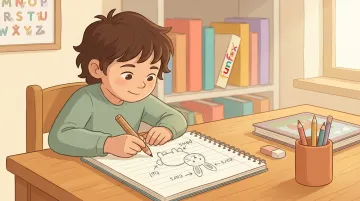
For informative writing specifically, the expectation is straightforward: name a topic, supply two to three facts, and provide a simple closing. ACARA's Year 1 satisfactory portfolio includes a sample called "Information text: Koalas" where students read informative texts, listed facts in pairs, then wrote a short piece with a labelled illustration — that's the real-world benchmark.
Writing Ability Varies Widely — And That's Expected
There is a wide spread of writing ability in any Year 1 class, and that's completely normal. Some children will write one sentence per fact. Others will extend with an extra detail or two. Both are appropriate responses to the task. Parents should avoid comparing their child to an imagined "Year 1 standard" and instead look for logical sequencing and basic sentence structure — those are the genuine markers of development at this stage.
The Key Building Blocks of Year 1 Informative Writing
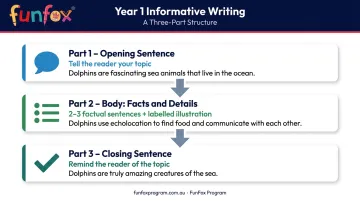
Every informative text at Year 1 — no matter how short — has three core parts. Think of writing about penguins: you'd start by telling the reader what you're writing about, share a few facts, then wrap it up. That's the whole structure.
Opening Sentence (Topic Introduction)
The opening sentence tells the reader what the piece is about. For young writers, a blank page is intimidating. Sentence starters remove that barrier entirely.
Try these scaffolds at home:
- "Did you know that penguins are birds?"
- "Let me tell you about penguins."
- "There is a lot to learn about penguins."
Any of these gives the child a running start without dictating what they say next.
Body: Facts and Details
This is where children write two to three factual sentences about their topic. The critical skill to build here is understanding the difference between a fact and an opinion.
A quick, child-friendly way to explain it:
| Type | Example |
|---|---|
| Fact | Dogs have four legs. |
| Opinion | Dogs are the best pets. |
A fact can be checked and proven. An opinion is what someone thinks or feels. ABC Education's interactive fact vs. opinion lesson uses exactly this kind of language and is free to access.
At Year 1 level, a labelled illustration counts as part of the informative text — the Australian Curriculum explicitly notes that informative texts may include words, illustrations, and diagrams. Children who are still building writing stamina can express plenty of information through a well-labelled drawing.
Closing Sentence
The closing sentence signals that the piece is finished and reminds the reader of the topic. Sentence starters work just as well here:
- "Now you know about penguins."
- "I hope you learned something about penguins."
- "Penguins are birds that live in cold places."
The goal is simple: the child learns that a piece of writing has a deliberate ending, not one that just trails off.
How to Support Informative Writing Practice at Home
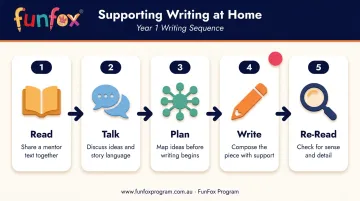
The most effective home support sequence — backed by writing research from IES What Works Clearinghouse and confirmed in ACARA's own Year 1 sample tasks — follows this order: read, talk, plan, write, re-read.
Read Nonfiction First
Before your child writes a single word, read informative texts together. Simple nonfiction picture books about animals, weather, insects, or space build an instinct for how informative writing sounds and feels. Your local library is a good starting point. Free online options include:
- ABC Education (abc.net.au/education) — free, mapped to the Australian Curriculum
- National Geographic Kids (kids.nationalgeographic.com) — animal facts, science topics, great for browsing
- Reading Eggs — offers over 4,000 fiction and nonfiction e-books for reading ages 5–12, with a 30-day free trial
Talk Through Facts Before Writing
Ask your child to tell you their facts out loud before picking up a pencil. This "oral rehearsal" strategy works particularly well for Year 1 students because it separates the composing step from the transcribing step — they're not trying to think of what to say and write it down simultaneously.
Once they've said it clearly, writing it becomes much easier.
Use a Simple Graphic Organiser
Before drafting, have your child fill in a basic "web" or "tree map." The topic goes in the centre; three branches hold key facts. Children should write keywords or draw quick sketches on the organiser — not full sentences. Research from Reading Rockets confirms that graphic organisers help students organise ideas and break writing into manageable steps, which is especially important for young writers managing multiple cognitive demands at once.
Model Writing Together
Sit beside your child and write a short informative piece together about something they love — a favourite animal, a recent trip, their pet. Think aloud as you choose facts, form sentences, and write the closing. This removes the anxiety of independent writing and shows the whole process in action. You're not doing it for them — you're showing them what the thinking looks like.
Consider Structured Expert Guidance
For parents who want curriculum-aligned support beyond what's manageable at home, FunFox's Foundation Club is designed specifically for Year 1 and Year 2 students. It's a hybrid program combining structured writing instruction with guided reading, running as small-group online sessions (maximum six students) each week.
Term 4 dedicates explicit attention to informative writing — organising facts for report and explanatory writing — with personalised teacher feedback provided on independent tasks via Seesaw. The small class size means teachers can respond to each child's actual needs, not a class average.
Engaging Informative Writing Activities for Year 1
Three Practical At-Home Activities
1. "All About My [Topic]" Mini-Book Fold three sheets of paper in half to create a booklet. Each page gets one fact plus an illustration. The cover names the topic; the last page has a closing sentence. This activity reinforces the three-part structure in a hands-on format that feels more like making than writing.
2. Fact vs. Opinion Sorting Cards Write simple statements on index cards — mix facts ("A cat has four legs") with opinions ("Cats are better than dogs") — and have your child sort them into two piles. It also works well as a dinner-table game played orally. This builds the fact/opinion distinction that keeps informative writing accurate.
3. "Teach a Family Member" Report Your child picks a topic they know well and writes a short report to teach a parent, grandparent, or sibling something new. The audience motivation is powerful — children write more carefully when they know a real person will read it.
Free Worksheet Resources
These Australian Curriculum-aligned platforms offer graphic organisers, sentence starters, and writing templates for Year 1:
- Teach Starter (teachstarter.com/au) — Year 1 informative writing and information report collections, including animal research booklets and differentiated graphic organisers
- NSW Department of Education English K–2 Units (education.nsw.gov.au) — free curriculum support for planning and programming English K–6
- Twinkl Australia (twinkl.com.au) — extensive range of Year 1 writing scaffolds, sentence starter cards, and curriculum-linked templates
Digital Resources Worth Exploring
These tools work best alongside structured writing practice — useful for sparking interest, not replacing it:
- ABC Education — free, curriculum-linked interactive resources including fact vs. opinion activities
- Britannica Kids (kids.britannica.com) — age-appropriate articles at different reading levels; offers a 7-day free trial for premium access
- National Geographic Kids — animal and science topic pages work well as "research" sources for mini-book activities
Frequently Asked Questions
What is informative writing in 1st grade?
Informative writing (also called informational or expository writing) is non-fiction writing where children share factual information about a topic. In Year 1, this means short texts with a topic introduction, two to three facts, and a closing sentence — supported by illustrations.
What should a Year 1 be able to write?
By the end of Year 1, most children can write simple sentences with basic punctuation and produce short texts across informative, narrative, and opinion genres. Ability varies widely at this stage, and that's completely normal.
What topics are good for informative writing in Year 1?
High-interest, familiar topics work best — animals, weather, space, insects, plants, and community helpers. Children write most confidently about subjects they already know something about or have recently explored through reading, conversation, or a school excursion.
How is informative writing different from narrative writing in Year 1?
Informative writing presents facts to teach the reader something; narrative writing tells a story with characters, a setting, and a plot. Both use complete sentences and basic punctuation, but their purpose and structure are distinct.
How can parents help with informative writing at home?
Read nonfiction books together first, use a simple graphic organiser for planning, model writing alongside your child, and encourage oral rehearsal of facts before writing. Even five minutes of relaxed writing practice a few times a week builds more confidence than an occasional intensive session.