Introduction
Many parents notice the same thing around Year 6: their child reads fluently, gets through books without difficulty, yet stumbles when asked "what was the author trying to show?" or "why do you think the character made that choice?"
That gap — between decoding words and actually processing meaning — is a reading comprehension gap, and it catches more families off guard than you'd expect.
Closing that gap matters more in Year 6 than at any earlier stage. It's the final year of primary school, and the skills students build now — inference, critical thinking, thematic analysis — underpin every subject in high school, not just English.
This guide covers:
- The core comprehension skills expected under the Australian Curriculum v9.0 at Year 6 level
- The text types students should be reading
- Practical home activities that genuinely build skill
- How to tell if your child needs extra support
Key Takeaways
- Year 6 comprehension goes far beyond word reading — it requires inference, summarising, and literary analysis
- The Australian Curriculum requires students to build both literal and inferred meaning across diverse text types
- Simple home habits like open-ended questioning during reading noticeably strengthen comprehension skills
- Fluent word reading does not guarantee strong comprehension; decoding and understanding are separate skills
- Structured programs combining discussion and guided questioning produce stronger results than worksheets alone
What Year 6 Reading Comprehension Actually Involves
At Year 6, reading comprehension means far more than decoding words. Students are expected to understand what's directly stated, interpret what's implied, and respond to a text's meaning with evidence and reasoning.
Year 6 marks a genuine shift in what's expected. Students are no longer just reading for information. They're expected to analyse language choices, identify themes, and compare ideas across different texts — with a clear sense of why an author made specific decisions.
What the Australian Curriculum Requires
Under Australian Curriculum v9.0, the key comprehension descriptor for Year 6 (AC9E6LY05) requires students to use strategies including visualising, predicting, connecting, summarising, monitoring, and questioning to build both literal and inferred meaning, and to compare content from a variety of sources.
Other Year 6 descriptors add further expectations:
- AC9E6LA08 — authors' use of figurative language including metaphors, similes, personification, idioms, and hyperbole
- AC9E6LE02 — identifying themes, similarities, and differences across literary texts
- AC9E6LY03 — analysing how text structures and language features work together to meet a text's purpose
These expectations go well beyond basic retrieval. Students who haven't practised inference, language analysis, and cross-text comparison will find this level genuinely challenging — which is exactly what the activities and resources below are designed to address.
Core Reading Comprehension Skills Every Year 6 Student Needs
Retrieval and Literal Comprehension
This is the foundation. Students locate information directly stated in a text — who, what, when, where. At Year 6, students must support every answer with evidence from the text — not prior knowledge or guesswork.
Inference — The Hardest Skill
Inference requires students to combine text clues with their own knowledge to reach conclusions not explicitly stated. That includes a character's motivation, the emotional tone of a scene, or the implied meaning of a phrase.
It's consistently the most underdeveloped skill at this level. Students who struggle here often perform well on retrieval tasks but lose marks the moment a question asks "why" or "how do you know." Targeted practice with these question types makes the biggest difference.
Prediction, Summarising, and Connecting
The curriculum names all three as distinct strategies:
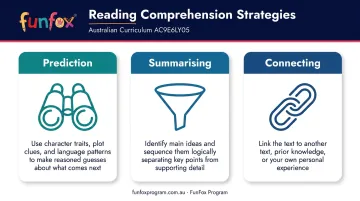
- Prediction — using character traits, plot clues, and language choices to make reasoned guesses about what happens next
- Summarising — identifying the main ideas and retelling them in logical order, distinguishing key points from supporting details
- Connecting — linking what they're reading to another text, prior knowledge, or personal experience
Themes, Figurative Language, and Author's Purpose
Year 6 students are expected to:
- Identify themes such as friendship, courage, or injustice
- Recognise and explain figurative language: similes, metaphors, personification, hyperbole
- Explain why an author chose specific words or structures to create an effect on the reader
None of these skills develop automatically from reading volume. Without direct instruction on how to analyse language and identify authorial intent, most students default to surface-level responses — even when they're strong readers.
Text Types Year 6 Students Should Be Reading
The Australian Curriculum groups Year 6 reading into broad categories: texts that inform, influence, and engage audiences, plus literary texts and multimodal and digital texts.
In practice, this means students need regular exposure to:
| Text Category | Examples | Purpose |
|---|---|---|
| Literary / Narrative | Novels, short stories, myths, plays | Explore experience, character, and themes |
| Poetry | Classic and contemporary poems | Figurative language, rhythm, compressed meaning |
| Informative | Information reports, explanations, biographies | Building and conveying knowledge |
| Persuasive | Opinion articles, arguments | Influencing the reader's thinking |
| Digital / Multimodal | Online articles, infographics, media texts | Reading across formats and sources |
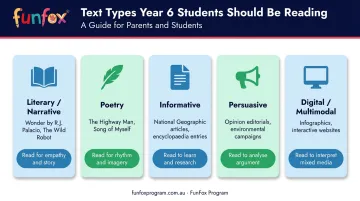
Each of these text types builds a different set of comprehension skills — and that balance matters at home just as much as it does in the classroom.
The most common gap: reading only fiction. A child who reads novels exclusively may be well-practised in narrative comprehension but struggle with the structural features of explanatory or persuasive texts. Both text types appear heavily in high school assessments.
If your child loves fiction, try introducing non-fiction on a topic they're genuinely curious about — sport, animals, history, science. That curiosity makes the harder reading feel worthwhile.
Practical Activities to Build Reading Comprehension at Home
You don't need specialist training to support comprehension at home. These strategies are grounded in how comprehension actually develops — through active engagement with text, not passive reading.
The Stop and Question Method
Pause during shared reading and ask open-ended questions that mirror what's assessed at school:
- "Why do you think the character made that choice?"
- "What does this line tell us about how the author wants us to feel?"
- "What do you think will happen next — what clues are you using?"
Questions starting with "what," "how," and "why" prompt fuller responses than yes/no questions. This mirrors the questioning approach used in Australian primary classrooms to develop deeper reading habits.
Retelling in One Paragraph
After a chapter or article, ask your child to give a 3–5 sentence summary — spoken or written. The goal is identifying what matters most, not retelling every detail. This builds the summarising skill directly assessed in Year 6 comprehension tasks.
Figurative Language Hunting
Figurative language is tested explicitly in Year 6 assessments, so spotting it in everyday reading pays off. While reading together, challenge your child to find an example, then work through three quick questions:
- What device is it?
- What does it mean literally?
- Why might the author have used it instead of plain language?
This three-step analysis is exactly what Year 6 assessments ask for.
Text-to-Text and Text-to-World Connections
Ask your child to connect what they're reading to another book, a news story, or something from their own life. This "connecting" strategy is explicitly named in AC9E6LY05 and builds the comparative comprehension expected at Year 6.
Reading Response Journals
A reading response journal is one of the simplest tools with an outsized payoff. After reading, your child jots down:
- What they understood
- What confused them
- What the author seemed to be trying to say
- Any words they didn't know
Writing these reflections builds metacognitive awareness: the habit of noticing gaps in understanding rather than reading past them. Research consistently links this skill to measurable gains in reading comprehension.
How to Spot If Your Child Is Struggling
The Warning Signs
Watch for these patterns:
- Reads words aloud accurately but cannot answer questions about the text
- Struggles to summarise a passage in their own words
- Interprets everything literally and misses implied meaning
- Avoids reading tasks or claims texts are "boring" when the real difficulty is comprehension
Decoding vs. Comprehension — Know the Difference
Here's how to tell them apart:
- A decoding problem means the child struggles to read the words themselves — they may sound out slowly, skip words, or mispronounce frequently
- A comprehension problem means the child reads fluently but doesn't process meaning — they can read the words aloud without understanding them
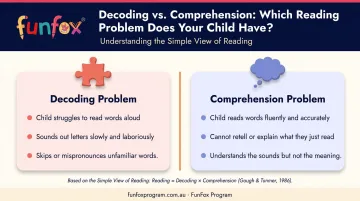
Research on the Simple View of Reading explains this clearly: reading comprehension depends on both decoding ability and language comprehension, and a weakness in either one will undermine overall reading.
A child described as a "poor comprehender" by researchers may decode perfectly well but still struggle with inference, vocabulary, narrative understanding, and connecting ideas.
Don't wait for a formal assessment. If you're noticing these signs in Term 1 or 2 of Year 6, there's still real time to build comprehension skills before high school, where students are expected to read independently across every subject.
Reading Comprehension Resources and Tools for Year 6
What to Look For in Any Resource
The strongest evidence for what works in upper primary comprehension comes from AERO's explicit instruction guidance and the Education Endowment Foundation's Key Stage 2 literacy research — both point to the same conclusion: modelling, guided practice, discussion, and feedback outperform isolated practice tasks.
A good Year 6 comprehension resource should:
- Include a mix of literal and inferential questions (not just surface-level retrieval)
- Use texts slightly above the child's comfort zone to create meaningful stretch
- Prompt explanation, not just answers — "how do you know?" matters as much as "what happened?"
- Cover a variety of text types, not just narrative fiction
Worksheets — Useful, but Limited
Comprehension worksheets have their place, particularly for practising specific question types. But as literacy expert Tim Shanahan notes, question-and-answer sessions often function more as assessment than actual instruction — practice with formats doesn't automatically transfer to stronger reading comprehension.
Worksheets work best as preparation for, or reflection after, guided discussion. They're a tool, not a program on their own.
Guided Reading Programs
For children who struggle specifically with inference, thematic analysis, or reading more complex texts, a small-group or one-on-one guided reading program provides the structured support that worksheets can't.
FunFox Program's Readers Club runs live online sessions for students in Years 3–8, with groups capped at 3–6 students. Each 60-minute weekly session covers:
- Fiction, non-fiction, and poetry texts chosen to stretch Year 6 readers
- Explicit strategy teaching: inference, skimming and scanning, literary analysis, and thematic interpretation
- Discussion-based comprehension that mirrors Australian Curriculum expectations
End-of-term parent-teacher meetings give families a clear picture of where their child is progressing and where extra attention is needed.
Signs a Resource Is Actually Building Comprehension
A few practical checks:
- Can your child explain why their answer is correct, not just state it?
- Are they improving on inference questions, not just retrieval?
- Do they engage with the material, or do they rush to finish?
- Is the text variety broad enough to build flexible comprehension across formats?
If the answer to most of these is yes after 4–6 weeks, the resource is doing its job.
Frequently Asked Questions
What reading comprehension skills should Year 6 students have?
Under the Australian Curriculum v9.0, Year 6 students are expected to build literal and inferred meaning using strategies including retrieval, inference, prediction, connecting, summarising, and questioning. They should also identify themes, recognise figurative language, and explain how authors use language choices to create effects on the reader.
How can I help my child improve reading comprehension at home?
Read together regularly and ask open-ended questions during and after reading, such as "why," "how," and "what do you think?" Encouraging a variety of text types beyond fiction also makes a real difference — non-fiction, poetry, and digital articles all build different comprehension muscles.
What types of texts should Year 6 students be reading?
Both fiction (novels, short stories, poetry, plays) and non-fiction (information reports, persuasive texts, biographies, digital articles). Text variety matters because students who read only one genre often struggle when they encounter unfamiliar formats in class or exams.
How do I know if my child is struggling with reading comprehension specifically?
The key signal is a mismatch: fluent word reading but an inability to summarise, answer inference questions, or explain what a text was about. This is different from a decoding problem, where the child struggles with the words themselves. A comprehension gap requires different support than a phonics or fluency gap.
What is the difference between retrieval and inference in reading?
Retrieval means finding information that is directly stated in the text — the answer is right there on the page. Inference means reading between the lines to understand meaning that is implied but not written explicitly, such as a character's feelings based on their actions or the mood suggested by a setting description.
Are reading comprehension worksheets enough to improve Year 6 skills?
Worksheets are useful for practising specific question types but shouldn't be the whole program. The strongest gains come from combining structured practice with discussion, guided questioning, and exposure to a wide range of real texts.