
Introduction
Picture this: a student closes a book they genuinely enjoyed, sits down to write about it, and freezes. They know what happened in the story. They just don't know how to turn that into an essay.
That's exactly where a literary analysis essay outline becomes useful.
A literary analysis essay examines how an author uses literary devices to convey meaning. It's not a plot summary or book report — it argues why specific authorial choices matter and what effect those choices have on the reader.
This guide covers what a literary analysis essay outline is, what it must include, how to build one in five steps, and a sample outline for reference.
Key Takeaways
- A literary analysis essay outline is a planning tool that organises your argument, evidence, and structure before writing begins.
- Every outline needs three core sections: an introduction (with thesis), body paragraphs (with evidence and analysis), and a conclusion.
- The thesis statement is a debatable claim about how the author achieves something — and every other part of the outline supports it.
- Close reading comes before outlining; without it, there's nothing analytical to say.
- A solid outline prevents the most common pitfalls: retelling the plot, unsupported claims, and losing focus mid-essay.
What Is a Literary Analysis Essay Outline?
A literary analysis essay outline is the structural blueprint you build before you start writing.
It maps out the argument, evidence, and flow in advance — not the essay itself, and not a chapter-by-chapter summary of the text.
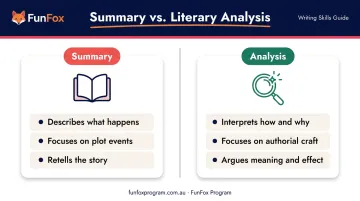
Analysis vs. Summary
This distinction trips up many younger writers. Here's the difference:
- Summary describes what happens: "The character moves away and loses contact with her friend."
- Analysis interprets how and why: "The author uses physical distance as a metaphor for emotional disconnection, reinforcing the novel's theme of isolation."
As QCAA's Literature guidance puts it, students should assume their audience already knows the text — the job of the essay is to interpret it, not recount it.
Why Bother Outlining?
An outline does four practical things:
- Saves time during drafting by eliminating dead ends
- Keeps every paragraph connected to the thesis
- Ensures evidence is specific before writing begins
- Reveals gaps in the argument early — when they're easy to fix
What Goes Into a Literary Analysis Essay Outline?
Every literary analysis essay outline has three sections: an introduction, body paragraphs, and a conclusion. Here's what each one contains.
Introduction Section
The introduction block in your outline should note three things:
- A hook — a quote from the text, a provocative question, or a striking observation
- Brief context — the author's name, the work being analysed, and any relevant background
- The thesis statement — the single most important sentence in the entire essay
The thesis is where most students need the most help. A strong literary analysis thesis doesn't describe what a text is about — it makes a debatable claim about how the author uses a specific technique to convey a theme.
Use this formula:
[Author] uses [technique/device] in [Work] to show that [theme/argument].
Weak thesis: "E.B. White uses language in Charlotte's Web." Strong thesis: "E.B. White uses Charlotte's web-spinning as an extended metaphor to show that love expresses itself through selfless action, not words."
The second version names a specific technique, makes a claim, and gives the entire essay direction. As NSW Department of Education's Year 7–10 writing guidance notes, a thesis acts as a roadmap — defining the argument before a single body paragraph is written.
Body Paragraphs Section
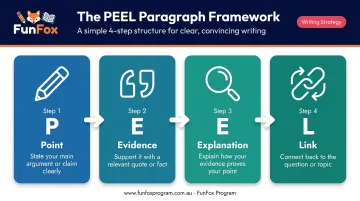
Each body paragraph in the outline maps to one supporting argument. Without a clear structure, body paragraphs tend to drift. The PEEL framework keeps each paragraph focused and tied back to your thesis:
- Point — the specific argument this paragraph advances
- Evidence — a direct quote or passage that supports that argument
- Explanation — why that evidence matters and what it reveals
- Link — how this paragraph connects back to the overall thesis
For each body paragraph in the outline, note the topic sentence, which piece of textual evidence you'll use, and a brief explanation of how it supports your argument. Dot points work well at this stage — full sentences come later.
Conclusion Section
The conclusion block needs three notes:
- A restatement of the thesis in new words (not a copy-paste)
- A brief synthesis of the main arguments — pulling them together, not just listing them again
- A closing thought on the wider significance of the analysis
How to Create a Literary Analysis Essay Outline: Step by Step
This is a five-step process. Each step feeds directly into the next.
Step 1: Read the Text Closely
Close reading means reading with an analytical lens — actively looking for patterns, language choices, and literary devices. Useful devices to watch for include:
- Metaphor, simile, and imagery
- Symbolism and motifs
- Tone and narrative voice
- Structure and perspective
Annotate as you go. Sticky notes, margin comments, or a reading journal all work. Ask yourself: What's interesting, surprising, or unusual here — and why might the author have chosen this?
Step 2: Identify a Focus and Develop a Thesis
After close reading, choose one clear interpretive focus. How does a character change? How does symbolism reinforce a theme? How does structure affect meaning?
Then sharpen your observation into a thesis:
| Draft Version | Problem | Improved Version |
|---|---|---|
| "The author uses symbolism." | Too vague — says nothing about meaning | "The author uses the recurring image of locked doors to show that grief, left unspoken, becomes its own kind of prison." |
A workable thesis is specific enough that someone could reasonably argue against it.
Step 3: Choose Your Main Arguments and Find Evidence
Identify 2–3 key arguments that support your thesis, then find specific textual evidence for each — a quote, passage, or scene that backs it up. Each argument becomes one body paragraph.
Two rules to keep in mind:
- Arguments must be analytical, not just descriptive
- Every claim needs at least one piece of evidence
Step 4: Organise and Draft the Outline
With your arguments and evidence in hand, translate everything into a formatted outline. Bullet points are fine — no need for full sentences.
Structure:
- Introduction: Hook + context + thesis
- Body Paragraph 1: Topic sentence + evidence + analysis note + link to thesis
- Body paragraphs 2 and 3: Repeat the same structure, one new argument each
- Conclusion: Thesis restatement + synthesis + significance
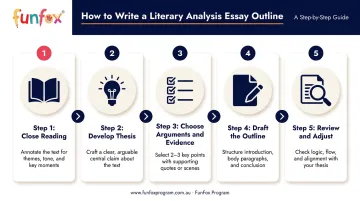
Step 5: Review and Adjust Before Writing
The outline is only useful if it's solid. Before drafting, run through three quick checks:
- Does every body paragraph connect back to the thesis?
- Is the evidence specific enough to support the claim?
- Are the arguments in a logical order?
Catching gaps at the outline stage takes minutes. Finding them mid-draft takes much longer.
Sample Literary Analysis Essay Outline
The following sample outline uses Wonder by R.J. Palacio — a widely read text in Australian upper primary and lower secondary classrooms — as its source text.
Text: Wonder by R.J. Palacio Focus: How Palacio uses shifting narrative perspectives to develop the theme of empathy
INTRODUCTION
- Hook: Open with a question — "What would it mean to truly see someone the way they want to be seen?"
- Context: Wonder (2012) by R.J. Palacio; tells the story of Auggie Pullman, a boy with a facial difference entering mainstream school for the first time
- Thesis: Palacio uses multiple first-person narrators in Wonder to argue that empathy requires active effort — understanding others demands we step outside our own perspective entirely.
BODY PARAGRAPH 1
- Topic sentence: Auggie's first-person narration establishes his internal world, creating immediate reader identification with his experience of exclusion.
- Evidence: Auggie's reflections on "the look" — the involuntary reaction strangers have when they first see his face
- Analysis note: Palacio uses free indirect thought to give readers access to Auggie's emotional responses, making the reader complicit in understanding (and feeling) his isolation
- Link: This grounds the thesis — readers must enter Auggie's perspective to grasp what empathy actually costs
BODY PARAGRAPH 2
- Topic sentence: Via's chapters reframe the central conflict from the perspective of someone who loves Auggie but has learned to be invisible beside him.
- Evidence: Via's observation that she used to be her parents' "Auggie" before her brother was born
- Analysis note: The shift in narrator reveals how empathy within families can be quietly eroded by necessity — Palacio shows empathy as a resource that can be depleted
- Link: Extends the thesis by showing empathy's limits — effort is required to sustain it even among those who love each other
BODY PARAGRAPH 3
- Topic sentence: Jack Will's narrator section is the structural turning point — it shows empathy being chosen deliberately, at personal cost.
- Evidence: Jack's realisation, after Halloween, that he has been performing friendship rather than practising it
- Analysis note: Palacio places this moment of recognition at the structural midpoint of the novel, signalling that genuine empathy requires a conscious decision, not just good intentions
- Link: Completes the thesis argument — empathy is demonstrated as active and effortful across all three narrators
CONCLUSION
- Thesis restatement: Through three distinct narrative voices, Palacio shows that seeing another person clearly is not passive — it takes effort, honesty, and a willingness to feel uncomfortable.
- Synthesis: Each narrator contributes a different dimension of empathy: Auggie shows what it costs to be unseen; Via shows what it costs those closest to him; Jack shows that choosing empathy is a moral act.
- Significance: In a curriculum context where students are asked to interpret authorial intent, Wonder's multi-perspective structure is itself an argument — form mirrors theme.
What Makes This Outline Work
A few things worth noticing:
- The thesis makes a specific claim about HOW Palacio achieves something (through multiple narrators), not just what the book is about. Someone could reasonably argue against it.
- Each topic sentence connects directly to the thesis and introduces a new strand of the argument — not a new plot event.
- The analysis notes explain the author's craft, not just the character's feelings. That's the difference between summary and analysis.
This kind of structured outlining practice — done regularly — is how students develop the critical thinking habits that carry well beyond primary school.
FunFox's Readers Club (Years 3–6) introduces exactly this type of literary analysis work, helping students identify literary devices and move past surface-level comprehension. For Years 7–10, the High School Literacy Club takes it further with explicit essay writing and advanced text analysis.
Common Mistakes Students Make When Outlining a Literary Analysis Essay
Summarising Instead of Analysing
This is the most frequent mistake, and it does the most damage to an essay's quality.
Summary: "Auggie has a hard time fitting in at his new school." Analysis: "Palacio uses Auggie's fragmented social interactions to show that acceptance, unlike tolerance, cannot be performed — it has to be felt."
Every body paragraph should answer: How or why does the author do this? Not: What happens next?
A Thesis That's Too Broad
A thesis like "Shakespeare uses language in Hamlet" is technically true of every piece of writing ever. It can't structure an essay because there's nothing to argue against.
Weak: "Lois Lowry uses language in The Giver to explore the idea of memory." Stronger: "Lowry uses Jonas's growing access to colour as a metaphor for the psychological cost of collective forgetting — showing that a society without pain is also a society without meaning."
The stronger version makes a specific claim about effect. It's debatable. It gives the essay direction.
Skipping the Outline Entirely
Essays written without outlines tend to drift — arguments contradict each other, evidence runs dry mid-paragraph, and conclusions summarise plot instead of synthesising analysis.
Even a rough outline — 10 minutes of organising thoughts before writing — significantly improves the coherence of the final essay. Research cited in Writing Next found that strategy instruction involving planning had an effect size of 0.82 on writing quality for students in Years 4–12.
Planning is not a preliminary step. It's where the essay is built or broken.
Frequently Asked Questions
How do you structure a literary analysis essay?
A literary analysis essay follows a three-part structure: an introduction with a thesis, body paragraphs where each covers one argument supported by textual evidence, and a conclusion that synthesises the analysis. Each body paragraph should address how and why the author made specific choices — not just what happens in the text.
What are the 7 steps of literary analysis?
There's no single official framework, but the curriculum-backed process runs roughly: close reading, identifying literary devices, forming a thesis, gathering evidence, outlining, drafting, and revising. The outline sits in the middle of that sequence — it's where scattered observations become a structured argument.
What is the difference between a literary analysis essay and a book report?
A book report summarises what happens in a text. A literary analysis essay argues how and why the author made specific choices, and what effect those choices have on the reader. The focus shifts from retelling events to interpreting the decisions behind them.
How do you write a thesis statement for a literary analysis essay?
A literary analysis thesis makes a debatable, specific claim — not a plot summary. Use the formula: [Author] uses [technique] in [Work] to show that [theme/argument].
How long should a literary analysis essay outline be?
Not long. A well-structured outline for a standard five-paragraph essay fits on one page — covering the thesis, three argument points with evidence notes, and a conclusion plan. Keep it concise; the outline is a planning tool, not a first draft.
Can you change your outline after you start writing?
Yes. Outlines are working documents. If a new insight emerges mid-draft, adjust the outline — as long as every change still serves the original thesis. A good outline guides the argument; it doesn't lock you into ideas that no longer fit.