Introduction
Picture this: your Grade 4 child sits at the kitchen table, worksheet in front of them, pencil hovering. They have a story somewhere in their head — you can almost see it — but nothing makes it onto the page. This moment is far more common than most parents realise.
Grade 4 is a genuine turning point in writing development. Students are no longer just asked to write sentences or retell events. They're expected to construct purposeful stories with developed characters, a clear narrative arc, and deliberate language choices.
That's a significant leap, and many children struggle to translate a good idea into a shaped, structured story.
Worksheets can help, but not all of them do. A planning frame that scaffolds the thinking without doing the thinking for the child is what actually moves a reluctant writer forward.
This guide covers:
- What narrative writing looks like at Grade 4 level
- The key skills students need to build
- The types of worksheets that genuinely support those skills
- How to use them well at home
- Ready-to-use prompts to get started
Key Takeaways
- Grade 4 students are expected to write structured stories with a clear beginning, middle, and end, including developed characters and a central conflict.
- Worksheets work best when they scaffold the planning process, not replace the creative thinking.
- Planning frames, story arc diagrams, and self-editing checklists each target a different writing skill.
- Pairing worksheets with the right prompts makes practice feel purposeful, not mechanical.
- Short, consistent practice sessions at home, paired with targeted feedback, build writing confidence over time.
What Is Narrative Writing at Grade 4 Level?
ACARA defines a narrative as "a story of events or experiences, real or imagined." For Grade 4 students, that definition starts to carry real weight — because by Year 4, the Australian Curriculum expects students to do considerably more than recount what happened.
Personal vs. Fictional Narrative
Two types of narrative writing are taught at this level, and both matter:
- Personal narrative draws on real experiences — a moment that felt embarrassing, exciting, or surprising. Students have immediate content to work with, which builds confidence.
- Fictional narrative involves invented characters and events. It stretches imagination and demands more deliberate planning, since the student can't rely on memory.
Both are relevant to Australian Curriculum expectations. ACARA content descriptor ACELT1607 specifically requires students to "create literary texts that explore students' own experiences and imagining," meaning neither type should be neglected.
What the Curriculum Actually Expects
Under the Australian Curriculum, Year 4 students are expected to:
- Identify and use the characteristic features of imaginative texts (ACELY1690)
- Plan, draft, and publish imaginative texts with increasing control over text structure and language features (ACELY1694)
- Develop storylines, characters, and settings (ACELT1794)
- Discuss how authors hold readers' interest through character development and plot tension (ACELT1605)
These expectations cover structure, craft, and critical thinking — all at once. Year 4 students don't sit the NAPLAN writing assessment themselves (it falls in Years 3, 5, 7, and 9), but Year 4 sits directly between two assessed years. The skills built now directly shape Year 5 NAPLAN readiness.
Key Narrative Writing Skills Grade 4 Students Need
Most Grade 4 students aren't short on ideas. What they struggle with is structure — knowing how to shape an idea into a story that works. These are the five skills that matter most at this level.
Clear Story Structure
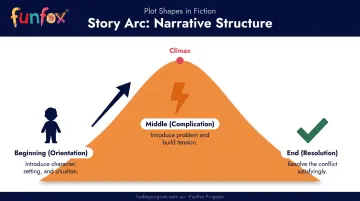
Students need to understand and apply three distinct phases:
- Beginning (orientation): Introduce the character, setting, and situation
- Middle (complication): Introduce the problem and build tension
- End (resolution): Resolve the conflict in a satisfying way
The most common failure pattern? Students write a detailed beginning, rush the middle, and then tack on a one-sentence resolution. Worksheets with a visual story arc or "story mountain" diagram — where students map each phase before writing — directly address this by forcing them to think through the whole story first.
Character Development
Grade 4 students should move beyond naming characters. A well-designed character planning worksheet asks:
- What does your character want?
- What stands in their way?
- How do they feel at the start — and how do they feel at the end?
Answering these questions before writing begins gives students a character who actually does something in the story, rather than just existing in it.
Show, Don't Tell
This is classroom shorthand for a genuine craft skill: instead of writing "she was scared," describe what fear looks like — shaking hands, a dry mouth, the sound of her own heartbeat.
ACARA work samples for Year 4 highlight the use of simile and precise adjectives to convey setting and emotion. Sentence-transformation exercises — "rewrite this sentence to show, not tell" — build this habit without overwhelming students.
Dialogue and Vocabulary
Two skills worth targeting with dedicated worksheets:
- Use dialogue to reveal character and move the story forward. A dialogue-writing frame that covers punctuation of direct speech lets students practise this in isolation before incorporating it into a full draft.
- Upgrade weak word choices — swapping "walked" for "crept," "big" for "towering" — to build the vocabulary habits that make writing vivid.
Types of Narrative Writing Worksheets for Grade 4
The worksheet type should match what the student needs to work on. These four types cover the full writing process.
Story Planning Graphic Organisers
This is the most important worksheet type for Grade 4 — and the most skipped. Research from Reading Rockets describes story maps as graphic organisers that help students learn narrative elements including characters, plot, setting, problem, and solution.
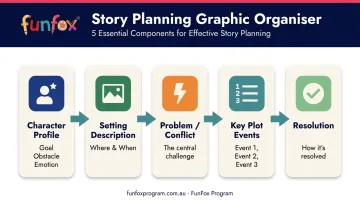
An effective story planning organiser includes:
- Character profile box (name, goal, obstacle, emotion)
- Setting description
- Problem/conflict
- Key plot events (at least three)
- Resolution
Without this step, most Grade 4 students write "and then... and then... and then..." stories that never build tension or reach a satisfying end.
Narrative Prompt Worksheets
These come in two forms:
Personal narrative prompts anchor writing in real emotion. Prompts rooted in feelings — proud, nervous, embarrassed — are more effective than prompts rooted in events, because even children without dramatic life experiences have felt strong emotions. Example: "Write about a time you surprised yourself."
Fictional narrative prompts give students a starting scenario or story problem to solve. The best ones have a built-in mystery or conflict. Examples:
- "You find a mysterious map tucked inside a library book — write the story of where it leads you."
- "A package arrives at your door addressed to someone who doesn't exist."
The best fictional narrative worksheets include a brief planning section built into the sheet, so students can't skip straight to writing.
Story Arc Worksheets
These present a visual framework — often a mountain shape — where students map their story's events before drafting. They work well for students who write linear stories, because the mountain shape makes rising action, a climax, and a falling resolution visible as distinct phases.
Once a student can see their story as a shape, they can start to control its pacing. A good arc worksheet prompts students to name the turning point, not just list events in order.
Self-Editing Checklists
A checklist worksheet gives students specific questions to apply to their finished draft:
- Does my story have a clear problem?
- Did I use at least one piece of dialogue?
- Did I vary my sentence lengths?
- Did I use a strong verb in at least three sentences?
- Does my ending connect back to the beginning?
This builds the habit of reading their own work critically, not just correcting surface errors. The IES guide on teaching elementary writing specifically recommends self-regulated editing strategies as a core way to improve student writing outcomes.
How to Use Narrative Writing Worksheets Effectively
Handing a child a worksheet and walking away is the most common mistake — and it rarely works. Here's what actually helps.
Talk Before You Write
The Education Endowment Foundation recommends that students articulate ideas verbally before the physical act of writing. Ask your child to tell you their story before they write a single word. Can they explain who the character is? What the problem is? How it ends? Gaps in the verbal version will appear in the written version — and it's much easier to fix them before drafting begins.
A Simple Weekly Routine
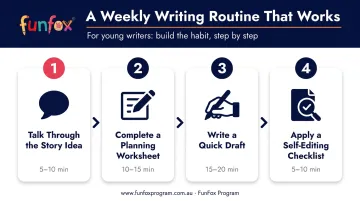
Infrequent marathon sessions don't build writing skill. A short, consistent routine works better:
- Talk through the story idea (5–10 minutes)
- Complete a planning worksheet (10–15 minutes)
- Write a quick draft (15–20 minutes)
- Apply a self-editing checklist (5–10 minutes)
Once a week, consistently. That regularity compounds — which is exactly what the next step depends on.
Ask One Targeted Question
Rather than general encouragement ("that's great!"), ask one specific question after reading your child's draft: "What problem does your character face?" or "Can you tell me more about how your character feels at the end?" Targeted questions develop critical thinking and teach children to assess their own work — which is the actual goal.
When Worksheets Aren't Enough
Worksheets support planning and self-monitoring, but they can't replicate a trained teacher responding in real time to a child's actual writing. If your Grade 4 child consistently struggles to move from planning to a coherent draft, or if their stories lack the craft elements the worksheet is designed to build, structured feedback from an experienced writing teacher can shift the trajectory quickly.
FunFox Program's Writers Club fills that gap directly. In Term 2, the program works through narrative writing specifically — character development, dialogue, and plot structure — in live online groups of no more than six students. Every worksheet gets personalised teacher feedback, so children hear what's working in their story, not just what the prompt asked for.

Grade 4 Narrative Writing Prompts to Pair With Worksheets
Not every prompt sparks the same kind of writing. Matching the right prompt type to the right student — and the right worksheet — makes a real difference in what they produce.
Personal Narrative Prompts
The best personal prompts invite reflection, not just retelling. Choose prompts rooted in emotion:
- Write about a time you made a decision you later regretted.
- Describe the day something didn't go as planned — and what you did next.
- Tell the story of a moment when you surprised yourself.
- Write about a time you felt nervous before something and how it turned out.
- Describe a small moment that felt really important to you at the time.
Fictional Narrative Prompts
Strong fictional prompts give students a tension to explore from the very first sentence:
- A package arrives at your door addressed to someone who doesn't exist.
- Your pet suddenly starts talking — write the first conversation you have.
- You wake up one morning to find your town has completely disappeared.
- You find a mysterious map tucked inside a library book.
- A new student at school knows something about you that you've never told anyone.
Finish-the-Story Prompts
Reluctant writers often struggle most with where to begin. Giving them a first line removes that barrier entirely:
- "She opened the old wooden box and found something that changed everything..."
- "The moment I stepped through the door, I knew something was wrong..."
- "He thought it would be an ordinary Tuesday. It wasn't."
These work best alongside a planning graphic organiser — have students fill in the character, setting, and conflict boxes before they continue writing.
Frequently Asked Questions
What skills should a Grade 4 student have in narrative writing?
Grade 4 students should be able to structure a story with a clear beginning, middle, and end; develop characters through actions, dialogue, and emotions; use descriptive and sensory language; and write for a specific audience and purpose. These expectations align directly with Australian Curriculum Year 4 content descriptors including ACELT1794 and ACELY1694.
What types of narrative writing worksheets are most useful for Grade 4?
The most effective types are story planning graphic organisers, narrative prompt sheets (both personal and fictional), story arc diagrams, and self-editing checklists. Each targets a different stage of the writing process — planning, drafting, and reviewing — so students benefit most from using all four in sequence.
How can I support narrative writing practice at home without being a writing teacher?
Ask your child to tell you their story aloud before they write anything, then use a planning worksheet to capture the key elements. Focus feedback on one or two specific elements — "tell me more about your character's problem" — rather than correcting everything at once. Consistency matters more than session length.
What is the difference between personal narrative and fictional narrative at Grade 4?
Personal narrative draws on real experiences; fictional narrative involves invented characters and events. Both are assessed in the Australian Curriculum, and NAPLAN's narrative writing marking guide covers both story craft and language control — making practice in each type worthwhile.
Why do many Grade 4 students struggle with narrative writing even when they have good ideas?
Most Grade 4 students struggle with structure, not ideas. They skip planning, chain events with "and then... and then..." without building tension, or rush the ending into a single sentence. Worksheets that guide planning before writing give students a roadmap so their ideas land on the page in a shape that actually works.
How does narrative writing connect to the Australian Curriculum for Year 4?
The Australian Curriculum expects Year 4 students to plan, draft, and publish imaginative writing with increasing control over structure and language. Because NAPLAN writing assessments fall in Years 3 and 5, the narrative skills built in Year 4 directly prepare students for their next assessed task.