This is one of the most common sticking points for students in upper primary and secondary school. The good news: a counter argument doesn't weaken your essay. When done properly, it does the opposite. It signals to your reader — and your marker — that you've genuinely thought through the topic from multiple angles.
This guide walks through exactly what a counter argument is, how to write one step by step, the different types you'll encounter, mistakes to avoid, and the phrases that make the whole process much easier.
Key Takeaways
- A counter argument is the opposing viewpoint to your main claim — addressing it strengthens your essay, not weakens it.
- Every counter argument needs three parts: the opposing view, an acknowledgment of its merit, and a rebuttal that reasserts your position.
- Place your counter argument before the conclusion, after the introduction, or within a body paragraph — not in the conclusion.
- Use fair, neutral language when acknowledging the opposing view — it builds credibility with markers.
- Signal phrases like "Some people argue that…" and "However, this overlooks…" keep your counter argument clear and structured.
What Is a Counter Argument in an Essay?
A counter argument is a viewpoint that directly opposes or challenges your essay's main argument — your thesis. The Harvard College Writing Center describes counterarguments as "arguments that your readers could reasonably raise to challenge either your thesis or any of the other claims" in your essay.
You'll also see it called an "opposing view," "opposing claim," or "counterclaim." These all refer to the same thing: the other side of the debate.
Counter Argument vs. Rebuttal — What's the Difference?
Students often confuse these two, but they serve different functions:
- Counter argument: presents the opposing side's position fairly, without dismissing or mocking it
- Rebuttal: your response to that position, explaining why your original argument still holds
One without the other leaves the essay unfinished. Present only the counter argument, and you've handed the reader a reason to disagree with you. Present only the rebuttal without establishing the opposing view first, and the reader has no context for what you're responding to.
Why Does Including One Make Your Essay Stronger?
Voluntarily raising the argument against your own position might seem like a weakness. It isn't. A reader, or a marker, already knows the other side exists. When you acknowledge it first and then explain why your argument holds up anyway, you demonstrate that your position is considered and well-reasoned, not one-sided.
The NAPLAN Persuasive Writing Marking Guide recognises "Some may argue…" as a feature of strong persuasive responses. It supports the overall assessment of ideas, persuasive devices, and text structure.
How to Write a Counter Argument in an Essay: Step by Step
Step 1: Confirm Your Own Thesis First
Before looking at what the other side says, you need a clear thesis of your own. One or two sentences that state your position precisely.
A vague main argument makes it nearly impossible to identify what "opposing" even looks like. Lock in your claim before anything else.
Step 2: Identify the Opposing Viewpoint
Ask yourself: what would a reasonable person who disagrees with me actually argue? What evidence might they use?
The opposing view you choose must be genuine — not a strawman. As the UNC Writing Center explains, a strawman fallacy means setting up a weak, distorted version of the opposing argument and knocking that down instead. Readers who know the topic will notice immediately, and it undermines your credibility faster than any weak evidence could.
Step 3: Present the Counter Argument Fairly
Summarise the opposing view in one or two neutral sentences. No mockery, no dismissiveness — just an honest, objective account of what the other side argues.
Here's what that looks like in practice, using school uniforms as an example:
| Dismissive (avoid this) | Fair (aim for this) |
|---|---|
| "Some people foolishly think uniforms are a problem, but they clearly haven't thought it through." | "Critics argue that school uniforms restrict students' ability to express their individuality and may not reflect the diversity of student backgrounds." |
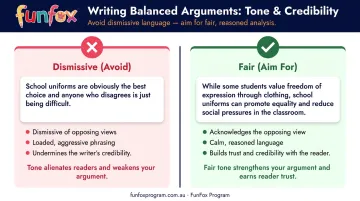
The second version acknowledges a real concern. The first one just antagonises the reader.
Step 4: Write Your Rebuttal
The rebuttal follows directly after the counter argument. It steers the essay back to your original position by doing one of three things:
- Identifying a logical flaw or gap in the opposing evidence
- Providing stronger evidence that outweighs the other side's claim
- Conceding a minor point while demonstrating your main argument still holds
The rebuttal must connect back to your thesis. After reading it, your reader should feel your position has been reinforced — not that you've presented two equal sides and left them to decide.
Where you place this rebuttal in your essay matters just as much as how you write it.
Step 5: Choose Where to Place It
The three most common placements are:
- Before the conclusion — the most common default. Works well for addressing any lingering doubts before you wrap up.
- Right after the introduction — useful when your essay directly challenges an existing argument or policy.
- Within a body paragraph — placed immediately after the specific claim it challenges, for a more integrated approach.
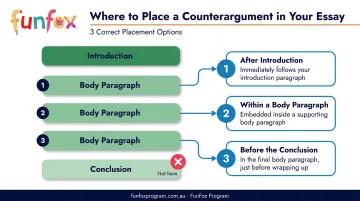
One placement to avoid: the conclusion. There's no space to properly address it there, and it risks leaving readers on an uncertain note rather than a confident one. Harvard's guidance on counterarguments makes this same point explicitly.
FunFox's Writers Club teaches students to practise this kind of structured argumentative writing, building the habits that carry through from upper primary into high school English assessments.
Types of Counter Arguments (With Examples)
Counter arguments don't all look the same. The type you're dealing with depends on where the weakness or tension in your argument lies. Harvard's Writing Center identifies several distinct categories of objections — here's how they map to student writing:
Questioning an Assumption
The opposing view challenges an assumption your argument depends on.
Example: "Schools should use more technology in class." Counter: "This assumes all students have equal access to devices at home — which data shows is not the case for many Australian families."
Conflicting Evidence
The other side cites research or data that appears to contradict your claim. Counter with stronger or more recent evidence — or expose the limitations of theirs.
Highlighting Drawbacks or Consequences
The opposing view accepts your goal but points out a cost or negative outcome.
Example: "Making school lunches free." Counter: "Critics argue schools would face budget shortfalls affecting other programs." Your rebuttal: explain how funding models address this.
Suggesting an Alternative Solution
The other side doesn't dispute the problem — just your proposed fix. Your rebuttal should show why your solution is more practical or effective than theirs.
Here's a quick-reference summary:
| Type | What it challenges | Your rebuttal approach |
|---|---|---|
| Questioning an Assumption | A premise your argument relies on | Show the assumption holds, or adjust your claim |
| Conflicting Evidence | Your data or research | Present stronger evidence or challenge theirs |
| Drawbacks or Consequences | The cost of your proposed outcome | Explain how those costs are managed or outweighed |
| Alternative Solution | Your chosen fix, not the problem itself | Show your solution is more practical or effective |
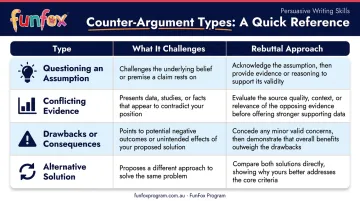
Identifying the type before you write saves you from a generic rebuttal — each calls for a different move.
Common Mistakes to Avoid
Using a Dismissive or Aggressive Tone
Calling the opposing view "ridiculous" or "obviously wrong" immediately weakens your credibility. Markers at every level — from NAPLAN through to high school English — look for fair, considered engagement with other perspectives. NSW Education's definition of argument explicitly notes that argument does not need to be combative. Neutral, respectful language signals maturity — and markers notice the difference.
Misrepresenting the Opposing View
Summarising the counter argument inaccurately — or cherry-picking the weakest version of it — is the strawman fallacy in action. Any reader who knows the topic will lose trust in your essay the moment they spot it. Take the time to understand the opposing view properly before you write about it.
Forgetting to Write the Rebuttal
This happens more often than it should. A student presents the opposing argument clearly, then moves on to the next paragraph without responding to it. The result is an essay that accidentally makes the other side's case for them. Every counter argument must be paired with a rebuttal — no exceptions.
A quick checklist before you submit:
- Avoided dismissive or aggressive language toward the opposing view
- Represented the counter argument accurately and fairly
- Followed every counter argument with a clear rebuttal
Helpful Phrases to Start a Counter Argument
Having the right phrases ready makes the writing process much smoother. Vary these across your essay rather than repeating the same opener — markers notice when every paragraph starts identically.
To introduce the opposing view:
- "Some people argue that…"
- "Critics claim that…"
- "Opponents of this view suggest that…"
- "It is true that…"
- "One common concern is that…"
To signal the rebuttal:
- "However, this overlooks…"
- "While this may be true, it does not account for…"
- "Nevertheless, the evidence shows…"
- "Although this point has merit, it is outweighed by…"
- "This argument falls short because…"
To return to your thesis:
- "For this reason…"
- "This confirms that…"
- "The stronger case, therefore, remains…"
A good rule of thumb: draw from all three categories within a single counter argument paragraph, not just one. Mixing an introduction phrase, a rebuttal signal, and a thesis return phrase gives your paragraph a clear three-part structure. For a broader list of argument transition options, Keys to Literacy's argument transition guide is a practical reference worth bookmarking.
Frequently Asked Questions
Frequently Asked Questions
What is a counter argument in an essay?
A counter argument is the opposing viewpoint to your essay's main claim, included to show you've considered multiple perspectives. When followed by a rebuttal explaining why your argument is stronger, it makes your overall position more persuasive, not less.
How do you start a counter argument in an essay?
Use a signal phrase such as "Some people argue that…" or "Critics claim that…," then summarise the opposing position in one or two sentences. Follow immediately with your rebuttal to maintain the essay's direction.
What is an example of a counter argument in an essay?
Take an essay arguing that homework should be reduced. Counter argument: "Supporters of homework argue it reinforces classroom learning and builds independent study habits." Rebuttal: "However, research suggests excessive homework increases student stress without producing proportional gains in academic outcomes."
Where does a counter argument go in an essay?
The most common placement is the paragraph before the conclusion. It can also appear after the introduction or within a body paragraph directly after the claim it challenges. Avoid placing it in the conclusion — there's no room to address it properly there.
What is the difference between a counter argument and a rebuttal?
The counter argument presents the opposing view; the rebuttal is your response explaining why your original argument is stronger. Both are essential — a counter argument without a rebuttal leaves the essay unbalanced and unconvincing.
Do I need a counter argument in every essay?
Counter arguments are expected in argumentative and persuasive essays, where they demonstrate critical thinking. They're not required in narratives or reflective pieces — check your assignment instructions or ask your teacher if unsure.