Introduction
Think about the last story your child couldn't put down. The moment they gasped at an unexpected twist, or begged for one more chapter at bedtime. None of that happened by accident.
Every moment of tension, wonder, or emotional connection was the result of a deliberate choice the writer made. Those choices have a name: narrative techniques.
The trouble is, most Australian families first encounter these terms on a school assessment — dropped in without much context. Children are asked to "use figurative language" or "create suspense," but rarely does anyone explain what those things actually mean or how to do them.
This guide is for two audiences: parents who want to understand what their children are working towards, and young writers who want real tools they can use straight away. We cover what narrative techniques are, which ones matter most at primary school level, and how to start applying them from the very next draft.
Key Takeaways
- Narrative techniques are deliberate writer choices that shape how a story is experienced (not just what happens in it).
- Techniques fall into six practical categories: setting, plot, character, perspective, style, and theme.
- For primary students, the highest-impact techniques are figurative language, sensory detail, dialogue, and foreshadowing.
- Knowing a technique's name matters less than understanding its effect — that's what assessments actually reward.
- Children build these skills fastest through guided reading, modelling, and structured writing practice, not passive exposure alone.
What Are Narrative Techniques?
Narrative techniques are the deliberate methods a writer uses to communicate meaning, create emotion, and keep a reader engaged. They go by several names — literary devices, language features, narrative devices — and while these terms aren't perfectly interchangeable across every curriculum document, they all refer to the same core idea: purposeful choices a writer makes to shape the reader's experience.
The key word is deliberate. A writer who opens a story with storm clouds isn't just describing the weather — they're building mood, signalling something bad is coming, and pulling the reader in. That's a technique at work.
Elements vs. Techniques
This is where many students (and parents) get confused:
- Narrative elements — character, setting, plot, conflict, theme — are the building blocks present in every story, by default.
- Narrative techniques are the optional, intentional choices a writer makes to develop those elements with skill.
Consider a house: every house has walls, a roof, and a floor (elements). The materials used, the colours chosen, the layout — those are the design decisions (techniques). A story can have all its elements and still fall flat. Techniques are what make it vivid.
The Six Categories of Narrative Techniques
Grouping techniques into categories makes them far easier to learn and apply — especially for children who are encountering them for the first time. Most teaching frameworks, including those aligned to the Australian Curriculum, organise techniques across these six practical categories.
Setting Techniques
Setting becomes a technique when it's used deliberately — not just to tell the reader where the story takes place, but to reflect mood, hint at conflict, or reveal character. A crumbling old house in a mystery signals unease before a single suspicious event has occurred. Used well, setting shapes how readers feel before anything has even happened.
Plot Techniques
Plot techniques control the sequence, pace, and surprise of events. The most commonly taught include:
- Foreshadowing — planting early clues that hint at later events
- Flashback — returning to a past moment that adds context or meaning
- Cliffhanger — leaving a scene unresolved to propel the reader forward
- Plot twist — an unexpected turn that reframes what the reader thought they knew
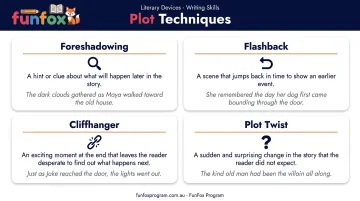
Together, they give writers precise control over when readers feel tense, curious, or surprised.
Character and Perspective Techniques
Character techniques shape how readers understand and connect with the people in a story. Perspective techniques control who tells the story and how much the reader is allowed to know. Key examples:
- First-person narrator — the character speaks as "I," creating intimacy
- Third-person omniscient — an all-knowing narrator outside the story
- Unreliable narrator — a narrator who withholds or distorts information
- Dialogue — revealing personality and relationships through speech
Style and Theme Techniques
Style techniques are the language-level choices that make writing vivid and memorable:
- Simile and metaphor — comparing ideas to create striking images
- Personification — giving human qualities to objects or animals
- Sensory detail — engaging sight, sound, smell, taste, and touch
- Alliteration and onomatopoeia — using sound to reinforce meaning
Theme techniques — such as symbolism, allegory, and motif — carry the story's deeper meaning or moral. The Australian Curriculum introduces style techniques first, making them the first stop for primary school writers learning literary craft.
Essential Narrative Techniques Every Young Writer Should Know
Rather than cataloguing every possible device, this section focuses on the techniques that make the most immediate difference to primary school writing quality — the ones that appear regularly in Australian curriculum tasks and NAPLAN narrative writing.
Foreshadowing
Foreshadowing means placing deliberate clues early in a story that hint at something coming later. It creates a sense of inevitability and rewards attentive readers.
A child-friendly example: a character notices dark clouds gathering on the horizon before something goes wrong. Readers feel the dread building before anything has happened. Even young writers can use this — the trick is to plan the ending first, then write the beginning with that ending in mind.
Narrative Hook and Cliffhanger
A narrative hook is an opening line or scene designed to immediately capture attention and make the reader want more. A cliffhanger does the same job at the end of a chapter — leaving an outcome unresolved so the reader must keep going.
Both techniques manage reader momentum. ReadWriteThink's lesson for Grades 3–5 describes the hook as catching readers in the first few lines — exactly like fishing. These are among the most teachable techniques at primary level because children can practise them as short, standalone exercises.
Figurative Language: Simile, Metaphor, and Personification
These three are the foundation of figurative language instruction in primary school. Each transforms flat description into writing that creates vivid mental images:
- Simile — comparing two things using "like" or "as": Her voice was as sharp as broken glass.
- Metaphor — describing something as if it were something else: The classroom was a zoo.
- Personification — giving human qualities to non-human things: The wind whispered through the trees.
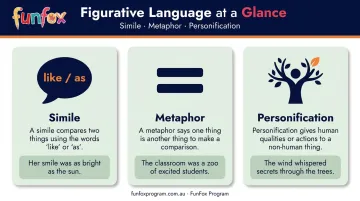
The Australian Curriculum formally introduces these in Year 5, though many children encounter them earlier. NSW Stage 3 resources explicitly name all three as literary devices students should identify and analyse for effect.
Sensory Detail
Descriptive writing uses sensory detail to create strong impressions — engaging sight, sound, touch, smell, and taste rather than simply telling the reader what is happening. The difference between "it was cold outside" and "the air bit at her fingers and the snow crunched under every step" is sensory detail.
Done well, sensory detail pulls readers into the story world — they stop reading about events and start experiencing them. NAPLAN narrative marking criteria reward this directly, awarding higher scores for writing that shows rather than tells.
Dialogue
Dialogue does more than record what characters say. Victorian curriculum guidance notes that dialogue contributes to narrative building and gives insight into characters and relationships. Effective dialogue:
- Reveals personality through word choice and tone
- Drives the plot forward
- Creates a sense of real human interaction
The distinction worth teaching early is between dialogue that moves a story forward and dialogue that stalls it. Getting this right (along with correct punctuation) is often what separates a competent primary school narrative from a strong one.
Symbolism
Symbolism uses an object, colour, or image to represent a larger idea. A broken toy representing a lost friendship. A single candle holding onto its flame in a storm. Children often use symbols naturally without realising it — teaching them to do so intentionally is an intentional craft skill that typically develops from upper primary onwards.
Narrative Structure vs. Narrative Techniques
This is the distinction that confuses students and parents most often.
Narrative structure is the overall framework of a story, the blueprint. Most teachers use Freytag's Pyramid: exposition, rising action, climax, falling action, and resolution. ReadWriteThink's plot diagram traces this model directly back to Gustav Freytag's modification of Aristotle's original framework.
Narrative techniques are the individual choices made within that framework. Think: a cliffhanger at the end of a chapter, a metaphor that captures a character's grief, or storm clouds in chapter one that signal trouble ahead.
A useful way to explain this to children: structure is the blueprint of a house — it tells you where the walls, rooms, and doors go. Techniques are the materials and design choices that make it distinctive.
The 7 Core Elements of Narrative
Teachers and curricula often refer to seven core elements that every story contains:
- Character
- Setting
- Plot
- Conflict
- Theme
- Point of view
- Narrative voice
These elements are present by default. Techniques are the tools used to develop them with intentionality. Structure helps a writer plan a story that makes sense. Techniques help them write a story that engages, surprises, and resonates. Both are needed — one without the other produces writing that is either well-organised but flat, or creative but hard to follow.
How to Help Your Child Develop Narrative Technique Skills
Children learn narrative techniques most effectively through a combination of reading as a writer — noticing how published authors make deliberate choices — and writing with structured feedback. Passive reading alone doesn't build technique awareness. Children need to be guided to name what they're noticing and discuss why it works.
The Progression That Works
The Australian Curriculum offers a useful sequence:
- Year 2: Creating characters and settings; experimenting with dialogue
- Year 3: Language devices like rhythm and onomatopoeia
- Year 4: Direct/indirect speech; deliberate word play
- Year 5: Point of view; simile, metaphor, and personification
- Year 6: Analysing how text structures and language features work together
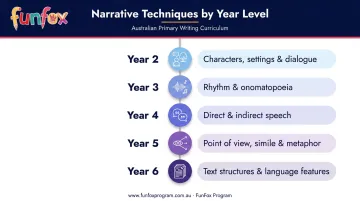
Introduce techniques one at a time, starting with figurative language and sensory detail, then building towards plot techniques like foreshadowing and perspective choices in upper primary.
Practical Strategies for Home
These activities work without any special resources:
- Read a paragraph together from a favourite book and ask: "What did the author do there, and why did it work?"
- Revise rather than rewrite: take a piece your child has already written and add one new technique. Just one.
- Write five different opening lines for the same story and ask which one pulls the reader in hardest. It's a quick way to practise hooks without the pressure of a full draft.
Home practice builds awareness, but children also benefit from structured support where a teacher can respond to their specific writing in real time. The FunFox Writers Club introduces and reinforces narrative techniques progressively within small groups of no more than six students.
Weekly live Zoom sessions, written feedback via Seesaw, and end-of-term parent-teacher meetings give children the personalised response that turns technique awareness into confident, purposeful writing.
Common Misconceptions About Narrative Techniques
More techniques ≠ better writing
Overloading a story with similes, alliteration, and symbols in every sentence makes writing feel forced. The goal is purposeful, selective use: each technique should earn its place by serving the story's meaning or the reader's experience.
Naming a technique is not the same as understanding it
Many students can label a metaphor but cannot explain why the writer chose it or what it achieves. NSW Stage 2 and Stage 3 resources explicitly state that students should identify literary devices and analyse their effect on the reader. In assessments, analysis always requires discussing the effect, not just the name.
Narrative techniques aren't only for fiction
The Australian Curriculum applies language features and literary devices across written, spoken, digital, and multimedia texts. Techniques like sensory detail, narrative hook, and dialogue appear across many text types:
- Memoirs and personal narratives
- Journalism and feature writing
- Speeches and persuasive essays
- Digital and multimedia content
Children who understand these tools write with more control across every text type.
Frequently Asked Questions
What techniques are used in narrative writing?
The main categories are plot techniques (foreshadowing, flashback, cliffhanger), character techniques (dialogue, point of view), style techniques (simile, metaphor, sensory detail), and theme techniques (symbolism, motif). For primary school writers, figurative language and plot techniques tend to have the most immediate impact on writing quality.
What are the 7 elements of narrative writing?
The seven elements are character, setting, plot, conflict, theme, point of view, and narrative voice. These are the building blocks present in every story. Narrative techniques are the deliberate choices writers make to develop these elements with skill and intention.
What is the difference between narrative structure and narrative technique?
Narrative structure is the overall shape of a story — beginning, rising action, climax, falling action, resolution. Narrative techniques are the specific tools used within that structure, such as a cliffhanger to build suspense or a metaphor to convey a character's emotions.
What narrative techniques should primary school students learn first?
Start with figurative language — simile, metaphor, and personification — and sensory detail, as these have the most immediate and visible impact on writing quality. From there, move to plot techniques like foreshadowing and cliffhangers in upper primary.
How do narrative techniques help with reading comprehension?
When children can recognise a technique and understand its intended effect, they read with far greater depth and awareness. This directly improves inference skills and the ability to analyse texts in assessments — capabilities that show up clearly in NAPLAN and school English assessments.
Can narrative techniques be used in non-fiction writing?
Yes. Techniques like sensory detail, dialogue, narrative hook, and foreshadowing appear across non-fiction genres including memoirs, journalism, and personal essays. Children who build these skills in creative writing carry them into persuasive texts, reports, and other genres they encounter throughout school.