This guide covers exactly what a narrative essay is, its five key elements, two original writing samples pitched at different year levels, and a practical step-by-step writing process young writers can actually use.
Key Takeaways:
- A narrative essay tells a story with a clear beginning, middle, and end — plus a personal reflection
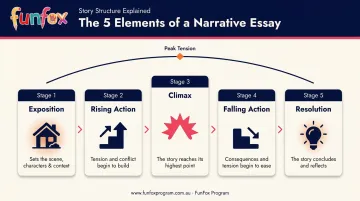
- Strong narratives are built on five elements: exposition, rising action, climax, falling action, and resolution
- The best student essays zoom in on one specific moment rather than trying to cover too much
- Showing detail beats telling emotion — "my hands wouldn't stop shaking" beats "I was nervous"
- Planning before drafting makes a significant difference to the quality of the final piece
What Is a Narrative Essay and Why Does It Matter?
A narrative essay is a structured piece of writing that tells a story (either a true personal experience or an imagined one) from a clear point of view. It has a beginning, a middle, and an end that leads to a reflection or insight. The story moves through time, and by the end, the reader understands something meaningful about what happened.
This sets it apart from the other essay types your child will encounter at school:
- Argumentative essay — defends a claim or position with evidence
- Descriptive essay — paints a detailed picture of a person, place, or thing
- Narrative essay — moves through events and builds toward a meaningful moment or lesson
The NSW Department of Education defines narrative as "the communication of a sequence of related events into a story" that connects people to "information, values and ideas" and explores human actions, motivations, and reactions.
For primary school students, narrative writing does more than produce a story — it builds vocabulary, sequencing skills, and the ability to communicate ideas in a structured way. Those same skills show up in science reports, history responses, and NAPLAN writing tasks — making narrative writing one of the most transferable things a student can practise.
The 5 Key Elements of a Narrative Essay
The five-part structure below is a widely used literary model that works well as a teaching framework for primary school students. Note that NAPLAN's narrative marking guide assesses student narratives against three core components — orientation, complication, and resolution — so you may see this simpler language in your child's school feedback. The five-part model below maps onto those three stages and gives students more detail to work with.
Exposition
This is where the story is set up. The writer introduces the setting, main character, and situation. A strong exposition grounds the reader quickly. Two or three sentences is enough at primary school level — don't spend half the essay here.
Rising Action
Events build here, and interest grows. The character faces a challenge, conflict, or something unexpected. For example: After waiting all week for the swimming carnival, I arrived at the pool and realised I'd forgotten my goggles.
Climax
The turning point — the most important moment in the story where the character must act or face their challenge head-on. The climax should feel earned, not sudden. If the reader isn't surprised or invested, the rising action hasn't done its job.
Falling Action
What happens immediately after the climax — the dust settles, and the consequences begin to unfold. Keep this brief. At primary school level, one or two sentences is usually enough.
Resolution
The closing, where the story wraps up and the writer reflects on what happened or what they learned. A simple one-to-two sentence reflection works better than a long moral statement. One precise detail — "I never left home without checking my bag again" — lands harder than a three-sentence lesson.
Narrative Essay Examples for Primary School Students
The samples below are written at a primary school level — practical models that students and parents can study and learn from. Each is followed by a short analysis of what makes it work.
Shorter Sample: Year 3–4 Level (approx. 180 words)
The Lost Library Book
The morning I realised my library book was missing felt like the ground had dropped out from under me. Mrs. Kapoor was going to collect them after lunch, and I had no idea where mine was.
I turned my bedroom upside down — checked under the bed, inside my school bag, even behind the couch cushions. My stomach got tighter with every room I searched. I found a missing sock, a half-eaten muesli bar, and three pencils. No book.
Just before I gave up, Mum called out from the laundry. She held up a slightly crumpled copy of The BFG with a look that said everything. It had fallen out of my bag on washing day.
I handed it in with three minutes to spare, the cover a little bent but otherwise fine.
That afternoon I started using the front pocket of my bag for library books only. Some lessons you only need to learn once.
What makes this sample effective:
- Clear structure — the problem is introduced quickly, builds through the search, and resolves with a specific action
- Sensory and physical detail ("stomach got tighter," "slightly crumpled copy") rather than just telling the reader the character felt worried
- A genuine, specific reflection in the final sentence rather than a generic "I learnt to be more responsible"
Longer Sample: Year 5–7 Level (approx. 350 words)
The Last Relay
The night before the school athletics carnival, I lay in bed running the relay race in my head. I was the anchor leg — the last runner — and our team had never won. Not once. This year, Coach Briggs had said we had a chance. I wasn't sure whether to believe her.
By the time the relay was called, my legs felt hollow. I watched my teammates take their turns. Priya ran a clean first leg. Marcus stumbled slightly on the bend but recovered. Then Jade flew around the final curve and pressed the baton into my palm.
I ran.
For the first few seconds everything felt wrong — too fast, too loud, the crowd a blur on either side. Then something shifted. My feet found a rhythm I didn't know I had, and the track narrowed down to just me and the girl beside me from St. Catherine's.
She was good. Faster than I expected. We crossed the finish line so close that neither of us knew who'd won until the announcer's voice crackled over the speaker.
"First place — Bayview Primary."
I don't remember sitting down on the grass, but I must have, because the next thing I knew Jade and Priya were pulling me up and Marcus was yelling something I couldn't quite hear over the noise.
We'd won by less than a second.
Walking home that afternoon, I kept turning it over. I hadn't won alone — that much was obvious. But I'd also stopped waiting to feel ready before I ran. I think that might be the thing about pressure: it doesn't go away, you just decide whether it's going to carry you or stop you.
What makes this sample effective:
- Pacing varies deliberately — short punchy sentences during the climax ("I ran.") create tension
- Sensory detail is specific: "my legs felt hollow," "the baton pressed into my palm"
- The reflection in the final paragraph earns its insight — it's personal and doesn't over-explain
- All five narrative elements are present, with the climax ("First place — Bayview Primary") clearly the emotional peak
How to Write a Narrative Essay: Step-by-Step for Young Writers
Step 1 — Choose a Focused Moment
The best narrative essays zoom in on one specific event, not an entire holiday or year. Ask your child to pick a moment they can still picture clearly — something that stayed with them, even if it seems small. A first day feeling, a disagreement with a friend, the moment they landed a skill they'd been practising — these make better essays than "my whole trip to Queensland."
Step 2 — Plan Using the Five-Part Structure
Before writing a single sentence, have your child fill in a simple planning table:
| Stage | What happens? |
|---|---|
| Exposition | Who, where, when? |
| Rising Action | What builds? |
| Climax | What's the turning point? |
| Falling Action | What happens next? |
| Resolution | How does it end? What did I learn? |
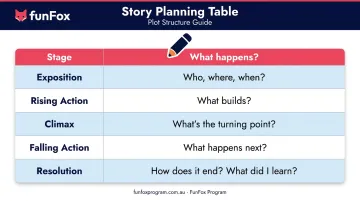
This takes about five minutes and makes the drafting process far smoother. FunFox's Writers Club uses structured pre-writing activities with students in Years 2–6 for exactly this reason: planning first means students spend their writing time on quality, not figuring out what comes next.
Step 3 — Write a Strong Opening
Weak opening: One day I went to the swimming pool for my first lesson.
That tells the reader almost nothing and creates no reason to keep reading. Try one of these three approaches instead:
- Drop into the action: The water was colder than I expected, and I hadn't even jumped in yet.
- Lead with sensory detail: Chlorine, the squeak of wet feet on tiles, and the instructor's whistle — that's how it started.
- Open with dialogue: "You'll be fine," Mum said, which is exactly what people say when they're not sure.
Step 4 — Build the Middle and Reach the Climax
Keep events in chronological order and build deliberately toward the turning point. If the climax arrives too quickly, the reader won't feel its weight. A few techniques help here:
- Short sentences create urgency — use them when tension peaks
- Longer sentences slow the pace, giving readers time to settle into a moment
- Withhold the climax just long enough that the reader is leaning forward
Step 5 — End with a Genuine Reflection
Weak ending: It was so fun and I had a great time.
Strong ending: I'd been so focused on not falling that I hadn't noticed I'd swum the whole length without stopping.
The difference is specificity. A strong reflection names the feeling and pins down the exact moment the writer saw something differently — not just that it was good, but why it mattered.
Common Narrative Essay Mistakes (and How to Fix Them)
Mistake 1 — Trying to Tell Too Much
Students often try to cover an entire holiday, school year, or sporting season in one essay. The result is a scattered, rushed piece that doesn't land anywhere. The fix: pick one scene and stay in it. If your child wrote two pages covering three weeks, ask them to find the single best moment and write only that.
Mistake 2 — A Weak or Missing Reflection
Many primary school essays end abruptly or with something generic like "It was amazing." A reflection should actually answer something: What did I feel at that moment? What do I understand differently now? A useful prompt: ask your child to finish the sentence "After this, I realised..." — whatever comes out of that is the reflection they should be writing.
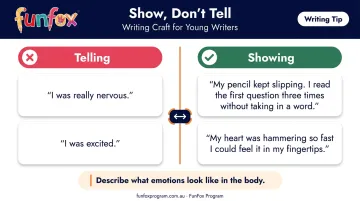
Mistake 3 — Telling Instead of Showing
Once reflection is in place, the next thing to look at is how the story itself is written. Telling instead of showing is the most common craft issue at primary school level. Two versions of the same moment:
- Telling: I was really nervous.
- Showing: My pencil kept slipping. I read the first question three times without taking in a word.
Showing drops the reader into the experience rather than summarising it from a distance. Encourage your child to describe what nervousness, excitement, or sadness looks like in their body, not just what it's called.
Frequently Asked Questions
What are the 5 elements of a narrative essay?
The five elements are exposition (setting up the story), rising action (building tension through events), climax (the turning point), falling action (the aftermath), and resolution (the closing reflection).
What is the difference between a narrative essay and a short story?
A narrative essay is typically written from the author's own perspective and ends with a personal reflection or insight. A short story is primarily fictional, focused on character and plot — the writer's own viewpoint isn't required.
How long should a narrative essay be for primary school students?
Years 3–4 students can aim for around 150–250 words, while Years 5–7 students typically produce stronger work at 300–500 words. Quality and structure matter far more than hitting a word count.
How do you start a narrative essay with a strong opening?
Three techniques work well: drop straight into the action, open with a vivid sensory detail, or begin with a line of dialogue that immediately sets the scene.
Can a narrative essay be fiction, or does it have to be a true story?
Narrative essays can be personal (drawn from real experience) or entirely invented — both are valid. At primary school level, personal narratives are more commonly assigned, but imagined stories are equally acceptable unless the task specifies otherwise.
What age should children start writing narrative essays?
Australian Curriculum v9 introduces imaginative text creation from Year 1. More structured narrative writing with a clear orientation, complication, and resolution is typically expected from Year 3 or 4 onwards, with increasing complexity through Years 5 and 6.