Introduction
Most primary school children can write a decent sentence by Year 2. Connecting those sentences into a focused, well-organised paragraph is where many struggle. That gap matters. Across science reports, history summaries, and English essays, paragraph writing is a skill children rely on throughout their entire schooling.
Teaching paragraph writing isn't simply a matter of explaining the rules. Rush to independent writing before children understand structure, or ignore the genre they're writing in, and confusion follows quickly. Sequence and scaffolding matter as much as the content itself.
This guide covers the three-part paragraph structure children need to know, a five-step teaching approach that builds from visual model to independent writing, proven techniques for making the skill stick, and practical strategies for when children still struggle.
Key Takeaways
- A strong paragraph has three core parts: a topic sentence, supporting sentences, and a concluding sentence.
- Start with visual models (like the hamburger method) before asking children to write independently.
- Paragraph structure varies by genre; teaching it in context is more effective than drilling it as a standalone rule.
- Rushing to independent writing — before children grasp each sentence's role — is the most common teaching mistake.
- Graphic organisers, sentence starters, and specific feedback are the most reliable tools for struggling writers.
What Makes a Strong Paragraph? Understanding the Structure
According to the ACARA English glossary, a paragraph is "a section of a text dealing with one topic, usually indicated by indentation or a new line." The organising principle is one topic — not a minimum sentence count, not a fixed length.
For primary school children, it helps to break that definition into its moving parts.
Topic Sentence
The topic sentence opens the paragraph and tells the reader exactly what the paragraph will be about. It should be specific enough to make a clear promise — and every sentence that follows must keep it.
Weak topic sentence: Dogs are interesting animals.
Strong topic sentence: Dogs make loyal companions because they are easy to train and respond well to their owners.
The second example gives the reader a clear expectation. It signals what the supporting sentences need to prove.
Supporting Sentences
Supporting sentences are where children do the actual work: providing evidence, detail, or examples that back up the topic sentence. The most common confusion here is that children introduce a brand-new idea mid-paragraph, not realising they've effectively started a new topic. A useful test: if a supporting sentence wouldn't fit under the topic sentence, it doesn't belong in the paragraph.
Concluding Sentence
The concluding sentence wraps up the paragraph by restating the main idea in a fresh way or summarising what the supporting sentences showed. It gives the reader a clean sense of closure.
The three-part structure is the foundational model for primary students, but paragraph length and style vary by genre. Narrative paragraphs may shift with a scene change or a line of dialogue; informational paragraphs follow the topic-detail-conclusion pattern more strictly.
Once children are confident with the basics, introducing this variation helps them write more flexibly across subjects.
How to Teach Paragraph Writing: A Step-by-Step Approach
The sequence matters as much as the content. Jumping to independent writing before children have built structural understanding produces surface-level work and frustration for everyone involved.
Step 1: Introduce the Concept with a Visual Model
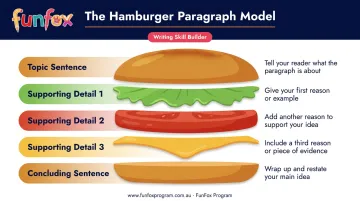
Before any writing happens, introduce the three-part structure through a concrete visual analogy. The hamburger model is the most widely used: the top bun represents the topic sentence, the fillings represent supporting details, and the bottom bun represents the concluding sentence.
For children aged 7–10, this works because it replaces abstract labels with something immediately familiar. Children can draw their own burger, label the parts, and refer back to it during writing.
Step 2: Analyse Real Examples Together
Choose a short paragraph from a book, class text, or article and read it aloud together. Then work through it as a pair:
- Identify the topic sentence (what does this paragraph promise?)
- Find the supporting sentences (what evidence or detail is given?)
- Locate the concluding sentence (how does it close the idea?)
Marking each component with a different colour or sticky note makes the structure visible. Seeing it in published writing reinforces that this is how real writers organise their ideas — not just a classroom exercise.
Step 3: Practise with Guided Activities Before Writing
Before asking children to write anything original, use low-stakes activities that build structural awareness. One effective option: cut a paragraph into individual sentences, jumble them, and ask the child to reassemble them in logical order. The task requires understanding of structure without the pressure of composition.
The IES/What Works Clearinghouse practice guide for elementary writing recommends explicit strategy instruction paired with gradual release of responsibility (moving from teacher-led modelling to guided practice before independent work).
Step 4: Scaffold Independent Writing with Prompts and Organisers
Once children demonstrate understanding through guided activities, introduce a writing prompt alongside a simple graphic organiser — a burger chart, a three-box planner, or a simple table with rows labelled "Topic Sentence," "Detail 1," "Detail 2," and "Concluding Sentence."
Scaffolding looks different by ability:
- Provide the organiser every session for children who need consistent structure
- Encourage stronger writers to work on lined paper and self-label their components
- Offer sentence starters ("My main idea is... One reason for this is...") for those who struggle to begin
Step 5: Review, Give Specific Feedback, and Celebrate Progress
Feedback at this stage should be structured and specific. Name what worked before suggesting one improvement:
"Your topic sentence clearly introduced your idea — I knew exactly what the paragraph would be about. For next time, try to make your concluding sentence sound a little different from your topic sentence."
The goal at this stage is growth, not perfection. Most children need repeated cycles of guided practice, feedback, and revision before paragraph structure becomes instinctive — and that's entirely normal.
Techniques That Help Paragraph Writing Click
No single method works for every child. The most effective approach combines visual strategies, structured frameworks, and contextualised practice.
The Hamburger Method
The hamburger model — introduced in the previous section — works particularly well for Years 2–4. It can be introduced via a drawn diagram, a printed worksheet, or a classroom poster. The visual stays useful as a reference even after children have moved to independent writing and children often glance back at it while drafting.
The PEEL Framework
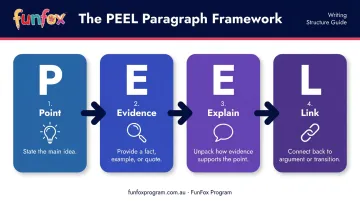
PEEL stands for Point, Evidence, Explain, Link. Each letter maps to a specific job within the paragraph:
- Point — state the main idea (equivalent to a topic sentence)
- Evidence — provide a fact, example, or quote
- Explain — unpack how the evidence supports the point
- Link — connect back to the original argument or transition to the next idea
PEEL suits upper-primary students (Years 4–6) working on informational or opinion writing. NSW Department of Education materials recognise PEEL in secondary contexts. For primary students, it's best introduced as preparation for the essay-style writing they'll encounter in high school, not as a replacement for the hamburger model in earlier years.
Teaching Transition Words Explicitly
ACARA defines text connectives as words and phrases that link ideas, including conjunctions, adverbs, and prepositional phrases. NAPLAN's cohesion criteria directly assess students' control of these devices — making them worth teaching explicitly, not just hoping children absorb them through reading.
Teach transition words in categories, with a visible word bank during writing:
| Category | Examples |
|---|---|
| Adding information | Additionally, Furthermore, Also |
| Contrasting | However, On the other hand, Although |
| Sequencing | First, Next, Finally |
| Giving examples | For example, For instance, Such as |
| Concluding | In conclusion, Overall, To summarise |
Teaching Paragraphs Within Genre Context
Paragraph structure changes depending on the type of writing. A narrative paragraph might shift with a character's action or a change in setting; a persuasive paragraph introduces a claim and supports it with evidence; an informational paragraph follows the topic-detail-conclusion pattern most strictly.
Teaching paragraph writing embedded within a specific genre — rather than as an isolated drill — helps children understand not just how to write a paragraph, but why the structure looks different in different contexts. Children who learn this way are far better equipped to adapt their writing across subjects and year levels.
When to Introduce Paragraph Writing — and What to Avoid
Curriculum Timing
Australian Curriculum v9.0 sets clear expectations for when paragraph skills are introduced:
- Year 2 — Students use text structures to organise and link ideas for a purpose, and develop an understanding of how texts are made cohesive
- Year 3 — Students use paragraphs and topic sentences to organise ideas around a central topic
- Year 4 — Students use paragraphs, topic sentences, and cohesive devices linking ideas within and between sentences
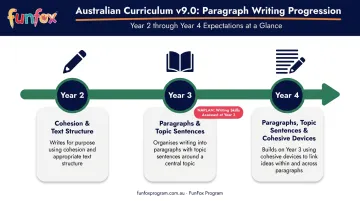
NAPLAN is sat in Years 3 and 5, and marks Text Structure, Cohesion, and Paragraphing in both narrative and persuasive writing. This means paragraph instruction that begins in Year 2–3 supports assessed writing skills by Year 3.
Common Teaching Mistakes to Avoid
Knowing the curriculum timeline is only half the picture — how paragraph writing is taught matters just as much. Three mistakes come up repeatedly:
- Teaching paragraphs in isolation — when children don't understand why paragraphs exist, the structure feels arbitrary rather than purposeful.
- Introducing the skill before children can write fluent sentences. Paragraph instruction assumes sentence-level competence — trying to teach both simultaneously overloads young writers.
- Enforcing a fixed sentence count (e.g., "always five sentences per paragraph"). ACARA defines paragraphs by one topic, not by length. Teaching a number rather than a function produces mechanical writing that doesn't adapt to purpose or genre.
- Applying informational paragraph rules to narrative tasks — single-sentence dialogue paragraphs are correct in narrative writing. Treating them as errors creates unnecessary confusion for children who are simply following the rules as they understand them.
What to Do When Your Child Still Struggles
The Three Most Common Sticking Points
- Topic sentence too vague or too broad — "Animals are important" tells the reader nothing specific. The paragraph has nowhere to go.
- Supporting sentences that go off-topic — Children often follow an interesting tangent without realising they've left the original idea behind.
- Not knowing when to start a new paragraph — In longer pieces, children run ideas together because they don't have a clear rule for when a paragraph ends.
Strategies That Help at Home
- Paragraph prompt cards — Provide sentence starters for each part: "My main idea is… One reason for this is… Another detail is… In conclusion…" These lower the starting barrier without removing the thinking.
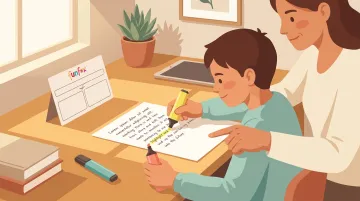
- Colour-coding drafts — Ask children to highlight their topic sentence in one colour, supporting sentences in a second, and the concluding sentence in a third. Structure becomes visible in their own writing.
- Paragraph sorting — Cut a sample paragraph into individual sentences and ask children to reassemble it. This builds structural awareness without the cognitive load of original composition.
Children who consistently struggle with organising their writing — even after repeated practice — often benefit from structured support with targeted feedback. That's exactly what FunFox's Writers Club is built for.
Small groups of no more than six students, weekly live sessions, and personalised feedback through Seesaw mean paragraph-level issues don't get lost in a crowded classroom. The program covers Years 2–6 and aligns with the Australian curriculum, including the writing demands children face in NAPLAN.
Conclusion
Strong paragraph writing rests on three foundations: understanding the structure, practising with the right scaffolds, and receiving specific, encouraging feedback. Each element depends on the others. A child can grasp topic sentences conceptually but still struggle to apply them without guided practice and honest, timely feedback.
Results take time and vary widely from child to child. The goal is steady progress toward clearer, more organised writing — not overnight mastery. At FunFox, that means pairing structured weekly lessons with personalised teacher feedback so children don't just learn what a good paragraph looks like — they learn how to write one, and then another, and then keep going on their own.
Frequently Asked Questions
How do you teach paragraph writing?
Start with a visual model like the hamburger method to introduce structure, then move through guided analysis of real texts and scaffolded activities before asking for original writing. Targeted feedback at each stage is what moves students forward.
What are the 5 steps of paragraph writing?
Choose a clear topic, write a strong topic sentence, add supporting sentences with details or evidence, write a concluding sentence, then review for focus and coherence. Each step builds on the one before it.
At what age should children start learning paragraph writing?
Most children begin around ages 7–9 (Years 2–3 in Australia), once they can write consistent, complete sentences. The Australian Curriculum v9.0 formally introduces paragraphing at Year 3, with cohesion skills starting from Year 2.
What is the hamburger method for teaching paragraphs?
It's a visual strategy where the top bun represents the topic sentence, the fillings represent supporting details, and the bottom bun represents the concluding sentence. This makes abstract structure concrete and memorable for young learners.
How long should a paragraph be for primary school students?
There's no fixed rule — many classrooms use 3–5 sentences as a starting guide, but length varies by genre and purpose. What counts is that every sentence has a clear function within the paragraph.
What are the most common mistakes children make in paragraph writing?
The three most frequent issues are writing a topic sentence that's too vague, including off-topic sentences in the body, and not knowing when to begin a new paragraph when their idea shifts.