Introduction
Picture this: a child sits down to write a letter to their school principal requesting permission to start a lunchtime book club. They begin with "Hey! Hope you're doing well…" — and immediately, something feels off.
Knowing which type of letter to write, and how to write it correctly, is a skill that matters. The Australian Curriculum recognises this directly, noting that forms of address vary according to degree of formality in social situations — and that students need to learn how to write for different audiences and purposes.
Formal and informal letters share the same basic concept, but their tone, structure, language, and purpose work very differently. Using the wrong one — even with the right words — changes how a message lands.
This guide covers what makes each type distinct, how to structure and write both from scratch, and the mistakes students most often make — so the next letter your child writes lands exactly the way they intend.
Key Takeaways
- Formal letters use a strict structure and polite, impersonal language — suited for teachers, principals, or officials.
- Informal letters are conversational and personal, with a flexible structure for friends and family.
- Both types share the same core components: address, date, greeting, body, closing, and signature.
- Tone confusion is the most common mistake — one casual phrase in a formal letter can undermine the whole thing.
- Real-world practice builds skills faster than worksheets alone.
Formal vs. Informal Letters: What's the Difference?
The simplest way to explain the difference is this: who are you writing to, and why?
Formal letters are written for professional, academic, or official purposes — contacting a principal, applying for something, or reaching out to an organisation. Informal letters are personal: writing to a friend about the holidays, or a letter to a grandparent catching them up on school life.
Language and Tone
The language difference is where students most often trip up. Here's what that looks like side by side:
| Situation | Formal | Informal |
|---|---|---|
| Opening a letter | "I am writing to inform you…" | "Just wanted to let you know…" |
| Saying you can't attend | "I am unable to attend" | "I can't make it" |
| Signing off | "Yours sincerely" | "Love from" / "See you soon" |
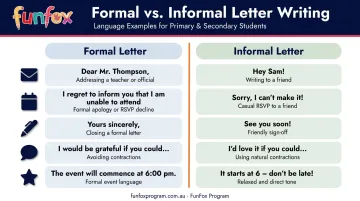
Formal letters avoid contractions entirely — "I am" not "I'm," "do not" not "don't." Informal letters not only allow contractions, they sound unnatural without them.
Formal writing also stays impersonal and professional throughout. Informal writing sounds like the person — chatty, warm, and personal.
Structure: Strict vs. Flexible
Formal letters follow a fixed structure with no room for deviation. Every part has a purpose and a place. Informal letters are looser, but they're not without structure: there's still an expected flow (greeting, body, sign-off) that keeps them easy to read.
The Audience Rule
Before picking up a pen, identify your relationship to the recipient:
- Formal tone suits teachers, principals, employers, council members, or anyone you don't know personally
- Informal tone suits friends, cousins, grandparents, or anyone you know well
A quick gut-check works well here: "Would I talk to this person at a school assembly or at a backyard barbecue?" That answer usually settles it.
How to Write a Formal Letter: Step-by-Step
A formal letter has a specific structure that must be followed. Skipping any part — or using the wrong tone — can undermine the message even if the content itself is solid.
Sender's Address and Date
Start in the top right corner with the sender's full address, then the date written out in full beneath it (for example, 15 November 2024). Formal letters are official and traceable — the date and address confirm exactly when and where the letter originated.
Recipient's Details and Salutation
Below the sender's address (on the left side), write the recipient's name, title, and address. Then comes the salutation:
- If you know their name: "Dear Mr. Johnson," or "Dear Ms. Lee,"
- If you don't know their name: "Dear Sir/Madam,"
Use a name whenever possible — it's more specific and shows care. BBC Bitesize confirms that formal salutations should use the recipient's name where known, or "Dear Sir or Madam" where unknown.
Body of the Letter
The body has three clear parts:
- Opening paragraph — states the purpose directly. Example: "I am writing to request permission to establish a lunchtime reading club at our school."
- Middle paragraph(s) — provides detail, reasons, or explanation supporting the purpose
- Closing paragraph — states any requested action or next steps clearly
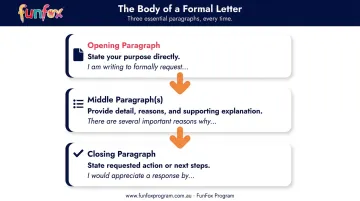
Stick to one idea per paragraph. Short, clear sentences work better here than long, winding ones.
Closing and Signature
Two options — and the choice depends on your salutation:
- "Yours sincerely" — when you've addressed the letter to a named person
- "Yours faithfully" — when you've used "Dear Sir/Madam"
Cambridge Dictionary confirms this distinction as standard convention. Sign your full name below the closing — not a nickname or casual sign-off.
That same principle extends to the entire letter. Tone must stay consistent from the first word to the last — a single casual phrase like "I just thought I'd ask…" in an otherwise formal letter immediately weakens it.
How to Write an Informal Letter: Step-by-Step
An informal letter feels like a friendly conversation on paper. The rules are looser, but there's still a structure that makes letters easy and enjoyable to read.
Address and Date
Even in informal letters, include the sender's address and date at the top — typically in the top right corner, though placement is flexible. It helps the recipient know when and where you wrote from, which is especially useful if letters are exchanged over time.
Greeting
Informal greetings have plenty of options:
- "Dear Mia,"
- "Hi Jake!"
- "Hey Grandma!"
First names are expected here, and exclamation marks are completely fine. For very close friends or family, a nickname works too. BBC Bitesize's guide to writing to a friend confirms that "Dear," "Hello," or "Hi" plus the recipient's name are all appropriate informal openers.
Body of the Letter
This is where informal letters really open up. A typical body might:
- Open with a check-in: "How have you been? I hope things are good your end!"
- Share your main news, respond to something they said, or catch up on recent events
- Close out naturally with plans to write again or see each other soon
Here's a short example of an informal body paragraph:
"We just got back from our trip to Queensland and it was amazing! We saw crocodiles at a wildlife park (from a safe distance, don't worry), and I finally got to try a real Queenslander meat pie. I kept thinking you would have loved it."
Contractions ("we'd," "don't," "I'll") are not just allowed — they make the letter feel genuine. Personal stories, humour, and casual expressions all belong here.
Closing and Sign-Off
Common informal closings include:
- "Love," / "Love from,"
- "Your friend,"
- "See you soon,"
- "All the best,"
- "Yours,"
One informal-letter exclusive: the P.S. (postscript). Oxford Learner's Dictionaries defines it as an extra message added at the end of a letter after signing the writer's name — perfect for something you forgot to mention, or a fun afterthought — something formal letters never include.
Spelling and grammar still matter in informal letters — a conversational tone is no excuse for careless writing.
Common Mistakes to Avoid
Most letter-writing errors come down to the same handful of slip-ups — and once you know what to watch for, they're easy to avoid.
1. Tone mismatch — Writing "Hey there!" to a principal, or "I am writing to inform you of my recent holiday activities" to a best friend, both land awkwardly. Quick self-check: "Would I actually say this to this person face-to-face?" If not, rewrite it.
2. Skipping structural elements — Missing the sender's address, date, or sign-off makes a letter look incomplete no matter how strong the content is. Before submitting, run through this checklist:
- Sender's address and date
- Greeting and body
- Closing and signature
3. Wrong salutation for the relationship — "Dear Sir/Madam" to a close friend, or "Hey!" to a school official, are classic errors. Always identify your relationship to the recipient before choosing a greeting. Friend or family? Go casual. Teacher, principal, or stranger? Go formal.
Tips to Help Children Improve Their Letter Writing Skills
Make Practice Real
Worksheets have their place, but nothing beats writing for a real reason. Suggest these tasks to children at home:
- A thank-you note after a birthday gift
- A letter to a grandparent sharing news from school
- A polite email to a teacher asking about an assignment
When children write with genuine purpose and a real recipient in mind, the skills stick differently.
Use Model Letters
Reading good examples before writing helps children internalise tone and structure naturally. The examples in this guide work as starting points — reading them closely first helps children notice what makes each type work.
Consider Structured Writing Programs
AERO's analysis of NAPLAN writing data found that explicit, systematic strategy instruction in planning, drafting, and revising has a significant positive effect on primary writing quality — far more than unguided practice alone.
For families who want consistent, guided support, structured writing programs designed for primary students can make a real difference. FunFox's Writers Club runs weekly live online classes in small groups of no more than six students, giving children regular practice across different writing styles within a curriculum-aligned framework.
The combination of direct instruction, independent practice, and personalised feedback helps children build genuine skill — not just familiarity with formats.
Frequently Asked Questions
What is the main difference between a formal and informal letter?
Formal letters are used for professional or official purposes — writing to a principal, making a request, or contacting an organisation — and follow a strict structure with polite, impersonal language. Informal letters are personal and conversational, written to people you know well, with a relaxed tone and flexible structure.
How do you start a formal letter?
A formal letter begins with the sender's full address and date at the top, followed by the recipient's name and address. The salutation should be "Dear Mr./Ms. [Name]," if the name is known, or "Dear Sir/Madam," if it is not.
What are the key parts of an informal letter?
An informal letter includes the sender's address, date, a casual greeting (such as "Hi [Name]!" or "Dear [Name],"), conversational body paragraphs, a friendly closing, and the writer's signature. Tone stays warm and personal throughout, and a P.S. is always welcome.
Can you use contractions in a formal letter?
No. Contractions like "I'm," "don't," and "can't" reduce the professional tone and should be avoided in formal letters. In informal letters, contractions are encouraged — they make the writing feel natural and genuine.
What are some examples of formal letter closings?
Use "Yours sincerely" when you've addressed the letter to a named person, and "Yours faithfully" when you've used "Dear Sir/Madam." Informal closings include "Love," "All the best," "Your friend," or "See you soon."
How can children practise writing formal and informal letters at home?
Real-world tasks work best: thank-you notes, letters to relatives, or polite emails to teachers all count. For more consistent guidance, programs like FunFox's Writers Club offer regular, teacher-led practice across different writing formats in a small-group setting.