The reality is far broader. Creative writing spans everything from a two-line poem to a comic strip to a six-word story that stops you cold. And research shows that reading and writing skills are deeply connected — with correlations between word reading and written composition as high as .80 in some longitudinal studies. Exposure to varied writing forms genuinely builds stronger literacy.
This article walks through 10 types of creative writing with real examples, and explains why each one is worth exploring with your primary school child.
Key Takeaways
- Creative writing is any writing that uses imagination and personal expression, not just factual reporting
- There are at least 10 distinct forms, each building different literacy and thinking skills
- Poetry, short stories, and personal narratives are the most accessible starting points for primary-aged children
- Trying different types keeps writing fresh and helps children discover what they're genuinely good at
- Consistent, low-pressure practice matters more than occasional polished pieces
What Is Creative Writing?
Creative writing is any writing where the author uses imagination, voice, and craft to create something beyond a purely factual account. Unlike a science report or a maths worksheet, it invites the writer to make real choices — about character, structure, emotion, and language.
The Australian Curriculum distinguishes between imaginative, informative, and persuasive texts, with creative writing sitting firmly in the imaginative category. Students are expected to create texts with imaginative and literary qualities across different genres and forms.
Most parents are surprised to learn their children are already doing creative writing without calling it that. Making up stories, writing birthday card messages, keeping a diary — all of it counts.
Why Creative Writing Matters for Primary School Children
A 2025 peer-reviewed study found that daily 20-minute creative writing workshops with Grades 2 to 5 students improved verbal fluency and divergent thinking, while reinforcing imagination and emotional stability.
Beyond test scores, creative writing gives children:
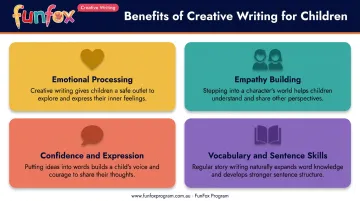
- A safe space to process experiences and emotions
- Practice inhabiting different perspectives, which builds empathy naturally
- Confidence in expressing themselves, both on paper and verbally
- Vocabulary and sentence construction skills that carry into every subject
That variety matters more than many parents realise. Children who only ever write narratives miss out on the distinct skills that poetry, scripts, and flash fiction develop. FunFox's Writers Club addresses this directly, giving primary school students structured exposure to a range of writing forms in small, encouraging groups.
10 Types of Creative Writing With Examples
Creative writing is not one-size-fits-all. Different types suit different personalities, moods, and skill levels. Read through the list below and share the examples with your child — notice which ones make their eyes light up.
1. Poetry
Poetry uses carefully chosen words, rhythm, and imagery to evoke emotion or paint a picture. It can be as short as three lines (a haiku) or run for pages. Crucially, it does not have to rhyme.
A simple haiku example:
An old silent pond — A frog jumps into the pond. Splash! Silence again.
Why kids love it: Poetry encourages precision with language, builds phonemic awareness, and has no strict length requirement — which makes it far less intimidating than a full story.
Research confirms that playing with poetry develops phonemic awareness, a strong predictor of reading acquisition. A simple prompt ("write about something you saw today using five words") is all you need to start.
2. Short Stories
Short stories are brief works of fiction — typically a few hundred to several thousand words — that focus on a single event, character, or moment. They have a clear beginning, middle, and end. O. Henry's "The Gift of the Magi" (1905), about a couple who each sacrifice something precious to buy the other a gift, is a classic example of how much emotional weight a short story can carry.
The real value here: Long enough to develop a real plot and characters, short enough to actually finish. Completing a story matters — it gives children a genuine sense of accomplishment.
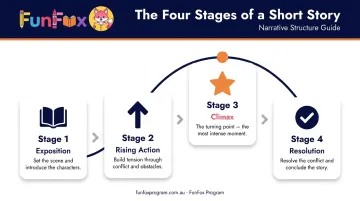
It also teaches narrative structure (exposition, rising action, climax, resolution) in a way that feels concrete rather than theoretical.
3. Flash Fiction
Flash fiction is ultra-short storytelling — usually under 1,000 words, sometimes as few as 100. The challenge: tell a complete, satisfying story in as few words as possible.
The most famous example is the six-word story "For sale: baby shoes, never worn" — though its attribution to Hemingway is contested. What matters is what it demonstrates: a whole world of grief and implication packed into six words.
The writing lesson inside: The short length makes it feel achievable, even for reluctant writers. The constraint of concision also teaches editing skills — the idea that every word must earn its place. That's a sophisticated lesson disguised as a fun challenge.
4. Personal Narratives
Personal narrative writing draws on the writer's own life. The writer recounts a real experience and reflects on what it meant to them. Think: a child writing about the day they got a pet, a moment they felt nervous before a school performance, or a holiday that didn't go to plan.
Why it works so well: It connects writing to real life, so children already know the story — the hardest part (getting started) becomes much easier. It's also closely aligned with Australian curriculum expectations, where students create narrative texts and respond personally to their own experiences. Practising this form builds directly transferable school assessment skills.
5. Journals and Diary Writing
Journal writing is private, personal, and has no formal structure. The writer records thoughts, feelings, observations, or daily events — with no audience and no right answer.
Children who've read Diary of a Wimpy Kid (Jeff Kinney, 2007) already understand the format instinctively. Greg Heffley's voice is immediate, honest, and funny — exactly what a personal diary sounds like.
For reluctant writers especially: Regular journaling builds writing fluency and helps children develop their own voice. It also reduces the fear of the blank page, because there's nothing to get wrong. Parents can encourage this simply by gifting a dedicated notebook and stepping back — no feedback required.
6. Plays and Scripts
Scripts tell stories entirely through dialogue and stage directions. There's no narrator explaining how characters feel — the words and actions carry everything. This is "show, don't tell" at its most direct.
BBC Bitesize's KS2 resources identify the key features children need to know: character names, dialogue, and stage directions that tell actors what to do or how to speak.
What makes it work: Kids naturally love acting and roleplay. Writing a short script to perform with friends or family gives writing an immediate, tangible purpose. It also teaches something specific: how different characters sound — one of the hardest skills in fiction writing to develop.
7. Fairy Tales and Fables
Fairy tales feature magical elements and heroic journeys (Cinderella, Hansel and Gretel). Fables are shorter moral tales using animals as characters — Aesop's The Tortoise and the Hare, traditionally attributed to Aesop, is the classic example.
Both follow recognisable structures that children can imitate or deliberately subvert.
Why these are ideal entry points: Children already know the conventions, so the barrier to starting is low. Encouraging a child to write their own version — or invent a new one — teaches story structure, character archetypes, and the idea that every story carries a theme. Children absorb these structures from as early as Kindergarten, which means the hardest part (getting started) is almost already done.
8. Song Lyrics
Song lyrics are poetry set to music — they use rhyme, rhythm, repetition, and imagery to tell a story or convey an emotion in compressed form. Leonard Cohen's "Hallelujah" (from Various Positions, 1984) is a masterclass in how lyrics can carry spiritual and emotional weight. For younger children, any song they already love and know by heart is a working example.
For the child who "hates writing": Children who resist writing will often happily write song lyrics because it feels like play. A 2025 study linked phonics-integrated music rhythm activities to improved reading fluency and accuracy — evidence that rhythm-and-sound work translates into real literacy gains.
9. Comics and Graphic Stories
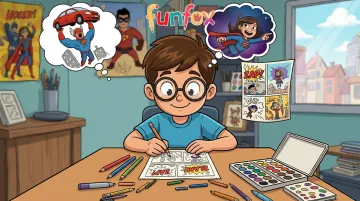
Comics are a hybrid form where visual art and written text work together. The writer plans panels, writes dialogue in speech bubbles, and crafts captions. Dog Man (Dav Pilkey), Diary of a Wimpy Kid, and the classic Calvin and Hobbes (Bill Watterson, 1985–1995) are all examples children will know and love.
Why comics develop strong writers: The International Literacy Association notes that graphic novels help students build visual literacy and make meaning across both image and text. Comics force children to decide what belongs in words versus what can be shown visually — exactly the thinking behind "show, don't tell." For children who love drawing, this form makes writing feel like a natural extension of something they already enjoy.
10. Myths and Adventure Stories
Myths, legends, and adventure stories feature heroes on quests, fantastical creatures, and themes of courage and good versus evil. Percy Jackson and the Olympians: The Lightning Thief (Rick Riordan, 2005) retells Greek mythology through a 12-year-old on a quest. The BFG (Roald Dahl, 1982) and The Chronicles of Narnia (C.S. Lewis, 1950–1956) are equally beloved examples.
Why adventure stories hook young writers: Adventure and fantasy are the genres children naturally gravitate toward when left to write freely. Writing in this form teaches world-building, plotting across multiple scenes, and how to create compelling characters with real stakes. The Australian Curriculum explicitly includes "realistic and fantasy settings and characters" as a Year 5 writing focus — so this form carries direct curriculum relevance too.
How to Help Your Child Explore Different Types of Creative Writing
The best starting point is always what already excites them. A child who loves drawing? Start with comics. One who's obsessed with a particular song? Try lyrics. Following natural interest lowers resistance and builds confidence faster than any structured approach.
A few practical strategies that actually work:
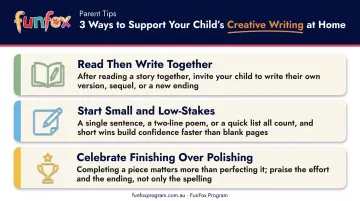
- Read a poem together, then invite your child to write one in the same style. Exposure to strong examples raises the quality of their own output.
- Start small and keep it low-stakes. A journal entry no one reads, a six-word story on a sticky note, a comic strip with stick figures — all of it counts.
- Celebrate finishing over polishing. Completing something — anything — builds a child's identity as a writer.
For parents who want more structure behind the practice, FunFox's Writers Club offers weekly online creative writing sessions for primary school students in small groups, with personalised teacher feedback built into every term.
Frequently Asked Questions
What is creative writing and its examples?
Creative writing is any writing that uses imagination and personal expression rather than purely conveying facts. Examples include poetry, short stories, personal narratives, scripts, song lyrics, flash fiction, fairy tales, and comics — each using language differently to create an imaginative experience for the reader.
What are the 7 types of creative writing with examples?
Commonly cited core forms include poetry, short fiction, flash fiction, personal essays/narratives, plays and scripts, novels, and memoir. There are many more beyond seven — fairy tales, song lyrics, comics, and myths are all valid forms with distinct conventions and purposes.
What are the 5 R's of creative writing?
The 5 R's framework originates in creative nonfiction, developed by Lee Gutkind: Real Life, Reflection, Research, Reading, and 'Riting. It emphasises grounding stories in real experience, reflecting on meaning, and revising carefully — principles that apply across most writing forms.
Is creative writing good for children?
Yes. Research links creative writing practice to stronger vocabulary, reading comprehension, verbal fluency, and emotional development. The National Literacy Trust also reports that writing supports children's mental wellbeing, with many children saying writing helps them relax and feel happy.
What age should children start creative writing?
Children can begin experimenting with creative writing from around age 5 to 6, starting with dictated stories, simple poems, or drawing-and-writing combinations. More structured practice suits Year 2 onwards, once children have enough fluency to focus on ideas rather than letter formation.
What is the difference between creative writing and academic writing?
Academic writing prioritises clarity, evidence, and formal structure to inform or persuade. Creative writing centres on imagination, voice, and expression to engage or move the reader. The two forms genuinely support each other — children who write creatively tend to develop stronger sentence construction and idea organisation, which feeds directly into academic performance.