Introduction
Picture this: your child sits down to write about their favourite animal and fills half a page with enthusiasm. Frogs jump. Frogs eat bugs. I like green. They live near ponds. My friend has a pet frog. It's all there — but jumbled together in one breathless block with no clear breaks or structure.
This is one of the most common writing challenges parents notice in Year 3. Children have ideas. What they often lack is the explicit knowledge of how to organise those ideas into paragraphs — and that's a skill that needs to be taught directly, not absorbed by accident.
That expectation is built into the curriculum. Australian Curriculum v9 confirms that Year 3 students are expected to plan, create, and publish texts with ideas grouped into simple paragraphs. This isn't an extension activity — it's a core Year 3 requirement.
This guide gives you a clear, practical path to help your child get there — from understanding what a Year 3 paragraph actually looks like, to spotting common mistakes and building the habit at home.
Key Takeaways
- A Grade 3 paragraph focuses on one idea: a topic sentence, two to three detail sentences, and a closing sentence.
- Knowing when to start a new paragraph is just as important as knowing how to write one.
- The hamburger model is the most effective visual tool for teaching paragraph structure to 8–9-year-olds.
- Common mistakes include single-sentence paragraphs, mixed ideas, and missing closing sentences.
- Short, consistent home practice builds skills faster than occasional long sessions.
The Building Blocks of a Grade 3 Paragraph
A paragraph is a group of sentences that belong together because they all talk about the same idea. That's the key distinction — not just any group of sentences, but a group that's connected.
Compare these two examples:
- Random sentences: "Frogs are green. I love pizza. My shoe is untied."
- A paragraph: "Frogs are fascinating creatures. They can leap up to twenty times their body length. They also breathe through their skin. Frogs are truly one of nature's most impressive animals."
The second group has direction. Every sentence connects to the opening idea.
That structure — purposeful, connected, complete — is exactly what Year 3 students are expected to build. The Victorian Curriculum describes paragraphs as a key organisational feature, with each one beginning with a topic sentence that predicts how the paragraph will develop. The structure most commonly taught at this level has three parts:
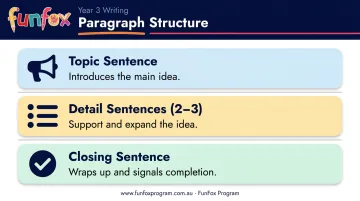
- Topic sentence — introduces the main idea
- Detail sentences — support and expand the idea
- Closing sentence — wraps up and signals completion
Here's how each part works in practice.
The Topic Sentence
The topic sentence is the opening sentence of a paragraph. Its job is to tell the reader exactly what the paragraph will be about — every sentence that follows should connect back to it.
Weak topic sentence: "I have a dog." Strong topic sentence: "My dog is one of the funniest animals I have ever seen."
The second version gives the reader a clear direction: this paragraph will be about the dog's funny behaviour, not just the fact that a dog exists. That's the difference between a topic sentence and an opening statement.
The Detail Sentences
Detail sentences form the middle of the paragraph. At Year 3, students typically write two to three of these. Each one adds a reason, example, fact, or description that supports the topic sentence.
Linking words help these sentences flow rather than sound like a disconnected list. Some useful examples for Year 3 students:
- "For example…"
- "Another reason…"
- "In addition…"
- "Also…"
Using these connectives is a specific expectation in ACARA Year 3 work samples — students should be linking and sequencing ideas, not just listing them.
The Closing Sentence
The closing sentence signals to the reader: this idea is finished. It restates the main idea in different words or offers a final thought. It should not simply copy the topic sentence word for word.
A paragraph without one feels like it stops mid-thought. A strong closing sentence gives the reader a sense of completion before moving on.
How to Write a Paragraph in Grade 3: Step-by-Step
Teaching Year 3 students to follow these steps — rather than simply telling them to "write a paragraph" — builds the habit of planning before writing.
Step 1: Pick One Idea and Plan It
Choose a single, specific topic. Not "animals" — but "why frogs are interesting." Not "sport" — but "why I love swimming."
Then use a simple planning box:
- Write the topic in the centre of a blank page
- Jot two or three supporting ideas around it
- Choose the strongest two or three to use
This step stops students from cramming every thought into one paragraph.
Step 2: Write the Topic Sentence
Turn the topic into a clear, specific opening sentence. A simple formula works well at this age:
[Topic] + [What you think or feel about it]
For example: "Dolphins are one of the most intelligent animals in the ocean."
Encourage students to avoid vague openers like "This paragraph is about dolphins." That tells the reader nothing interesting.
Step 3: Add Your Detail Sentences
Write two to three sentences that each support the topic sentence. Each one should:
- Add a new reason, fact, or example
- Start with a linking word or phrase
- Connect clearly back to the opening idea
Example detail sentences: "For example, dolphins can learn tricks and solve puzzles. They also communicate with each other using clicks and whistles. In addition, dolphins have been observed helping injured animals — including humans."
Step 4: Write the Closing Sentence
The closing sentence echoes the topic sentence without repeating it. It might summarise, offer a final observation, or loop back to the beginning.
Without closing sentence: "...In addition, dolphins have been observed helping injured animals." — stops abruptly.
With closing sentence: "...It is easy to see why dolphins are considered one of the cleverest creatures on Earth." — feels complete.
That sense of resolution matters. Done consistently, it's the habit that separates students who write sentences from students who write structured, purposeful paragraphs.
When Should a Grade 3 Student Start a New Paragraph?
Knowing when to begin a new paragraph is a skill that develops alongside writing ability — and Year 3 is exactly when students begin applying this in longer pieces.
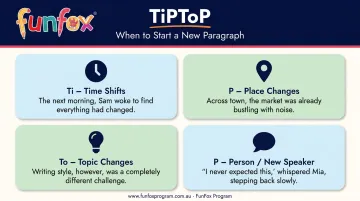
A helpful framework is the TiPToP rule: start a new paragraph whenever one of these four things changes:
| Change | New Paragraph? |
|---|---|
| Time shifts | Yes |
| Place changes | Yes |
| Topic changes | Yes |
| Person (new speaker) | Yes |
When the Topic Changes
Every new idea needs its own paragraph. If a student is writing about their favourite animal, one paragraph covers what it looks like, the next covers what it eats, and a third covers where it lives. Mixing these together creates the jumbled-page problem from the introduction.
When Time or Place Changes
In narrative writing, a scene shift signals a new paragraph. For example:
"That morning, Lily packed her bag and headed to the park." — new paragraph here when the scene moves to the park.
Readers naturally expect this shift. Teaching students to spot scene changes early makes their stories far easier to navigate as they get longer.
When a New Person Speaks
Each time a different character speaks in a story, a new paragraph begins. It's a Year 3 expectation that catches many students off guard — they often run all dialogue together in one block, leaving readers guessing who said what.
A quick example shows why it matters:
"Let's go to the park," said Mia.
"I'll get my shoes," Tom replied.
Two speakers, two paragraphs. Once students see it this way, the rule sticks.
Common Paragraph Writing Mistakes in Grade 3 (and How to Fix Them)
Common Paragraph Writing Mistakes in Year 3 (and How to Fix Them)
Most Year 3 paragraph problems follow predictable patterns. Once you can spot them, they're straightforward to address.
Writing Only One Sentence — or Going On Forever
Some students write single-sentence "paragraphs." Others write one unbroken block for an entire page. Knowing which extreme to look for makes the conversation with your child much easier.
The fix: Teach students that a Year 3 paragraph typically contains three to five sentences. Count them together. If there's only one, ask: "What's one reason or example you could add?" If there are ten, ask: "Does every sentence belong to the same idea?"
Mixing Different Ideas in One Paragraph
When students skip the planning step, they tend to jump from idea to idea within the same paragraph. A paragraph about why they love swimming might suddenly include a sentence about their dog.
The fix: Return to Step 1. Check every sentence against the topic sentence: "Does this sentence belong here?" If not, it belongs in its own paragraph — or gets cut.
Missing or Weak Topic and Closing Sentences
Many Year 3 students plunge straight into details and forget to open or close properly. Parents can use these two questions during review:
- "What is this paragraph about?" — If the child can't answer from the first sentence, the topic sentence needs work.
- "How does it end?" — If the paragraph just stops, a closing sentence is missing.
How to Help Your Grade 3 Child Practise Paragraph Writing at Home
The IES/WWC practice guide for elementary writing recommends frequent writing practice as a key driver of improvement. Short, regular tasks at home — rather than occasional long sessions — build both confidence and fluency.
Try a Sentence Sort Activity
Print a short paragraph from a book or news article and cut it into individual sentences. Mix them up and ask your child to put them back in the right order.
This builds structural understanding without the pressure of generating new ideas. Children start to notice that topic sentences feel different from supporting ones — and that recognition transfers directly into their own writing.
Use the Hamburger Organiser
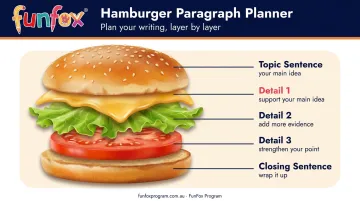
The paragraph hamburger is a visual planning tool that makes abstract structure concrete:
- Top bun = topic sentence
- Fillings = detail sentences (two to three)
- Bottom bun = closing sentence
Draw it on a piece of paper before your child writes anything. Have them fill in each section first, then use those notes to write the paragraph. Separating planning from writing gives children a clear starting point, so they spend less time staring at a blank page and more time building ideas.
For parents who want structured support beyond home practice, FunFox's Writers Club offers small-group online sessions (maximum six students) where Year 3 students work through curriculum-aligned writing tasks with expert teacher feedback. Each session includes personalised written feedback, so children know exactly what they did well and what to work on next.
Frequently Asked Questions
What is a Year 3 paragraph?
A Year 3 paragraph is a group of three to five sentences all focused on one main idea, typically structured with a topic sentence, two to three supporting detail sentences, and a closing sentence. This reflects Australian Curriculum v9 expectations for students aged 8–9.
How do you teach Year 3 students to write paragraphs?
Effective teaching uses concrete visual tools like the hamburger organiser, modelled examples that students can read and analyse, short guided practice tasks, and clear rules for when to start a new paragraph. Students work from structured scaffolds first, then gradually move toward independent writing.
What age should a child be able to write a paragraph?
Most children begin learning paragraph concepts around ages 7–8 (Year 2) and are expected to write structured paragraphs independently by ages 8–9 in Year 3. Individual readiness varies, and some students benefit from explicit support along the way.
What are the 5 steps of paragraph writing?
Choose a single topic, plan two to three supporting ideas, write a topic sentence, write two to three detail sentences using linking words, then finish with a closing sentence. Repeating these steps across different topics builds the habit until the structure feels natural.
How long should a paragraph be in Grade 3?
A typical Grade 3 paragraph contains three to five sentences — one topic sentence, two to three detail sentences, and one closing sentence. Length varies depending on the task and the student's development, but this range is a solid working target.