
Key Takeaways
- Early literacy gaps compound over time — the primary years (ages 5–12) are the best window to close them
- One in three Australian students is not mastering foundational reading skills
- Signs of difficulty show up in reading and writing, often before grades drop
- Tutoring adds measurable progress: small-group averages 4 extra months' growth; one-to-one averages 5 months
- Live online tutoring matches in-person outcomes for literacy-focused sessions
Why English Foundations Matter in Primary School
Reading and writing are not stand-alone subjects: they are the tools children use to access every other area of learning. A Year 4 student who cannot reliably interpret a written question will struggle in maths, science, and HASS, regardless of how well they understand the underlying concepts.
The primary years (roughly ages 5–12) are the critical window for building these skills. Research from the Grattan Institute found that approximately one in three Australian students is not mastering the reading skills they need, with the lifetime cost of poor reading performance estimated at $40 billion for the students most severely affected.
Gaps formed during this period tend to layer on top of each other. What looks like a small deficit in Year 2 can become a significant barrier by Year 5.
What the Australian Curriculum Expects
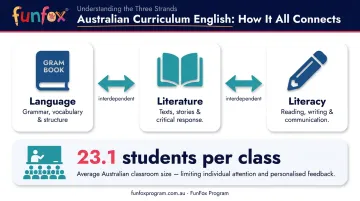
The Australian Curriculum: English is built around three interrelated strands:
- Language — understanding how English works, including grammar, vocabulary, and sentence structure
- Literature — engaging with texts of cultural, social, and personal value
- Literacy — applying language knowledge to interpret and create texts with accuracy and fluency
Children who fall behind in one strand quickly fall behind in all three, because the strands reinforce each other. Less reading means a smaller vocabulary. A limited vocabulary constrains writing, and weaker writing makes increasingly complex texts harder to follow.
The Classroom Reality
Australia's average primary class size is 23.1 students, according to OECD's 2025 Education at a Glance data. Even with skilled teachers, that ratio makes it difficult to identify and address each child's specific literacy gaps in real time. Tutoring works alongside classroom teaching, adding the targeted, personalised practice that a busy classroom setting cannot always provide.
Signs Your Child Might Benefit from an English Tutor
You do not have to wait until report cards flag a problem. Many children benefit from early, targeted support — and the earlier a gap is identified, the easier it is to close.
Reading Red Flags to Watch For
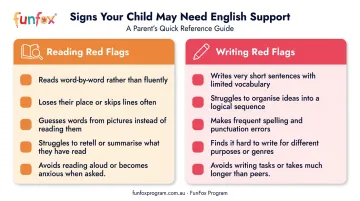
Observable signs a child is struggling with reading include:
- Avoids reading aloud or becomes anxious when asked to
- Loses the thread of a story, even after finishing it
- Reads slowly, skips words, or guesses at unfamiliar words
- Cannot answer comprehension questions about a passage they just read
- Shows reluctance to read independently at home, even when capable
Reluctance to read is often interpreted as a motivation problem, when it is more often a fluency or comprehension problem — reading feels effortful, so the child avoids it.
Writing Red Flags to Watch For
Writing difficulties are sometimes harder to spot because children who can speak fluently are assumed to be capable writers. Watch for these patterns:
- Very short written responses relative to what the child says aloud
- Difficulty organising ideas into a sequence
- Repetitive sentence structures across all written work
- Spelling that lags noticeably behind peers
- Strong resistance to writing homework
Teacher comments in school reports are also direct signals. Feedback like "could elaborate more," "needs to develop sentence structure," or "ideas not fully developed in writing" points to a specific skills gap — not a lack of effort. That gap is exactly what structured tutoring is designed to close.
What to Look for in a Primary School English Tutor
Choosing the right tutor means knowing what questions to ask. Not all tutoring is equal, and for primary school students especially, the wrong approach can waste months of effort.
Curriculum Alignment
An effective English tutor for an Australian primary student must understand what the Australian Curriculum expects at each year level. This means sessions should address reading, writing, speaking and listening, spelling, grammar, and text creation — not just whatever homework is due that week.
Ask specifically: Does your program align with the Australian Curriculum's English strand? How do you sequence skills across the year?
A Structured, Progressive Approach
Good tutoring is not homework help. It follows a deliberate sequence that builds skills systematically — typically moving from phonics and word recognition through reading fluency, comprehension strategies, and then into written expression. If a tutor cannot describe how their program builds from one skill to the next, that's a red flag.
Tutor–Student Rapport
Primary school children learn through connection. A tutor who makes sessions genuinely engaging, celebrates small wins, and responds with warmth and encouragement will outperform a technically qualified tutor who relies purely on drills. Rapport is not a nice-to-have — research from Stanford's NSSA confirms that students who feel connected to their tutor are more likely to ask questions, stay engaged, and build lasting motivation.
Small Group vs. One-on-One
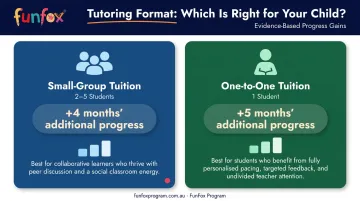
Both formats have strong evidence behind them:
| Format | Group Size | Average Impact |
|---|---|---|
| Small-group tuition | 2–5 students | 4 months' additional progress |
| One-to-one tuition | 1 student | 5 months' additional progress |
Small groups work well for most primary school students — children benefit from hearing peers respond, and the format costs less. One-to-one suits children who need intensive, highly personalised attention or who are working to catch up quickly.
Structured Programs Designed for Primary School English
Once you know what to look for, it's easier to evaluate specific programs against those criteria. FunFox, for example, is built specifically for primary school English — small-group live online sessions (maximum six students) for Years 1–6, with teachers trained in the FunFox Way and content aligned to the Australian Curriculum.
Its three primary programs each target a distinct need:
- Readers Club (Years 3–6) — builds comprehension strategies, critical thinking, and literary analysis
- Writers Club (Years 1–6) — covers descriptive, narrative, persuasive, and informative writing across a four-term rotation
- Foundation Club (Years 1–2) — combines reading and writing in a single program for early learners
Sessions run one hour per week, supported by structured worksheets and personalised feedback via Seesaw between classes.
Online vs. In-Person English Tutoring: What Works Best?
Many parents default to in-person tutoring out of habit. For primary school English specifically, that instinct is worth re-examining.
A 2025 EdWorkingPaper study comparing in-person and remote tutoring within the same early literacy program found no statistically significant difference in student literacy outcomes. When the tutoring is live, interactive, and delivered by a qualified teacher, the medium matters less than the method.
Practical trade-offs to consider:
- In-person sessions offer face-to-face contact, but geography, commute time, and fixed locations limit your options
- Online sessions remove those barriers — access to better-qualified specialists, no travel, and no disruption to the family routine
For foundational English skills — reading aloud, comprehension discussion, guided writing — a well-structured live online session works. All it takes is a device, a quiet corner, and a tutor experienced with young learners in a virtual setting. Many children engage more readily at home than in an unfamiliar external environment — and for programs like FunFox, which run all classes live online via Zoom, that familiarity is built in from day one.
How to Get the Most Out of Primary School English Tutoring
Tutoring outcomes improve when parents play an active role. These four practices make the biggest difference:
- Stick to a weekly schedule. Regular sessions produce stronger results than sporadic intensive bursts. Young learners build skills sequentially — missing sessions breaks that chain.
- Check in briefly after each class. Ask what your child practised or found tricky. That one question reinforces the lesson without adding pressure. The EEF found that parental engagement adds an average of 4 months' additional progress in literacy — a finding echoed across international research.
- Read together at home. Even 10–15 minutes of shared reading per night builds vocabulary and comprehension faster than any single weekly session can.
- Set realistic expectations. Meaningful literacy improvement takes months of consistent effort before it shows up in school performance. Confidence and willingness to engage are better early markers than grades.
How Much Does a Primary School English Tutor Cost in Australia?
Tutoring costs vary by format, experience level, and program structure. Here are current market reference points for Australian families:
| Format | Approximate Cost |
|---|---|
| Private one-to-one (less experienced tutor) | $50–$60/hour |
| Private one-to-one (qualified teacher) | $85+/hour |
| Tutoring centre group bundle (multi-subject) | From $75/week |
| Structured online group program (English-specific, per term) | ~$165/month |
FunFox's primary programs (Writers Club, Readers Club, Foundation Club) are priced at $165 monthly for a 3-month term, with a once-off registration fee of $80. Each term includes 10 weekly sessions plus holiday office hours.
A cheaper option isn't always better value. A tutor without a curriculum framework can produce slower results, meaning families pay for more sessions to see the same gains. Early intervention in primary school is more cost-effective than remedial support in high school, where gaps are deeper and take longer to close.
Frequently Asked Questions
How much does a primary school tutor cost per hour?
Private one-to-one tutors typically charge A$50–$60/hour for less experienced tutors and A$85+/hour for qualified teachers. Structured online group programs work out to less per session — FunFox's programs average A$49.50 per weekly class across a full term.
Is 1 hour of tutoring a week enough?
For most primary students, one focused hour per week is a solid foundation. Consistency matters more than duration — supplementing weekly sessions with regular at-home reading practice produces noticeably better results than sessions alone.
What age should a child start English tutoring?
Tutoring can begin as early as Prep or Year 1 if foundational gaps are identified. Any primary year is appropriate, though earlier intervention makes gaps easier to close before they affect confidence or performance across other subjects.
What does an English tutor for primary school actually do in sessions?
Sessions typically include guided reading, comprehension activities, vocabulary building, and structured writing exercises — tailored to the child's year level and specific areas of need. Structured programs like FunFox also cover literary analysis and genre-specific writing skills.
How do I know if tutoring is working for my child?
Watch for increased willingness to read or write at home, improved confidence when discussing school tasks, and positive teacher feedback. Measurable improvement in reading or writing typically emerges within 8–12 weeks of consistent sessions.
Is online English tutoring effective for primary school students?
Yes — live online tutoring with a qualified, engaged teacher is highly effective for primary school English. Many children engage more readily from a familiar home environment, and well-structured programs consistently deliver strong literacy outcomes regardless of format.