
Most people find this surprisingly hard. A professional bio is arguably one of the most reused pieces of writing you'll ever produce, yet the majority are either generic to the point of invisibility or crammed with so much information they lose the reader entirely.
This guide covers exactly what a professional bio is, what to include, a clear step-by-step writing process, real examples across different platforms, and the most common mistakes to fix before you hit publish.
Key Takeaways
- A professional bio is a concise, narrative-style summary of who you are — not a resume rewritten as paragraphs.
- Every strong bio answers four questions: Who are you? What have you accomplished? What do you do now? How can you help others?
- Match your bio to the platform — tone and length should shift from company pages to social media to speaker profiles.
- First person suits informal contexts; third person suits formal settings — never switch mid-bio.
- The easiest mistakes to fix: jargon, outdated details, vague buzzwords, and no call to action.
What Is a Professional Bio and When Do You Need One?
A professional bio is a short, paragraph-format narrative that captures your professional identity, key achievements, and a sense of your personality. Unlike a resume, which lists roles and responsibilities chronologically, a bio reads like a story. It gives the reader a sense of who you are, not just what you've done.
According to the Boise State Writing Center, a professional bio is "a written summary of a person's relevant professional and academic experiences" — and the key word there is relevant. A bio is not a complete professional history. It's a curated, audience-aware introduction.
When You'll Need One
You'll be asked for a professional bio in more situations than you might expect:
- Company "About" pages — when you join a new organisation or update your team profile
- LinkedIn profiles — the About section is a first-person bio
- Conference and speaker programmes — organisers typically request 75–120 words
- Guest article bylines — publications attach a brief bio to contributor pieces
- Freelance and portfolio sites — your bio is often the first thing potential clients read
- Networking and professional directory profiles — a short bio adds credibility instantly
Unlike a resume, which you update and tailor for each job application, a well-crafted bio can be lightly adapted across platforms. Get it right once, and a single bio can serve your LinkedIn profile, speaker notes, and portfolio site with only minor adjustments each time.
What to Include in a Professional Bio
Grammarly recommends building a bio from a clear set of elements: your name, current role, company or brand, goals, top accomplishments, an optional personal detail, and contact information. Indeed's guidance aligns closely, adding a clear call to action.
Think of these as building blocks. You won't always use every one — the mix depends on your audience and platform.
Name and Current Role
Always lead with your full name and current job title or professional role. This anchors everything that follows.
A strong example: Ambreen is the Founder and Head Teacher of FunFox Program, an online literacy and writing tutoring service for primary and early-secondary school students across Australia.
One sentence. Reader knows exactly who you are and what you do.
Relevant Experience and Achievements
Follow your opening with one or two career highlights that establish credibility for this specific audience. The Boise State Writing Center advises showing skills through concrete evidence rather than simply claiming them.
So instead of writing "extensive experience in curriculum design," cite a specific outcome — a programme you built, a milestone you hit, or a measurable result you delivered.
Professional Philosophy or Values
A bio gains real depth when it explains why you do what you do — not just what your job title says. Educators, coaches, and creative professionals benefit especially from including a clear philosophy statement: something genuine, not a recycled line about being "passionate about excellence."
Education or Credentials (Where Relevant)
Include degrees, certifications, or professional training when they add direct credibility for your audience. Early-career professionals and those in credential-heavy fields (law, medicine, education) should prioritise this. For experienced professionals with a strong track record, formal credentials matter less — your results do the talking.
Personal Detail and Call to Action
A brief personal detail — a hobby, a personal motivation, something specific — makes a bio human rather than clinical. Close with a clear call to action: an invitation to connect, a link to your portfolio, or an email address. According to Indeed, the CTA gives the reader somewhere to go — and that's what makes a bio work rather than just sit on a page.
How to Write a Professional Bio: Step-by-Step
Good ingredients in the wrong order still produce a flat result. Follow these steps for a bio that flows naturally and makes an impression.
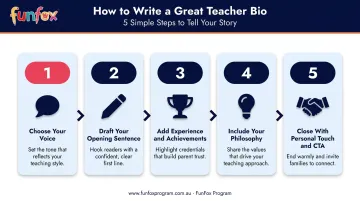
Step 1: Choose Your Voice
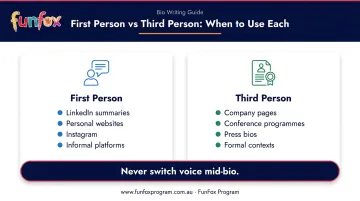
Decide between first person ("I am a curriculum designer…") and third person ("Nazneen is a curriculum designer…"). The practical rule:
- First person — personal websites, LinkedIn summaries, Instagram, informal platforms
- Third person — company pages, conference programmes, press bios, formal contexts
Switching mid-bio is one of the most common structural errors. Pick a voice and stay with it throughout.
Step 2: Draft Your Opening Sentence
Write one clear sentence that states who you are and what you do. No jargon, no qualifiers.
Structural formula: [Name] + [current role/title] + [what makes this relevant or distinctive]
Example: Nazneen is a curriculum designer and teaching adviser who develops structured literacy programmes for primary school students aligned to the Australian curriculum.
If you can't summarise yourself in one sentence, that's actually the first writing problem to solve — before you draft anything else.
Step 3: Add Depth With Experience and Achievements
Two or three sentences after your opener should add context the reader needs to trust you — not everything that feels impressive to list. Think: a relevant career milestone, a standout project, or the scope of your experience. Specificity matters more than volume.
What to include:
- Years of experience or a defining career moment
- A specific project, outcome, or number (e.g., "trained over 200 teachers across three states")
- The type of client, student, or organisation you work with
Step 4: Include Your Philosophy or Personal Motivation
One or two sentences here should reveal your why — the belief driving your work, or the problem you care most about solving. If it could apply to anyone in your field, rewrite it until it couldn't.
Example: Nazneen believes that structured literacy teaching, done well, gives children the tools to think independently — not just pass tests.
Step 5: Close With a Personal Touch and CTA
Close with something human — a hobby, an interest, or a detail that makes you a person rather than a résumé. Then add a clear call to action: a portfolio link, a LinkedIn invitation, or an email address. Keep it to one or two sentences so it feels warm, not transactional.
Example: Outside the classroom, Nazneen volunteers as a junior debate coach. If you'd like to connect, find her on [LinkedIn] or reach her at nazneen@example.com.
Professional Bio Examples Across Different Platforms
A bio isn't one-size-fits-all. The same core information should shift in tone, length, and structure depending on where it lives. Use these examples as starting frameworks — adapt them to your own voice and context.
Company Website or LinkedIn Bio (Third Person, Formal)
Nazneen is a curriculum designer and teaching adviser at FunFox Program, where she shapes the educational quality of literacy programmes for primary school students across Australia. With a background in curriculum development and classroom teaching, she oversees the design and sequencing of lessons across the Readers Club and Writers Club — ensuring every session is structured to challenge and support students at their level. Nazneen believes that confident readers and writers are made through consistent, well-designed instruction, not just natural ability. Outside of her work at FunFox, she enjoys reading widely across genres — a habit she actively encourages in the students she teaches. Connect with Nazneen via the FunFox website at funfoxprogram.com.au.
~110 words. Covers role, experience, philosophy, personal detail, and CTA.
Social Media Bio (First Person, Punchy)
Curriculum designer & literacy adviser | Helping primary school students become confident readers and writers | Explore our programmes at funfoxprogram.com.au
Under 150 characters per line. Role first, value offered, CTA. Prioritise readability over completeness.
Speaker Profile or Event Programme Bio
Nazneen is a curriculum designer and literacy specialist with over eight years of experience developing structured reading and writing programmes for primary school students. At FunFox Program, she leads curriculum advisory across the Readers and Writers Clubs, working with teachers across Australia. Her session explores how intentional curriculum sequencing builds student writing confidence from Year 1 through Year 6.
~65 words. Third person, credibility-focused, written for the specific event audience.
Early Career or No-Experience Bio
Not every bio starts with an impressive job title. If you're early in your career or transitioning industries, lead with your education, transferable skills, or goals:
Sarah Chen is a final-year Education student at the University of Sydney, specialising in primary literacy. Through her practicum placements across three Sydney schools, she has developed targeted reading programmes for mixed-ability classrooms and volunteered as a writing mentor with a local after-school programme. Sarah is passionate about making literacy instruction genuinely accessible and is actively seeking graduate teaching opportunities in 2025.
Skills, education, and concrete experience — even from placements or volunteering — carry real weight when you're starting out. The goal is to show what you can do, not apologise for what you haven't done yet.
Common Mistakes to Avoid When Writing Your Professional Bio
Most bio failures come from the same handful of predictable errors. Spotting them before you write saves a round of rewriting later.
Vague Buzzwords That Say Nothing
Business News Daily identifies terms like "specialised," "experienced," "leadership," "passionate," "expert," and "motivated" as among the most overused phrases in professional profiles. The problem isn't that these words are wrong — it's that they're so common they register as filler.
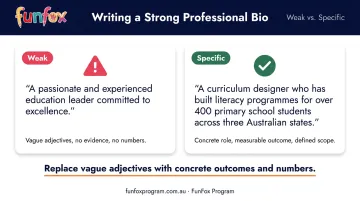
Compare these two approaches:
- Weak: "A passionate and experienced education leader committed to excellence."
- Specific: "A curriculum designer who has built literacy programmes for over 400 primary school students across three Australian states."
The second version is specific, credible, and memorable. The first could describe anyone.
The Laundry-List Bio
A bio that tries to include every role, qualification, and project you've ever touched reads like a resume — and loses the reader's attention quickly. The fix is being selective. Include only what is most relevant to your specific audience.
Strong writing is built as much on what you leave out as what you put in. Ask yourself: does this detail serve the person reading my bio, or does it just serve my ego?
Two Final Mistakes Worth Flagging
- Treat your bio as a living document. As Harvard Business Review notes, most people write a bio once and never revisit it. Review yours at least annually, or after any major career change — a new role, a notable project, or additional qualifications.
- Always close with a call to action. A bio without one tells people who you are and then leaves them with nowhere to go. Even a simple line — "Connect with me on LinkedIn" or "Visit my portfolio at [URL]" — turns a passive document into one that works for you.
Frequently Asked Questions
Can you give me an example of a bio?
Here's a brief third-person example: "Sarah Chen is a literacy educator and curriculum designer with eight years of experience developing reading programmes for primary school students in Australia. Outside the classroom, she mentors graduate teachers entering the profession. Connect at sarahchen.com.au." Examples vary significantly by platform — a speaker bio is more formal; a social media bio prioritises brevity.
What are the 5 main features of a biography?
The five core features are: your name and current role, relevant professional experience, key achievements, your professional philosophy or values, and a call to action or personal detail. A strong bio weaves these together in narrative form rather than presenting them as a checklist.
Should I write my professional bio in first or third person?
Use first person for informal or personal contexts — LinkedIn summaries, personal websites, Instagram. Use third person for formal settings — company pages, conference programmes, press bios. The most important rule: stay consistent throughout. Switching voice mid-bio is a common and jarring mistake.
How long should a professional bio be?
Aim for 50–100 words for social media, 100–150 words for most professional contexts, and up to 250 words for detailed speaker or company profiles. X (formerly Twitter) officially limits profile bios to 160 characters.
How often should I update my professional bio?
Review your bio at least once a year or after any significant career change — a new role, a major project, an award, or additional qualifications. A bio that still lists a role you left two years ago signals inattention — and gives readers a reason to question your other details.
What should I avoid including in a professional bio?
Cut outdated roles, irrelevant personal details, vague buzzwords, exaggerated claims, and anything that contradicts your current professional focus.