That uncertainty is exactly where most parents find themselves. This guide covers how to spot genuine warning signs, what separates a quality English tutor from an average one, and how to choose between local and online options — including what to ask before spending a cent.
Key Takeaways
- Primary school is the critical window for literacy foundations — gaps that form in Years 1–6 tend to widen without specialist support
- Look for tutors who are Australian curriculum-aligned, work in small groups or one-on-one, and focus specifically on literacy skills
- Online tutoring can be as effective as in-person when sessions are structured and led by qualified teachers
- Regular progress updates and parent communication keep you informed and ensure your child stays on track
- A structured enrolment process gives you a clearer picture of your child's needs than a single trial session
Why English Tutoring Makes a Real Difference in Primary School
Primary school — roughly Years 1 to 6 in Australia — is when the building blocks of literacy get laid down. Phonics, reading fluency, vocabulary, written expression, and comprehension don't just happen in sequence; each one depends on the last. When a child misses or misunderstands a foundational skill, the next layer becomes shaky too.
The Grattan Institute's 2024 Reading Guarantee report describes this as the "Matthew Effect" — weaker readers read less, practise less, and fall progressively further behind their peers. The same report found that only about one in five students who were at or below the minimum NAPLAN standard in Year 3 managed to catch up and stay on track through to Year 9. That's a sobering figure for any parent watching their child struggle.
Research from ACER points to Year 4 as a critical turning point. Before that, children are learning to read; after it, they're reading to learn. Gaps that haven't been addressed by then become harder to close, because reading is no longer just a subject — it's how students access every other subject. That's why early intervention matters so much.
What Tutoring Actually Does
Tutoring and homework help serve different purposes, and confusing the two is a common mistake.
When a child confuses "their/there/they're," homework help gets tonight's task done. Tutoring asks why the confusion exists — is it a phonemic awareness gap? Weak vocabulary? Inconsistent exposure to written language? Then it addresses that root cause directly.
Good primary English tutoring involves:
- Targeted, one-on-one or small-group sessions with a clear focus for each lesson
- Structured, personalised learning that builds on itself week to week
- A qualified teacher who can identify which sub-skill is the actual barrier
- Regular communication back to parents about what's being worked on and why
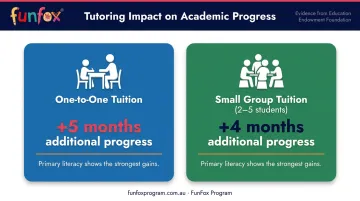
The Education Endowment Foundation reports that one-to-one tuition produces an average of +5 months' additional progress, with the strongest gains seen in primary-age students working on literacy. Small-group tuition of two to five students delivers +4 months on average — still meaningful, and more cost-accessible for many families.
Signs Your Child May Benefit from an English Tutor
Some signs are obvious. Others aren't. Here's what to actually watch for across different areas.
Reading Difficulties
These go beyond "reads slowly":
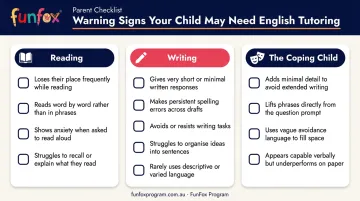
- Loses their place frequently or uses a finger to track every word well into primary school
- Reads word-by-word without any fluency or natural phrasing
- Avoids reading aloud or becomes visibly anxious when asked
- Can read the words but struggles to answer questions about what they just read
By Year 3, the Australian Curriculum expects students to read complex words fluently using phonics and word knowledge, and to identify both literal and implied meaning in texts. If your child is in Year 3 or above and still decoding slowly, that's worth addressing.
Writing Struggles
Watch for:
- Very short written responses, even when more is expected
- Persistent difficulty spelling common words (not just unusual ones)
- Reluctance to write or frequent complaints about not knowing what to say
- Ideas that don't translate into organised sentences or paragraphs
- Punctuation errors that keep repeating despite correction
Falling Behind Curriculum Benchmarks
Rather than guessing, ask your child's teacher directly: Is my child meeting, approaching, or below expected standards for their year level? Teachers have clear benchmarks at each year level and can tell you specifically where the gaps are. According to ACARA's 2025 NAPLAN results, around 10.8% of Year 3 students nationally were in the "Needs additional support" category for reading — these children often don't get flagged for school intervention until gaps become significant.
The "Coping" Child
Some children complete tasks adequately but at a surface level — not getting flagged at school, yet not building the deeper literacy skills they'll need by Years 5 and 6. They often mask gaps through avoidance, minimal effort, or leaning on context clues rather than genuine comprehension.
Signs include:
- Completing written tasks quickly with minimal detail
- Answering comprehension questions with phrases lifted directly from the text
- Saying "I'm just bad at writing" or "reading is boring" when pressed
- A sudden drop in enthusiasm for school without an obvious cause
These children benefit most from targeted tutoring early — when gaps are still small enough to close quickly, not after they've built up through several year levels.
What to Look for in a Primary School English Tutor
Not all tutors are equal, and for primary English specifically, a few factors make a substantial difference.
Australian Curriculum Alignment
A quality tutor should be familiar with the Australian Curriculum English strand — understanding what's expected at each year level for reading, writing, speaking, and language conventions. Ask prospective tutors directly: Are your lessons aligned to the Australian Curriculum? If they can't explain what that means for your child's year level, that's a red flag.
FunFox Program's classes are developed by Australian-qualified teachers and structured to match curriculum expectations from Year 1 through Year 6.
Specialist Literacy Focus
There's a meaningful difference between a general tutor who covers all subjects and one who specialises in primary English literacy. A specialist understands the progression of phonics, comprehension strategies, narrative writing, and language conventions — and knows how to identify which specific sub-skill is causing a problem.
For a child struggling with persuasive writing, is the issue argument structure? Vocabulary? Sentence construction? A generalist tutor often lacks the diagnostic framework to answer that question. A literacy specialist can pinpoint the gap and target it directly.
Small Group or One-on-One Delivery
The Education Endowment Foundation defines effective small-group tuition as one adult working with two to five students. Evidence shows that when group size exceeds six or seven, impact drops noticeably.
FunFox caps its live online classes at six students — typically running with three to six per session. That size allows teachers to spot individual misconceptions in real time, adjust their approach mid-lesson, and provide meaningful feedback to each child without the dynamic becoming a classroom lecture.
Structured Lessons with Clear Objectives
A tutoring session should have a specific purpose. Not "we'll do some reading today" but "today we're practising inference questions in non-fiction texts" or "this lesson focuses on structuring a persuasive paragraph with a clear argument and supporting evidence."
Ask any prospective tutor: What will a typical session look like, and how will you tell me what my child worked on and how they went?
Progress Communication
Reliable tutors don't just summarise at the end of each term. They communicate regularly — what was covered, how the child responded, and what the next focus will be. FunFox, for example, shares feedback via Seesaw after weekly independent tasks and holds a one-on-one parent-teacher meeting each term — so families always know where their child stands and what comes next.
Local vs. Online English Tutoring: Which Is Right for Your Child?
Local vs. Online English Tutoring: Which Is Right for Your Child?
Australian parents have two main paths: local in-person tutors found through referrals or agencies, and structured online programs. Both can work. The choice depends on your child's age, your location, and what's actually available.
When In-Person Works Well
Local tutors suit families where:
- The child is in Years 1–2 and still developing screen stamina
- Physical books, handwriting practice, or hands-on materials are important
- A trusted local tutor comes recommended by the school
- The child responds better to face-to-face interaction
The key drawback is availability. Quality specialist primary English tutors — as opposed to generalist subject tutors — are not evenly distributed. Families outside major cities often find the local options thin, and quality varies considerably without the structure of a purpose-built program.
When Online Works Well
Online tutoring removes geography from the equation entirely — families in regional, rural, and metro Australia all access the same program quality.
Practical advantages:
- No travel time, flexible scheduling across the week
- Sessions can be recorded and reviewed
- Often more affordable than private one-on-one in-person rates
- Access to specialist programs built specifically for primary literacy
The EEF has reported that online tuition can be as effective as face-to-face when implemented well — with structured sessions, qualified teachers, and real interaction (not automated systems).
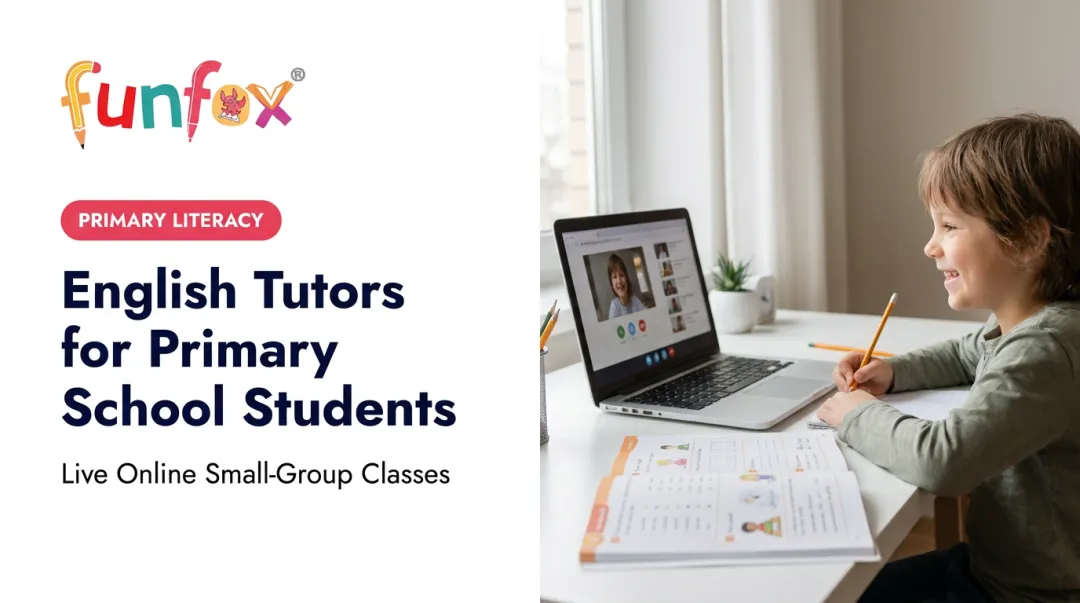
That's the model FunFox is built around. Live 60-minute Zoom classes run weekly with a maximum of six students and a qualified teacher throughout. Sessions are interactive, not recorded videos — students participate, share work, receive real-time feedback, and complete digital worksheets that teachers review individually via Seesaw between classes.
How to Decide
| Factor | Lean Toward In-Person | Lean Toward Online |
|---|---|---|
| Child's year level | Years 1–2 | Years 3–6 |
| Location | Major metro with quality local options | Regional, rural, or limited local specialists |
| Scheduling | Flexible and local | Busy family, need flexibility |
| Budget | Similar | Often more affordable |
| Program structure | Tutor-dependent | Built-in and consistent |
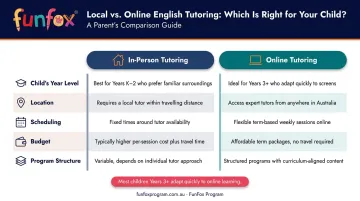
If you're on the fence, trial an online session — particularly for Years 3 and above. Most children adapt quickly, and the quality of the teacher matters far more than the format.
How to Find Primary School English Tutors in Your Area
Start With the School
Your child's classroom teacher or learning support coordinator is often the best first stop. Many schools maintain lists of trusted local tutors or can recommend agencies whose approaches align with how they teach. A teacher referral also reduces the risk of the tutor reinforcing something differently from how the school does it — which can confuse rather than help.
Use Reputable Platforms and Networks
Beyond school referrals:
- Tutoring agency websites and directories (check that tutors list their qualifications clearly)
- Parent forums and local Facebook community groups
- Word-of-mouth recommendations from families in the same year group
Non-negotiable check: Any tutor working with children independently should hold a current Working With Children Check (or the equivalent in your state). Ask for it. Don't assume.
Vet Before Committing
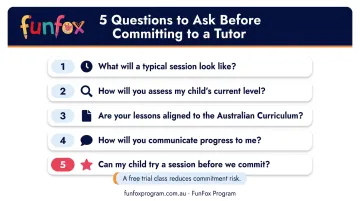
Before signing up for a package or term, ask:
- What will a typical session look like?
- How will you assess my child's current level?
- Are your lessons aligned to the Australian Curriculum?
- How will you communicate progress to me?
- Can my child try a session before we commit?
That last question matters more than most parents realise. FunFox offers free trial classes each term — a low-risk way to see how your child responds to the format and teaching style before committing to a full term.
Tips to Get the Most Out of English Tutoring Sessions
The families who see the fastest progress treat tutoring as one part of a consistent weekly routine — not just an hour that exists in isolation.
A few habits make a real difference:
- Set a specific goal upfront. "Improve at English" is too vague to measure. "Write a four-sentence paragraph with a clear topic sentence by the end of Term 2" gives the parent, tutor, and child something concrete to work toward.
- Build small daily habits between sessions. Ten minutes of reading together each evening, practising three spelling words, or discussing a story's characters at dinner reinforces what's covered in class. Tutoring accelerates progress when home supports it.
- Keep communication open. Regular updates between tutor and classroom teacher prevent conflicting approaches. Ask your tutor for a brief note after each session — what was covered, how your child responded — and pass that feedback to the school teacher as well.
Frequently Asked Questions
How do I know if my primary school child needs an English tutor?
Key signs include falling behind year-level benchmarks, consistently avoiding reading or writing tasks, low confidence, or teacher feedback flagging below-standard progress. Children who appear to be coping but produce minimal or surface-level work can also benefit — gaps don't need to be dramatic to be worth addressing.
What should I look for when choosing a primary school English tutor?
Prioritise Australian curriculum alignment, a specialist literacy focus (not just a general all-subjects tutor), small-group or one-on-one delivery, structured lessons with clear objectives, and regular progress communication. Ask directly how they'll assess your child at the outset and what reporting looks like term to term.
How often should my child have English tutoring sessions?
Short, regular sessions outperform infrequent longer ones — two to three sessions per week of 30 to 60 minutes is the norm for primary-aged students. At least 10 to 12 weeks is needed for meaningful progress to become visible; shorter commitments rarely produce lasting change.
What is the difference between local in-person and online English tutoring for primary students?
Both can be equally effective when well-structured and led by qualified teachers. In-person may suit younger children or those still building screen comfort, while online programs offer flexibility, access to specialists, and are often more affordable. Most children in Years 3 and above adapt to online learning with minimal adjustment.
At what age should a child start primary school English tutoring?
There's no fixed age. Early intervention in Years 1–2 for phonics and foundational reading can be genuinely impactful, and Years 3–4 is when comprehension and writing gaps become clearer and targeted tutoring shows strong results. The right time is when a specific need is identified — not a milestone age.
How much does primary school English tutoring cost in Australia?
Costs vary by format, qualifications, and group size. Private one-on-one tutors typically charge $40–$80 per hour, while structured online programs like FunFox offer term-based pricing — $165 monthly for a 3-month term — which often works out cheaper per session. When comparing options, weigh curriculum alignment and progress reporting alongside price.