Introduction
Picture this: a student spends an hour crafting a persuasive essay about plastic pollution. The arguments are solid, the evidence is there — and then the piece just… stops. No direction. No ask. The reader nods, closes the page, and moves on with their day.
That's the gap a call to action fills.
A call to action (CTA) is the moment in persuasive writing where you stop explaining why something matters and start telling the reader what to do about it. It belongs in school essays, speeches, fundraising letters, and opinion pieces just as much as it belongs on a website.
This guide covers what CTAs are, what makes them work, and real examples across academic and everyday writing contexts — for students, parents supporting literacy at home, and anyone who wants their writing to actually move people.
Key Takeaways:
- A CTA tells readers exactly what action to take — it goes beyond summarising an argument
- Effective CTAs use strong action verbs, clear specificity, and a sense of urgency
- The same argument can require different CTAs for different audiences
- Strong CTAs are one of the markers that distinguish a competent persuasive piece from a memorable one
- With the right practice, students can learn to write CTAs that feel natural — not forced or formulaic
What Is a Call to Action in Persuasive Writing?
Reading Rockets defines persuasive writing as writing in which the writer uses reasons and evidence to convince a reader of an opinion — and notes that a strong conclusion may include a call to action or a thought-provoking statement. That distinction matters.
A conclusion summarises. A CTA mobilises.
| Conclusion | Call to Action |
|---|---|
| "In conclusion, plastic pollution is a serious problem." | "Sign the petition today to demand a ban on single-use plastics in your school." |
| "School uniforms clearly have many benefits." | "Talk to your principal this week about updating your school's uniform policy." |
The conclusion wraps up the argument. The CTA gives the reader somewhere to go with it.
That same move — from argument to action — shows up across every persuasive writing form students encounter:
- Opinion essays — closing with a direct ask of the reader
- Persuasive speeches — ending with a rallying call to the audience
- Letters to the editor — urging readers or decision-makers to act
- Charity and community campaigns requesting donations, signatures, or participation
- Advertising copy that prompts clicks, purchases, or sign-ups
The form changes, but the intent is the same: give the reader something to do next.
Key Elements of an Effective Call to Action
Strong Action Verbs
Effective CTAs almost always open with an imperative verb — a word that commands rather than suggests. Compare "you might want to consider signing" with "sign." One hedges; the other acts.
High-impact CTA verbs across different contexts:
- Civic/community: demand, vote, attend, contact, petition
- Environmental: reduce, switch, sign, join, protect
- Social: speak up, share, support, stand with
- Academic: argue, demonstrate, challenge, choose
Clarity and Specificity
Vague CTAs ("do something about this") give readers nowhere to go. The best CTAs tell readers exactly what to do, when, and ideally how.
Weak: "We should all think about recycling more." Strong: "Write to your local council before Friday asking them to install a recycling bin in every classroom."
Emotional Resonance
A CTA gains power when it connects the action to an outcome the reader cares about. "Every signature helps protect one more sea turtle" doesn't just make an ask — it makes the ask feel worthwhile.
Sense of Urgency
Without urgency, readers delay. Persuasive writers create it through:
- Time-sensitive language: "before the end of term," "by Friday," "act now"
- Reference to worsening conditions: "every week we wait, more habitat is lost"
- Scarcity of opportunity: "this is the last chance to have your say"
Audience Alignment
The same argument lands differently depending on who's reading it. Consider how one case — extending lunch breaks — might close for three different audiences:
- For students: "Raise this at the next school council meeting — your voice counts."
- For parents: "Email the principal this week to request a review of the lunch timetable."
- For teachers: "Consider trialling a 10-minute extension this term and tracking student focus in afternoon lessons."
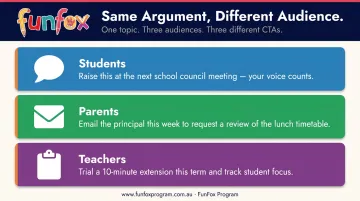
The most effective CTAs don't just ask for action — they ask for the right action from the right person.
Call to Action Examples in Persuasive Writing
Persuasive Essay CTAs (Academic Writing)
Here are three annotated examples showing the difference between weak and strong CTAs in school essays:
Topic: Screen time limits
- Weak CTA: "In conclusion, too much screen time is bad for kids and something should be done."
- Strong CTA: "Talk to your family tonight about setting a shared screen-time agreement — even 30 minutes less per day can make a real difference to sleep and focus."
- Why it works: Specific action, clear timeframe, connects to outcomes the reader cares about.
Topic: School canteen food choices
- Weak CTA: "Schools need to offer healthier food options."
- Strong CTA: "Submit a suggestion to your school canteen committee this term asking them to add at least one new fruit or vegetable option to the menu."
- Why it works: Tells the reader exactly what to do, when, and what to ask for.
Topic: Environmental action
- Weak CTA: "We should all care more about the environment."
- Strong CTA: "Join your school's environment club — or start one — and organise one clean-up activity before the end of this term."
- Why it works: Offers two clear options, adds urgency through a deadline, and empowers rather than lectures.
Persuasive Speech CTAs
Speech CTAs must work aloud — which means rhythm and directness matter more than in written essays. A good speech CTA often closes with a vision of what changes if the audience acts.
Example 1 — Library funding (Year 5–6 assembly): "So the next time you walk past the library, ask yourself: what would this space look like with new books, better chairs, and a place you actually wanted to sit? Then ask your teacher how you can help make that happen. Because this library belongs to all of us."
- Why it works: Opens with a question that makes the listener picture the change, then gives a concrete next step. The closing line creates shared ownership.
Example 2 — School recycling (Year 7): "You don't need to fix the whole world today. You just need to choose the right bin. Start tomorrow. Tell your friends. And let's make our school somewhere we're actually proud of."
- Why it works: Short, punchy sentences build momentum. The ask feels small and achievable, but the vision at the end is bigger than the bin — it's about pride in their school.
Both examples end with the audience visualising the outcome, not just hearing the ask.
Everyday and Real-World CTAs
The same principles appear in real Australian community and charity writing:
| Context | Weak Version | Strong Version |
|---|---|---|
| Charity fundraising | "Please help if you can." | "Donate before 30 June to protect native wildlife this winter." |
| Community notice | "Littering is a problem in our area." | "Join the Clean Up Australia Day event this Saturday at 9am — meet at the oval." |
| School council campaign | "Vote for better school facilities." | "Vote for Maya on Friday — she's already drafted a proposal for new playground equipment." |
| Environmental petition | "Sign if you care about the ocean." | "Sign this petition today so we can present 500 signatures to council by next Wednesday." |
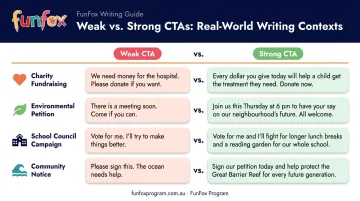
Organisations like RSPCA Australia and WWF-Australia use exactly these techniques — "Report Cruelty," "Donate by 30 June" — because they work.
Marketing and Digital Writing CTAs
The same logic that makes community and charity CTAs effective applies in commercial writing too. Marketing CTAs follow the same principles but tend to be shorter and more direct. Analysing them is a useful exercise for students — spotting what makes each one compelling builds real persuasive writing instincts.
Quick examples:
- "Download your free guide now."
- "Join 50,000+ readers — subscribe today."
- "Start your free trial."
- "Share this post to spread the word."
Each one has a clear verb, a specific action, and often a reason embedded in the ask itself.
How to Write a CTA That Motivates Action
Step 1 — Start With the Reader's Perspective
Before writing a single word of your CTA, ask: What does this reader already care about? A CTA anchored to the reader's own values feels like an invitation rather than a demand. If your audience cares about fairness, frame the action around fairness. If they care about their children's future, make that the emotional hook.
Step 2: Earn the CTA Through the Body of the Writing
A CTA is only as powerful as the argument that precedes it. Writers earn the right to their CTA by building credibility, using evidence, and creating genuine emotional investment throughout the piece. When a well-constructed argument finally arrives at "so here's what you can do," the reader already feels ready to act.
The NAPLAN Persuasive Writing Marking Guide assesses persuasive texts on their text structure, persuasive devices, and ideas — all of which contribute to how effectively a CTA lands.
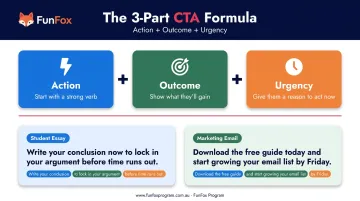
Step 3 — Use the Action + Outcome + Urgency Formula
A practical framework for drafting any CTA:
Action (what to do) + Outcome (why it matters) + Urgency (why now)
| Context | Applied Formula |
|---|---|
| Student essay | "Write to your principal this week [action] asking for a vegetable garden at school [outcome] — the budget decision is made next term [urgency]." |
| Marketing email | "Start your free trial today [action] and see your team's productivity improve in the first week [outcome] — offer ends Sunday [urgency]." |
Step 4: Draft, Read Aloud, Revise
Strong CTAs rarely nail it on the first draft. Write three versions and read each one aloud. The version that sounds most natural and decisive is usually the strongest. Pay attention to your verb choice — "please consider" signals hesitation, while "act now" signals conviction. That single word swap tells the reader exactly how much you believe in what you're asking.
Common Mistakes to Avoid When Writing a CTA
Being Too Vague or Passive
Phrases like "think about this" or "perhaps we could all do better" fail as CTAs because they don't commit to a specific action. The reader needs a clear directive.
- Before: "Maybe we should all try to be more environmentally conscious."
- After: "Switch to a reusable water bottle this week — it's one change that adds up fast."
Piling On Too Many CTAs
Ask your reader to do five things and they'll likely do none of them. Psychologists call this choice overload: when too many options are presented at once, people freeze instead of act. Choose one primary CTA. If a second supporting action is needed, make sure it complements the first rather than competing with it.
Mismatching the CTA to the Audience or Context
Asking a Year 5 student to make a purchase, sign a petition, or donate money misses the mark entirely. The action must match what the reader can realistically do. Tone matters too: academic essay CTAs should feel measured and evidence-backed, while a social media CTA can afford to be punchy and direct.
Getting these three things right — clarity, restraint, and audience fit — puts your CTA in a far stronger position to actually move people to act.
How Children Can Practise Writing Strong CTAs
Persuasive writing is a core part of the Australian Curriculum English from Year 3 through to Year 6 and beyond, with students expected to create texts for specific purposes and audiences. NAPLAN also assesses persuasive writing in Years 3, 5, 7, and 9 — making CTA skills directly relevant to academic performance.
The good news: practising CTA writing at home is easier than it sounds — and it doesn't have to feel like homework.
Three practical activities for parents and children:
The Family Persuasion Letter — Ask your child to write a letter to the family arguing for a change to a household rule (a later bedtime, a new pet, a different dinner night). The letter must end with a clear, specific CTA. Then discuss it together — did the CTA make you want to say yes?
The Club Campaign Speech — Have your child draft a short speech persuading classmates to join a club or activity they love. Focus on ending with a CTA that tells listeners exactly what to do and why it's worth their time.
CTA Spotting — Next time a leaflet comes through the letterbox or a charity appeal arrives in the mail, analyse it together. What verb does it use? Is there urgency? Who is the audience? This trains children to read persuasive writing critically — and write it more intentionally.

For practice that connects directly to the Australian Curriculum, the FunFox Writers Club runs live online writing sessions in small groups (maximum six students) for children in Years 2–6. Sessions are built around exactly the skills assessed in school — constructing arguments, using evidence, and closing writing with purposeful CTAs.
Parents stay informed through Seesaw feedback and end-of-term parent-teacher meetings, so progress is never a guessing game.
If your child is ready to write with more confidence and intention, explore the FunFox Writers Club program at funfoxprogram.com.au.
Frequently Asked Questions
What is a call to action in persuasive writing?
A call to action in persuasive writing is a direct statement, usually near the end of a piece, that tells the reader exactly what to do, think, or feel as a result of the argument. It's a key feature of persuasive texts in both academic essays and real-world writing like speeches, letters, and campaigns.
What are examples of calls to action?
CTAs appear across many contexts: "Sign the petition to ban plastic straws in our school" (persuasive essay), "Donate before the 30th" (fundraising letter), "Speak to your teacher this week" (speech), "Share this post to spread awareness" (social media), and "Start your free trial today" (marketing email).
What makes a call to action effective in persuasive writing?
The most effective CTAs combine a strong action verb, a specific and realistic ask, an emotional connection to why it matters, and a sense of urgency. They feel like the natural conclusion of a well-built argument — not an afterthought tacked on at the end.
How do you end a persuasive essay with a call to action?
After briefly summarising your argument, directly address the reader using an imperative verb ("sign," "write," "join"), state the specific action you're asking for, and paint a brief picture of the positive outcome that action creates. Keep it concise and confident.
What are strong action words for a call to action?
High-impact CTA verbs include: sign, demand, join, donate, speak up, write, choose, act, support, and start. The best verb depends on what your specific audience can realistically do — a classroom audience might "raise the issue," while a parent audience might "email the school."
How can children practise writing persuasive CTAs?
Real-world writing tasks work well — a persuasive letter to the family about a household rule, or a speech convincing classmates to join a club. Structured programs like the FunFox Writers Club offer guided practice in persuasive writing — covering how to build arguments and close with a strong CTA — in small-group online sessions aligned to the Australian Curriculum.