Introduction
Picture this: your child sits down with a book, finger tracing each word, sounding out syllables with visible effort. Or they stare at a blank page when asked to write a few sentences, pencil frozen. As a parent, it's natural to wonder what's going wrong — but what you're usually seeing isn't a lack of effort or ability. It's a gap in foundational literacy skills.
The stakes are real. Research from the Annie E. Casey Foundation found that children who weren't proficient readers by third grade were four times less likely to graduate high school on time. Closer to home, the Grattan Institute's 2024 report found roughly one in three Australian students isn't mastering the reading skills they need.
This guide breaks down the core literacy skills — phonics, fluency, comprehension, and writing mechanics — explaining what each involves, how they build on each other, and what you can do at home to strengthen them.
Key Takeaways
- Reading relies on five core components: phonological awareness, phonics, fluency, vocabulary, and comprehension.
- Writing foundations include transcription skills, sentence construction, planning, and writing for varied purposes.
- Teaching reading and writing together reinforces both skills and accelerates literacy development.
- Home literacy habits — reading aloud, word play, and conversation — are strong predictors of reading success.
- Children who struggle don't need different instruction — they need more explicit, consistent, and intensive support.
The Core Foundations of Reading
Reading isn't a natural ability. Unlike speaking, it requires deliberate instruction across several interconnected skills. The National Reading Panel identified five core components every child must develop to become a proficient reader.
Phonological and Phonemic Awareness
Phonological awareness is the ability to hear and manipulate the sound structure of language — recognising rhymes, clapping syllables, identifying onset and rime. Phonemic awareness is the more specific skill of isolating and manipulating individual sounds (phonemes) within spoken words.
This is a purely auditory, pre-reading skill. No letters involved. And it matters enormously: the vast majority of children who struggle to read have a core deficit in phonological processing, making this the single most important early indicator of reading risk.
Activities that build this skill:
- Clapping syllables in words ("but-ter-fly" = 3 claps)
- Identifying the first sound in a word ("What sound does sun start with?")
- Blending spoken sounds into words ("/d/ /o/ /g/ = dog")
- Rhyme recognition and generation
Phonics and Decoding
Phonics is the systematic understanding of letter-sound relationships. It bridges spoken language to print, enabling children to decode written words when reading and encode them when spelling.
Systematic, explicit phonics instruction — where letter-sound patterns are taught in a logical sequence — is far more effective than incidental or embedded approaches, especially for children at risk of reading difficulties. Decades of research support this consistently, and it holds especially true for struggling readers.
Decoding and encoding are two sides of the same coin. A child who understands that the letters sh make the /sh/ sound can both read "ship" and spell it.
Fluency and Orthographic Mapping
Reading fluency is the ability to read accurately, at a reasonable pace, and with appropriate expression. Fluency matters because decoding is cognitively demanding — when a child has to work hard to sound out every word, there's little mental capacity left to focus on meaning.
This is where orthographic mapping comes in. Through repeated successful decoding, words eventually become instantly recognisable. A child doesn't "memorise" sight words through flashcard drilling — they become automatic by decoding them successfully, again and again.
That growing bank of instantly recognised words frees up cognitive space. And what fills that space matters just as much as creating it.
Vocabulary and Comprehension
Vocabulary is both a cause and an effect of reading skill. Children who read widely build more vocabulary; a richer vocabulary allows them to access more complex texts.
Vocabulary gaps established in the preschool years can compound significantly by upper primary. A child who arrives at school knowing fewer words will fall further behind unless that gap is actively addressed.
Reading comprehension — the ability to interpret, analyse, and make meaning from text — is where all these skills converge. It depends on:
- Background knowledge (you can't infer what you don't know)
- Vocabulary depth
- Metacognitive strategies — predicting, re-reading, self-questioning
- Ability to make inferences beyond what's explicitly stated
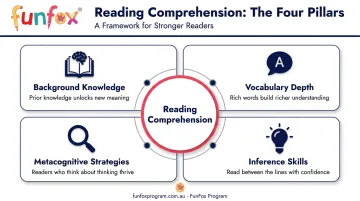
Comprehension is not a single skill but a constellation of them. Shallow "find the answer in the text" exercises practise retrieval — but true comprehension requires children to think across a text, connect it to what they already know, and question what they're reading.
The Core Foundations of Writing
Writing draws on many of the same linguistic resources as reading — but adds the demands of production, planning, and communication. Effective writing instruction targets both transcription (getting words onto the page) and composition (deciding what to say and how to say it).
Transcription Skills: Spelling and Handwriting
Transcription skills — spelling, handwriting, and increasingly keyboarding — need to become automatic. When a child is concentrating hard on how to form a letter or spell a word, that cognitive effort comes directly at the expense of the ideas they're trying to express.
Spelling instruction is especially high-value because it simultaneously deepens phonics knowledge and supports reading development. A child who practises spelling "night" is reinforcing the igh pattern in a way that helps them read it too.
Signs that transcription isn't yet automatic:
- Very slow, laboured writing that doesn't reflect what the child knows orally
- Reluctance to write longer pieces despite having ideas
- Significant spelling inconsistency even on common words
Sentence Construction and Grammar
Sentence construction is the skill of selecting words and syntactic structures to convey intended meaning clearly. Skilled writers produce a variety of sentence types — not just simple subject-verb-object patterns.
Research consistently shows that teaching children to combine short sentences into more complex ones has a measurable positive effect on writing quality. A child who can only write "The dog ran. It was fast. It was big." hasn't yet developed the sentence-level tools to write with precision or style.
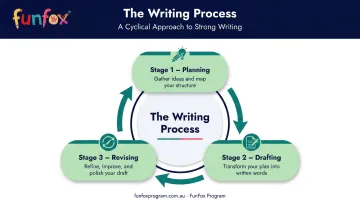
Planning, Drafting, and Revising
Proficient writers invest time before and after writing — not just during it. Young writers tend to skip planning altogether, producing "knowledge-telling": simply writing down what they remember in the order it comes to mind.
Teaching planning strategies has strong evidence behind it and leads to measurably better writing. Useful approaches include:
- Brainstorming ideas before starting
- Grouping related points together
- Using simple outlines to set structure
Revising is just as important, and just as often skipped. Many children treat a first draft as a finished product. Helping them understand that good writing involves rethinking and reshaping is part of building a real writing identity.
Writing motivation matters here too. Children who believe they can write tend to write more — and more practice leads to real improvement. Celebrating effort and progress, rather than demanding perfection, keeps that momentum going.
Writing for Purpose and Audience
Children need experience with multiple text types — narrative, persuasive, informative, descriptive — because skills don't automatically transfer between genres.
A child who writes excellent stories may struggle with a persuasive letter. Exposure to varied writing contexts builds adaptable, confident communicators. FunFox's Writers Club is structured around this: each term focuses on a single genre, building skills systematically rather than treating writing as one undifferentiated activity.
How Reading and Writing Foundations Connect
Reading and writing are not separate subjects. They share the same underlying linguistic knowledge: phonological awareness, spelling patterns, vocabulary, morphology, and text structure all serve both skills simultaneously.
Research published through the Carnegie Corporation found that writing instruction — particularly writing about texts — significantly improves reading comprehension. Students who write summaries, questions, and responses to what they've read understand it better. Fluency improves when children practise spelling and sentence construction. The two skills build each other.
Activities that blend both skills at home deliver compounding benefits:
- Read a story, then ask your child to write what happens next
- Read a short article together, then have them write three questions it raised for them
- After finishing a book chapter, ask them to write a sentence about each character
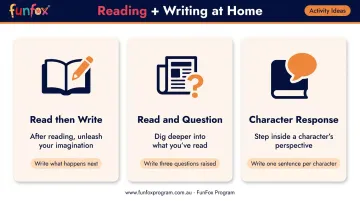
Each activity uses writing to consolidate reading comprehension while building composition skills at the same time.
The FunFox Foundation Club (Years 1–2) applies this directly: reading and writing instruction are woven into the same lessons, so children practise both skills together and learn to move naturally between reading a text and responding to it in writing.
Practical Ways to Build Literacy Foundations at Home
Strong foundations aren't built solely in classrooms. The home literacy environment — the quality of daily conversation, access to books, and purposeful word play — is a meaningful predictor of reading success.
Read Aloud Daily and Discuss What You Read
Reading aloud exposes children to richer vocabulary and more complex sentence structures than they can access independently. Discussion amplifies the benefit: asking "why do you think she did that?" or "what might happen next?" builds comprehension and critical thinking alongside enjoyment.
Don't stop reading aloud once your child can read independently. The vocabulary and ideas in books suitable for a Year 4 student to listen to are far more complex than what they can decode on their own.
Engage in Word Play and Phonics-Based Activities
Phonological awareness activities are most effective when they're playful, brief, and consistent. Try:
- Rhyming games in the car
- I Spy focused on first sounds ("I spy something starting with /k/")
- Syllable clapping for longer words
- Word-building with magnetic letters
- "Sound swapping" — change one sound in a word to make a new one
These don't need to take long. Five minutes of focused word play three or four times a week adds up.
Build Writing Habits Through Low-Stakes Activities
Formal writing assignments carry pressure. Low-stakes writing at home builds fluency and confidence without the anxiety:
- Writing shopping lists together
- Labelling drawings or household objects
- Keeping a simple diary (sentences only, no red pen in sight)
- Writing a postcard to a grandparent
- Leaving notes for each other around the house
Regularity matters more than quality at this stage.
Expand Vocabulary Through Conversation
Meaningful conversation is the most powerful vocabulary builder for primary school children — more so than screen time. Try introducing one "interesting" word a week: use it in conversation, connect it to something your child already knows, and look for it in books or daily life.
For example, introducing "reluctant" might start with: "You were a bit reluctant to try that new food, weren't you?"
Consider a Structured Programme
For children who need more consistent, targeted practice, a structured literacy programme can complement home efforts. FunFox's Readers Club and Writers Club deliver explicit, Australian curriculum-aligned reading and writing instruction in small online groups (maximum six students), so foundational gaps are identified and addressed systematically rather than avoided.
Common Challenges and How to Address Them
Some foundational literacy difficulties are entirely normal at certain developmental stages. Others signal a need for targeted support.
Common early difficulties (typically normal):
- Confusing similar sounds like /p/ and /b/
- Difficulty rhyming before age 5
- Inconsistent blending of sounds in early Year 1
- Slow, laboured writing in Years 1–2
Signs that warrant closer attention:
- Significant difficulty sounding out simple words by the end of Year 2
- Persistent avoidance of reading or writing tasks
- Very slow writing that prevents ideas from being expressed
- Frequent letter/sound confusion well into mid-primary years
- Minimal progress compared to peers despite regular instruction
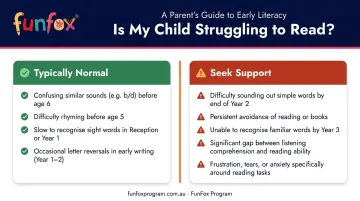
If you're noticing these signs, the research is clear: don't wait. Children who struggle with foundational literacy don't need a different type of instruction. They need the same evidence-based approaches — delivered with greater explicitness, higher intensity, and more consistent repetition. The sooner that support begins, the better the outcome.
Early intervention works. Research consistently shows that structured support in the first years of school produces far stronger outcomes than waiting to see if a child catches up independently — because without targeted help, most don't.
Frequently Asked Questions
What is the foundation for reading and writing?
The foundation for reading includes phonological awareness, phonics, fluency, vocabulary, and comprehension. Writing foundations encompass transcription skills (spelling, handwriting), sentence construction, and planning. Oral language development — the ability to listen, speak, and understand — underpins both.
What are the 5 R's of reading?
The 5 R's of reading refer to Read, Reflect, Recite, Review, and Relate — a framework supporting active engagement with text. Each stage encourages students to interact with content beyond passive reading, building retention and comprehension.
What is the 5-4-3-2-1 reading strategy?
The 5-4-3-2-1 strategy asks students to identify a set number of elements from a text — for example, five facts, four new words, three questions, two connections, and one main idea. It consolidates understanding after reading and works well for primary students from around Year 3 upward.
At what age should children develop foundational reading and writing skills?
Phonological awareness typically develops from ages 3–5, formal phonics and decoding from ages 5–7, and fluency and comprehension from ages 6–9, with writing developing in parallel. Development varies between children, so consistent progress over time matters more than hitting exact age-based milestones.
What are signs a child is struggling with reading or writing foundations?
Watch for these warning signs:
- Persistent difficulty sounding out simple words
- Avoidance of reading or writing tasks
- Very slow progress compared to peers
- Frequent letter or sound confusion past the early years of school
If these patterns persist beyond Year 2, seek a targeted assessment sooner rather than later.