Introduction
There's a particular moment many parents recognise — a four-year-old confidently announcing that the sky looks "magnificent," or a toddler dissolving into tears because they can't find the words to explain what's wrong. Both moments tell you something important: vocabulary isn't just about knowing words. It determines whether a child can reach a thought at all.
Most parents underestimate how much the early years matter. Research published in 2026 found that receptive vocabulary at age 4 predicted reading ability at age 8 in a sample of more than 9,000 Australian children — and that vocabulary at age 5 correlated with reading comprehension at age 10 (r = 0.60). These aren't small effects.
This article covers what vocabulary development actually means, what milestones to expect from birth to age 8, how vocabulary connects directly to reading and writing, and — most practically — what parents can do every day to build it.
Key Takeaways
- Vocabulary development begins at birth, with the most critical window falling between ages 0 and 5
- Children develop four vocabulary types — listening, speaking, reading, and writing — each one building on the previous
- Caregiver language — its quality and variety — is the single strongest driver of early vocabulary growth
- Daily reading aloud, conversation, and word play have a measurable impact on school readiness
- A rich early vocabulary predicts stronger reading comprehension, writing ability, and academic confidence through primary school and beyond
What Is Early Childhood Vocabulary Development?
Vocabulary development is the ongoing process by which children learn new words, grasp their meanings, and use them across listening, speaking, reading, and writing. Not all word knowledge looks the same, though — and understanding the distinction matters for parents.
Receptive vs. Expressive Vocabulary
There are two sides to a child's word knowledge:
- Receptive vocabulary — words a child understands when they hear them
- Expressive vocabulary — words a child actively produces in speech or writing
Receptive vocabulary consistently develops ahead of expressive vocabulary. As the Raising Children Network notes, toddlers aged 1–2 generally understand considerably more than they can say — which is why a baby who isn't talking much yet may still be absorbing language rapidly.
Both sides matter. A child with strong comprehension but limited expressive vocabulary may struggle to communicate ideas clearly. Parents who speak to their child and actively respond to their attempts tend to see faster growth in expressive vocabulary over time.
Where Vocabulary Is Actually Learned
Most early vocabulary isn't taught explicitly. Put Reading First notes that children acquire the meanings of most words indirectly — through daily conversation, listening to adults read aloud, and exploring the world through play. Before formal schooling begins, everyday home life is where most of this word learning actually happens.
Vocabulary Milestones: What to Expect as Your Child Grows
Every child develops at their own pace, but benchmarks help parents notice whether growth is on track — and where a little extra support might help.
Birth to 18 Months
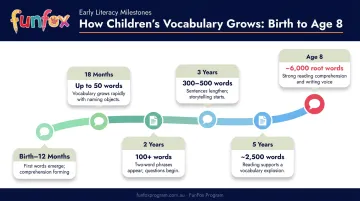
Language comprehension begins well before the first spoken word. By 10–12 months, children respond to simple words and phrases and may say one or two words like "mama" or "bye." According to Speech Pathology Australia, by 18 months most children:
- Understand up to 50 words and some short phrases
- Follow simple one-step instructions
- Say 6–20 single words
- Point to familiar objects when named
Ages 2–5: The Rapid Growth Period
This is where vocabulary truly accelerates. Word counts by age, based on Australian and international guidance:
| Age | Approximate Vocabulary |
|---|---|
| 2 years | 100+ words (CHOP guidance) |
| 3 years | 300–500 words |
| 5 years | ~2,500 words (healthdirect Australia) |
During these years, children move beyond naming words into concept vocabulary — spatial terms (above, behind), descriptive language (smooth, enormous), number words, and early time concepts. This shift matters because concept words underpin classroom instruction from the first day of school.
Ages 5–8: Where Vocabulary Meets Literacy
At school entry, children begin building academic vocabulary alongside everyday words. Research by Biemiller estimates children need vocabulary growth of 1,000 root word meanings per year through the primary grades, reaching approximately 6,000 by end of Year 2. Vocabulary gaps at this stage show up directly in reading comprehension results — including on NAPLAN assessments — making early support particularly well-timed.
Warning Signs Worth Noticing
Early attention makes a real difference. Consider seeking support if:
- By age 2, your child isn't saying approximately 50 words or combining words into simple phrases
- By age 3, they can't use 3-word sentences or follow 2-part instructions
- You notice limited variety in the words they use, or difficulty expressing basic needs
The Four Types of Vocabulary Children Build
Educators typically refer to four distinct vocabulary types, and they develop in a fairly consistent sequence.
| Vocabulary Type | What It Means |
|---|---|
| Listening | Words understood when heard |
| Speaking | Words used in conversation |
| Reading | Words recognised and understood in print |
| Writing | Words a child can produce independently in written form |
Listening and speaking vocabularies develop first and form the foundation for reading and writing. Rich oral language experience at home — long before formal schooling — matters enormously because of this sequence. A child who arrives at school with a wide speaking vocabulary has a genuine head start in learning to read and write.
The Three-Tier Framework Used in Australian Classrooms
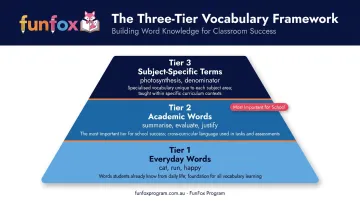
Many Australian teachers organise vocabulary instruction using a framework developed by Beck, McKeown, and Kucan, widely used in Victorian Department of Education guidance:
- Tier 1 — Everyday words children already know (cat, run, happy)
- Tier 2 — High-frequency academic words that appear across subjects but rarely in casual speech (summarise, distinguish, analyse, predict)
- Tier 3 — Subject-specific technical terms (photosynthesis, denominator)
Tier 2 words are the most important focus for school-age vocabulary development. A Year 4 student who doesn't know what "justify" or "evaluate" means will struggle to answer an exam question correctly — even if they know the content. These words appear constantly in schoolwork but almost never in everyday conversation, which is why many children arrive at school without them.
How Vocabulary Development Powers Reading and Writing
The Reading Connection
A child cannot understand what they're reading if they don't know what the words mean. This sounds obvious, but the implications are significant. Research by Suggate et al. (2018) found that reading comprehension at age 12 was predicted by vocabulary at 19 months — before most children have started walking steadily.
The relationship is also compounding. Children with stronger vocabularies become better readers; better readers encounter more words and build vocabulary faster. Those falling behind encounter fewer complex words and fall further behind. Stanovich (1986) described this as the Matthew Effect in reading — a widening gap where early advantage accumulates and early disadvantage compounds.
Chall and Jacobs (1983) found this gap becoming measurable by Year 4, with vocabulary knowledge the first skill to decline. By that point, children at risk were already a year behind grade norms — and more than two years behind by Year 7.
The pattern is consistent: vocabulary strength in the early years shapes how far a child can go as a reader, and how quickly the gap widens if they fall behind.
The Writing Connection
That same vocabulary strength carries directly into writing. Research by Wood et al. (2018) found that lexical diversity in children's written narratives — the variety of different words used — was more strongly correlated with reading vocabulary than total word count for students in Years 3–5.
Children with richer vocabularies write with more precision and nuance, moving beyond repetitive words to language that actually conveys meaning. In practical terms, this shows up in narrative writing, persuasive tasks, and the extended response formats Australian schools increasingly test from Year 3 onward.
The Vocabulary Gap
The difference in word exposure between children from language-rich and language-limited environments can emerge as early as 18 months. Hart and Risley's landmark 1995 research estimated children from professional families heard roughly 45 million words by age 4, compared to 13 million for children from lower-income families.
Later research (including Gilkerson et al., 2017, using all-day recordings) suggests a smaller gap than the original 30-million-word claim — but the directional finding holds. Children from more verbally rich home environments arrive at school with substantially larger vocabularies. The Australian AEDC 2024 National Report puts this in local terms: 7.7% of Australian children are developmentally vulnerable in the language and cognitive skills domain at school entry.
Practical Ways Parents Can Build Vocabulary at Home
The good news: none of what follows requires special resources — just a little attention to the words you choose and the conversations you invite.
Talk More — and More Specifically
Research by Rowe (2012) found that it's not just how much parents talk, but how varied and how wide-ranging the language is that predicts later vocabulary. Rather than always using the simplest available word, try:
- Narrating what you're doing ("I'm grating the parmesan — it's sharp and salty")
- Using descriptive language deliberately ("the traffic is gridlocked — that means completely stuck")
- Asking open-ended questions that require more than yes/no answers
Weisleder and Fernald (2013) confirmed that child-directed speech — language spoken to the child, not overheard in the background — predicted vocabulary at 24 months. Presence in the conversation matters more than ambient noise.
Read Aloud Daily
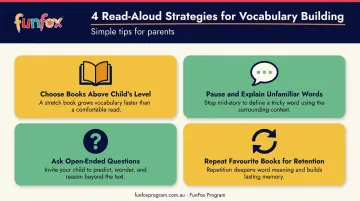
Shared reading is one of the most well-researched vocabulary-building activities available. Raising Children Network recommends aiming for at least one book every day. To get more out of it:
- Choose books slightly above your child's independent level
- Pause on unfamiliar words and explain them in context
- Ask questions: "Why do you think she felt nervous?" rather than "Did she feel nervous?"
- Repeat favourite books — Horst, Parsons, and Bryan (2011) found that 3-year-olds who heard the same stories repeatedly retained new vocabulary significantly better than those hearing different books each time
Play with Words
Frame vocabulary as something curious, not academic:
- Introduce one new word at breakfast and challenge everyone to use it throughout the day
- Swap synonyms mid-conversation: "another word for enormous is colossal"
- Hunt for specific word categories on walks or shopping trips
- When your child asks "what does that mean?", treat it as a genuine success, not an interruption
Get Out and Name the World
Word games at home build familiarity, but children retain vocabulary most durably when they experience the concepts behind the words. A trip to the market introduces abundant, fragrant, seasonal. The beach offers erode, current, horizon. Narrating what you observe together — and naming it precisely — builds the descriptive and categorical vocabulary that underpins school comprehension.
Structured Support When You Want It
For parents who want curriculum-aligned support alongside what they do at home, FunFox's Readers Club and Writers Club are built for exactly this. Classes run in groups of no more than six students, with teachers trained to expose children to rich language through quality texts and creative writing tasks — reinforcing the same vocabulary foundations you're building every day.
Frequently Asked Questions
At what age do children develop vocabulary?
Vocabulary development begins from birth, with comprehension forming before speech. First words typically appear around 12 months, and the most rapid growth occurs between ages 2 and 5. Vocabulary continues expanding throughout childhood and into adolescence.
What are the four types of vocabulary development?
The four types are listening, speaking, reading, and writing vocabulary. They develop in roughly this sequence, with listening and speaking laying the foundation for reading and writing.
How does vocabulary development affect reading comprehension?
Vocabulary knowledge is directly tied to comprehension. A child cannot understand texts containing words they don't know, which is why early vocabulary size is one of the strongest predictors of reading success at school.
How can parents help with vocabulary development at home?
Everyday conversation, reading aloud, word games, and narrating daily experiences are among the most effective strategies. No special resources are required — quality and variety of language matter more than any particular tool.
What is the vocabulary gap and why does it matter?
The vocabulary gap refers to the significant difference in word exposure between children from different home environments, observable as early as 18 months. It has lasting effects on reading ability, school readiness, and academic outcomes well into the secondary years.