Most young writers default to this checklist approach because nobody has shown them a better way. Physical features get listed like items at a supermarket, and the reader feels nothing. No curiosity, no connection, no desire to keep reading.
Writing a vivid character description is one of the most valuable skills a student can develop, and it's directly assessed in NAPLAN under Criterion 4 (Character and Setting) and Criterion 5 (Vocabulary). Higher-scoring narratives don't just name characters — they build them through actions, speech, thoughts, and carefully chosen detail.
This guide covers what makes character descriptions work, a step-by-step process to write them, key elements to include, common mistakes to avoid, and three exercises to practise.
Key Takeaways
- A great description creates a feeling about a character, not just a photograph of them
- Show rather than tell — actions, habits, and sensory details reveal personality more vividly than direct statements
- Spread description across the story — don't dump it all in one paragraph
- Clothing, voice, and body language reveal personality as much as physical appearance does
- Every character detail should do double duty — revealing who they are, not just what they look like
What Makes a Character Description Truly Stand Out?
The Checklist Problem
Most character descriptions fail the same way: they list features instead of creating impressions. Here's what that looks like in practice:
Weak: "Mr Twit was a large, messy man with a lot of hair."
Strong: "The whole of his face except for his forehead, his eyes and his nose, was covered with thick hair."
Both describe the same thing. But Dahl's version creates an immediate, slightly unsettling impression — you feel something about Mr Twit before you've even been told he's unpleasant. That's the difference between a checklist and a character description that works.
The goal isn't to photograph your character. It's to create an impression — so the reader feels something about who this person is.
Show, Don't Tell
Instead of writing "she was nervous," show what nervousness looks like:
- Chewed-down nails
- Fingers that won't stay still
- A voice that trails off mid-sentence
Roald Dahl does this with Mrs Twit: "If a person has ugly thoughts, it begins to show on the face." He doesn't say Mrs Twit is cruel. He shows it written on her skin.
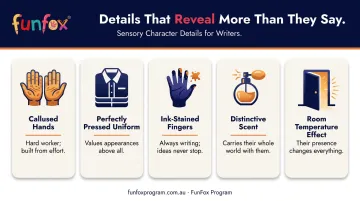
Details That Reveal More Than They Say
Every physical detail should earn its place by telling us something about the character's personality or history:
- A character with calluses on their hands works hard with those hands
- A character whose uniform is perfectly pressed every single day cares deeply about appearances
- A character with ink stains on their fingers is probably always writing something
- A character who smells of sawdust, lavender, or something metallic carries their world with them
- A character who makes the room feel warm — or cold, or electric — leaves an impression before they've said a word
Description isn't only visual. The more senses you draw on, the more present your character feels on the page.
How to Write a Character Description: Step-by-Step
These five steps break character description into manageable pieces — so writers can build a vivid, believable person without freezing up at a blank page.
Step 1: Know Your Character Before You Write
Before a single word goes on the page, answer these questions:
- What does this character care about most?
- What are they afraid of?
- What habit do they have without thinking?
- What do they want that they can't quite have?
Knowing who the character is on the inside makes the outside description feel true rather than invented. The details will choose themselves once you know the person.
Step 2: Choose 3–5 Details That Matter Most
Less is more. A reader doesn't need to know every feature — they need the features that say something important.
Ask: What would make this person recognisable in a crowd? What detail would make a reader remember them?
Dumbledore's introduction in Harry Potter and the Philosopher's Stone is a masterclass in selective detail: "He was tall, thin, and very old, judging by the silver of his hair and beard." Three facts. Enormous impression. J.K. Rowling adds his purple cloak and high-heeled buckled boots, and suddenly we know this is someone who doesn't care what anyone thinks of him.
Step 3: Use Comparisons — Similes and Metaphors
Comparing a feature to something familiar creates instant imagery. Two examples from children's literature that do this well:
- In Matilda, Miss Trunchbull's body "seemed to swell up like a bullfrog's" — one simile, and the physical threat is immediate
- Dumbledore's nose was "very long and crooked, as though it had been broken at least twice" — not just a shape, but a hint of a story
Young writers can try the same approach: hair the colour of autumn leaves, a voice that rumbles like distant thunder — or, more unexpectedly, a laugh that sounds exactly like a drawer being yanked open.
Step 4: Bring in Body Language and Movement
How a character moves tells us as much as what they look like. Compare these two:
- A shy character enters the classroom looking at the floor, shoulders pulled in, sliding into the nearest seat without making eye contact
- A confident character strides in, drops their bag with a thud, and starts talking before they've even sat down
Same situation. Completely different people.
Teach Starter's STEAL characterisation framework — Speech, Thoughts, Effect on others, Actions, Looks — is a useful tool here, reminding writers that personality comes through in what characters do, not only in what they look like.
Step 5: Weave Description Into the Story
The biggest structural mistake students make is pausing the story to deliver a full paragraph of description. This stops all momentum.
Instead, spread details across the narrative:
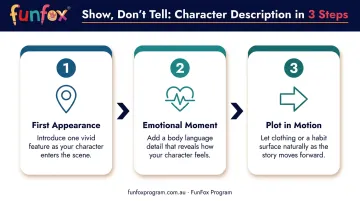
- Introduce one feature when the character first appears
- Add a body language detail during an emotional moment
- Let clothing or a habit appear naturally as the plot moves forward
A detail dropped mid-action — the way a hand tightens on a strap, the coat that's two sizes too big — lands far harder than anything listed in a static opening paragraph.
Key Elements to Include in Your Character Description
While every character is different, strong descriptions typically draw from these building blocks.
Physical Appearance
Cover the basics — height, build, hair, eyes — but prioritise the unusual. Generic features are forgettable; distinctive ones stick. Ask: what would this person look like to a stranger seeing them for the first time? What would that stranger notice and remember?
Clothing and Personal Style
What a character wears reveals personality without explanation:
- Miss Trunchbull's brown cotton smock and wide leather belt signal severity and physical authority — before she speaks a single word
- Dumbledore's floor-sweeping purple cloak and high-heeled buckled boots communicate magical eccentricity and complete self-assurance
Neither description uses a single adjective to tell us what to think. The clothes do the work.
Voice and Speech Patterns
This is one of the most overlooked elements of description. Consider:
- Does the character speak in short, clipped sentences or long ones that wind through several ideas before stopping?
- Do they whisper, or boom?
- Do they use formal language or slang?
A character who answers every question with a question sounds very different from one who never asks anything at all.
Body Language and Emotional Expression
Facial expressions, gestures, and posture are windows into a character's feelings. Here are six common cues to draw from:
| Body language | What it often reveals |
|---|---|
| Crossed arms | Defensiveness or discomfort |
| Drumming fingers | Impatience |
| Avoiding eye contact | Shyness, guilt, or fear |
| Standing very still | Control, calm, or tension |
| Touching the face | Uncertainty or self-consciousness |
| Leaning forward | Interest, urgency, or aggression |
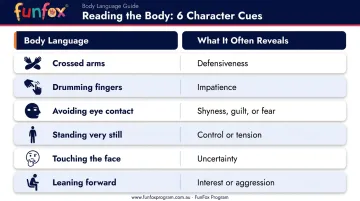
Used sparingly, these physical cues carry more emotional weight than direct statements. Showing a character drum their fingers tells readers far more than writing "she was impatient."
Common Mistakes Young Writers Make
Mistake 1 — The Laundry List
Before: "Jess had red hair, green eyes, a small nose, freckles on her cheeks, and was quite tall for her age."
After: "Jess's red hair caught the light whenever she turned her head — which she did constantly, because she never wanted to miss anything."
The second version uses one physical detail but gives us the personality underneath it. One well-chosen detail does more work than a full inventory ever could.
Mistake 2 — Telling Instead of Showing
"She was kind" tells us nothing we can see. Kindness needs to be demonstrated:
She noticed the new kid had nowhere to sit and moved her bag without being asked.
Research from Scholastic recommends teaching students from Year 3 upwards to show how characters respond through actions, thoughts, and dialogue — rather than simply labelling their traits.
This shift from telling to showing consistently produces the biggest improvement in student writing. It's also the one most teachers say students resist at first.
Mistake 3 — Generic Vocabulary and Overused Phrases
According to the NAPLAN Narrative Writing marking guide, higher-scoring narratives rely on precise, effective vocabulary rather than vague adjectives and stock phrases. Descriptions like these create no real picture:
- "nice eyes"
- "neat hair"
- "big smile"
- "tall for his age"
If a description could fit a thousand different people, it needs work. Encourage students to find original comparisons — and to avoid reducing characters to cultural or physical stereotypes.
Practice Exercises to Sharpen Character Description Skills
Exercise 1 — The Three-Detail Challenge
Choose a character — real or invented — and describe them using only three details. The catch: each detail must reveal something about their personality, not just their appearance.
This forces deliberate, selective thinking. Writers who struggle with over-listing often find this exercise harder than expected — and more useful.
Exercise 2 — Habit + Emotion + Relationship
Write a short description that includes:
- One visible habit (biting nails, tucking hair behind their ear constantly)
- One core emotion (always on edge, quietly content)
- One detail hinting at a close relationship (a worn photo in their pocket, a bracelet that's slightly too big)
Experienced authors use exactly this technique to create multi-layered characters quickly. Try it — aim for under 80 words total.
Exercise 3 — Practice With Guided Feedback
The real skill-building happens when students apply these techniques and get specific feedback. FunFox's Writers Club gives primary school students exactly this: structured character description practice in small online groups of no more than six, with personalised feedback from trained teachers through the Seesaw platform.
The program covers narrative writing across Term 2, weaving character development through the curriculum alongside vocabulary, sensory language, and sentence-level skills — all aligned to the Australian curriculum.
Frequently Asked Questions
Frequently Asked Questions
What are some good character description examples?
Roald Dahl's description of Mr Twit, whose face is entirely covered with thick, messy hair, creates an immediate impression through one specific detail. Rowling does the same with Dumbledore — silver hair, a purple cloak, a crooked nose — signalling age, magic, and eccentricity before he says a word. Both work because the physical details imply personality rather than just cataloguing a body.
What are 10 good character traits to include in a description?
Curious, cautious, impulsive, generous, secretive, warm, stubborn, observant, clumsy, and calm are a solid starting point. The best descriptions don't state these traits — they show them through specific actions, habits, or reactions that allow readers to draw their own conclusions.
How long should a character description be?
There's no fixed length. A minor character might need only one memorable sentence; a main character deserves detail spread across the whole story. Length is determined by the character's importance to the plot, not by any rule.
How do you describe a character without it sounding like a list?
Embed description into action. Reveal a character's red hair when the wind blows it across her face during an argument, not in a standalone sentence. Spreading details through scenes keeps the story moving and makes each detail feel earned rather than catalogued.
Should you describe a character's personality or just their appearance?
Both — and ideally through the same detail. Physical features are anchors, but habits, reactions, and speech patterns are what make readers care. Before adding any description, ask: what does this detail tell us about who this person really is?