
Introduction
Picture your child sitting with a book, stumped by a question — not because they don't know the answer, but because they've never learned to work through the problem themselves. That ability to pause, reason, and reach a conclusion? That's critical thinking, and it's one of the most valuable skills a child can build.
Many parents assume it's something schools address in high school — but the primary years are actually the ideal window. Even young children can learn to question, reason, and evaluate when given the right environment to practise.
This article covers what critical thinking actually means, why it matters for children specifically, the core skills worth developing, and practical strategies for nurturing them at home and in the classroom.
Key Takeaways
- Critical thinking is a cluster of learnable skills — not a fixed trait or something reserved for older students
- Australian children aged 8–12 are already navigating social media, making early critical thinking essential
- The Australian Curriculum recognises it as one of seven core General Capabilities — meaning schools are expected to teach it, and students are expected to use it
- Analytical thinking, questioning, and reflective habits can all be built through everyday activities
- Intentional reading and writing practice are among the most effective ways to build these skills
What Is Critical Thinking?
Critical thinking is the ability to actively analyse information, question assumptions, consider different perspectives, and reach a well-reasoned conclusion — rather than accepting whatever's placed in front of you.
The Foundation for Critical Thinking defines it as: "the intellectually disciplined process of actively and skillfully conceptualising, applying, analysing, synthesising, and/or evaluating information gathered from observation, experience, reflection, reasoning, or communication, as a guide to belief and action." (Scriven & Paul, 1987)
What Critical Thinking Looks Like for Children
For children, critical thinking doesn't mean being argumentative or contrarian. It means developing the habit of asking:
- "Why?"
- "How do I know that's true?"
- "Could there be another explanation?"
That's it. Thinking before reacting. Questioning before accepting.
These questions are the bridge between simply absorbing information and actually understanding it — which is where critical thinking parts ways with rote learning.
How It Differs from Memorisation
Rote learning — recalling facts, repeating information as told — sits at the bottom of Bloom's Taxonomy. Critical thinking occupies the upper levels: analysis, evaluation, synthesis, and creation. Modern education increasingly values these higher-order skills because facts can be looked up; reasoning can't be outsourced.
Why Critical Thinking Matters for Children
The Digital Environment Has Changed Everything
According to the ABS, 90% of Australian children aged 5–14 did at least one hour of screen-based activity per week outside school in 2021–22 — and the share doing 20+ hours per week climbed from 16% to 24% in just four years. Meanwhile, eSafety found that 84% of Australian children aged 8–12 had used at least one social media or messaging service in 2024.
Children are encountering more information, faster, at younger ages. Without the ability to evaluate sources and spot misleading content, they have no filter.
It's Built Into the Australian Curriculum
The Australian Curriculum includes Critical and Creative Thinking as one of its seven General Capabilities — structured around four elements: Inquiring, Generating, Analysing, and Reflecting. This isn't an add-on; it's woven into what teachers are expected to develop across all subjects.
It Supports Every Subject, Not Just English
Critical thinking underpins:
- Maths — multi-step problem solving and logical reasoning
- Science — forming hypotheses and evaluating evidence
- HSIE — understanding multiple perspectives on events and societies
- English — inferring meaning, analysing texts, constructing arguments
The Long-Term Professional Picture
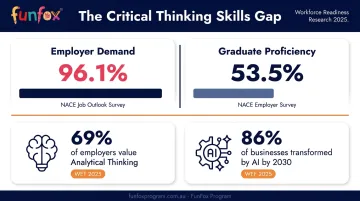
The NACE Job Outlook 2025 found that 96.1% of employers rate critical thinking as very or extremely important — yet only 53.5% consider graduates sufficiently proficient. The WEF Future of Jobs Report 2025 reinforces this, identifying analytical thinking as a core skill for 69% of employers — with AI expected to transform 86% of businesses by 2030.
Critical thinking is what automation cannot replicate. Children who build it early arrive at high school — and eventually the workforce — already practised at reasoning through problems that don't have a single right answer.
It Builds Confidence, Not Just Competence
Children who learn to reason through problems stop waiting to be told the right answer. They become more independent, more curious, and more resilient when things get difficult. That shift from reliance to reasoning is one of the clearest markers of a confident learner.
Core Critical Thinking Skills Every Child Should Develop
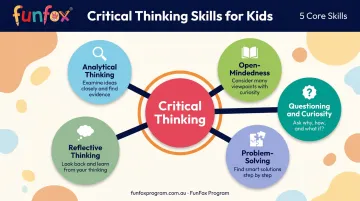
Critical thinking is actually a cluster of related habits, not a single ability. These five are the most important for primary-aged children.
Analytical Thinking
Breaking down a problem into smaller parts to understand it better. For a child, this might mean identifying the main idea in a paragraph, spotting a flaw in a classmate's argument, or asking why a story character made a particular choice rather than simply accepting it.
Open-Mindedness
The willingness to consider a perspective different from your own without immediately rejecting it. In group settings, open-minded children listen more carefully and update their thinking when they encounter new information, rather than defending a first impression at all costs. That flexibility makes collaboration genuinely productive.
Questioning and Curiosity
Natural curiosity — asking why, what if, and how do we know? — underpins all the other skills. Children who ask more probing questions build stronger reasoning skills over time. When parents value questions rather than just supplying answers, they model exactly the mindset they want to develop.
Problem-Solving
Putting critical thinking into action: identifying what the actual problem is, generating possible solutions, evaluating each one, and choosing the best path. The same skill looks different at different ages:
- A Year 3 student working through a multi-step maths word problem
- A Year 5 student mediating a disagreement between friends fairly
- Any child learning to pause before reacting and think through options
Reflective Thinking
Looking back on their own reasoning: Did that work? Why or why not? What would I change? This metacognitive habit is especially powerful for young learners.
The Education Endowment Foundation reports that metacognition and self-regulation strategies produce around +8 months of additional academic progress compared to standard instruction — among the strongest evidence-based gains in primary education research.
Practical Ways to Develop Critical Thinking in Children
Critical thinking isn't taught through one lesson. It's developed through consistent habits and the right environment. These strategies are accessible for everyday life — no formal curriculum required.
Ask Open-Ended Questions
Shift from closed questions ("Did you like the book?") to questions that require reasoning:
- "Why do you think the character made that choice?"
- "What would you have done differently?"
- "Do you think the ending was fair? Why?"
- "What would happen if the story had started differently?"
Questions like these push children to articulate why they think something — which is where the real reasoning happens.
Encourage Reading Beyond the Surface
Reading develops critical thinking when it's done with intention. Encourage children to:
- Predict what happens next before turning the page
- Question a character's motives rather than just tracking the plot
- Connect themes to real life
- Decide whether they find the author's argument convincing and why
When children read this way, they're not just following a story — they're practising the same evaluative thinking that NAPLAN and high school English assessments demand.
Introduce Debate and Discussion
Give children a topic and ask them to argue both sides — including the side they personally disagree with. Start with low-stakes, engaging topics ("Should school days start later?" or "Is it ever okay to break a rule?") and build toward more complex questions over time.
This builds open-mindedness, logical reasoning, and the ability to anticipate counterarguments — three skills that transfer directly into academic writing.
Use Logic Puzzles and Real-World Scenarios
Strategy games, riddles, logic puzzles, and "what would you do if...?" scenarios all develop sequential reasoning and decision-making. A 2024 cluster randomised controlled trial found that board-game-based learning can support cognitive and educational development in primary school students — evidence that play-based reasoning activities have real academic value.
Practice Opinion Writing and Structured Argumentation
Ask children to write (or explain aloud) an opinion with supporting reasons. The goal is to move from "I think X" to "I think X because of Y, and here's why Z doesn't contradict that."
Structured argumentation — tasks that require both evidence and reasoning — is one of the most effective bridges between literacy and critical thought. Done regularly, it's also the foundation of strong essay writing at high school level.
How Reading and Writing Nurture Critical Thinking
Reading comprehension — done well — requires inference, interpretation, and evaluation. These are forms of higher-order thinking that overlap directly with critical reasoning. Writing, particularly persuasive and analytical writing, adds another layer: it forces children to organise their ideas, support their claims, and account for opposing views.
Carnegie's Writing to Read research confirms that writing instruction can actively improve reading outcomes — the connection runs both ways. A literacy program that combines reading analysis with structured writing isn't just teaching English; it's building reasoning habits.
How FunFox Builds Both Skills Together
The FunFox Readers Club (Years 3–6) structures its curriculum around three explicit sections:
- Critical Thinking Skills — cultivating a mindset of inquiry and analytical reasoning
- Comprehension Strategies — adapting reading approaches from surface scanning to deep analysis
- Literary Analysis — introducing literary devices, contextual interpretation, and reading between the lines
The Writers Club (Years 1–6) mirrors this with a genre-based yearly arc. Term 3 focuses specifically on persuasive writing, where students build structured arguments with evidence — directly building the reasoning skills that carry across every subject.
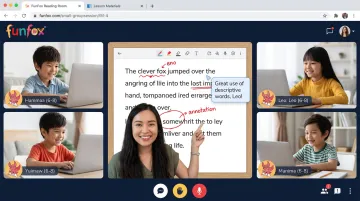
Both programs use small groups of three to six students, enabling peer-to-peer discussion, collaborative activities, and more personalised feedback than a larger class allows. Teachers respond to every worksheet through Seesaw. That write–feedback–revise cycle is reflective thinking in practice.
The FunFox Foundation Club (Years 1–2) introduces these habits even earlier, connecting comprehension to written expression from the start.
Frequently Asked Questions
What are the key critical reasoning skills?
The core skills are analytical thinking, open-mindedness, inference, problem-solving, and reflective thinking. These work together — analysis breaks information down, inference draws conclusions from it, and reflection evaluates whether the reasoning was sound.
What are the 5 C's of critical thinking?
A common educational framework lists Curiosity, Creativity, Clarity, Critical Analysis, and Communication. The more formally established version — the 4 C's of 21st-century learning — covers critical thinking, creativity, collaboration, and communication.
At what age can children start developing critical thinking skills?
Earlier than most parents expect. Research shows children as young as three begin evaluating source reliability and distinguishing accurate from inaccurate information. Primary school (ages 5–12) is a particularly formative window for building these skills intentionally.
How does reading help develop critical thinking in children?
Reading requires children to infer meaning, question characters' motives, predict outcomes, and evaluate ideas — especially when paired with discussion questions that go beyond "what happened?" Guided reading that asks children to interpret and analyse builds the same cognitive habits as formal reasoning tasks.
What is an example of critical thinking for a child?
A child asking "Why did the character lie — and was it the right thing to do?" after reading a story is engaging in critical thinking. So is a child who considers two solutions to a problem and explains which is fairer and why.
How can parents encourage critical thinking at home?
Ask open-ended questions during meals, car rides, and after reading. Encourage children to explain their reasoning, not just their answers. Valuing the process of working something out — over getting to the right answer quickly — does more for a child's thinking than any single activity.