This guide covers what "construction" means in both senses, how to use it confidently in a sentence, and how understanding sentence construction helps children write with more clarity and variety. Whether you're a parent supporting homework at home or a student working through a writing task, there's something practical here for you.
Key Takeaways
- "Construction" refers to building something or the grammatical arrangement of words in a sentence
- Every complete sentence requires a subject and a verb — no exceptions
- The four sentence types are simple, compound, complex, and compound-complex
- Common errors like run-on sentences and misplaced modifiers are easy to fix once you know what to look for
- Guided feedback builds sentence skills faster than practising alone
What Does "Construction" Mean?
"Construction" is a noun with two distinct layers of meaning, and both come up regularly in school.
The physical sense: Oxford Learner's Dictionaries defines construction as "the process or method of building or making something, especially roads, buildings and bridges." This is the meaning children encounter in everyday reading — think building sites, cranes, and concrete.
The grammatical sense: The same dictionary defines it as "the way in which words are used together and arranged to form a sentence, phrase, etc." This is the meaning teachers use when they say a sentence is "well-constructed" or ask students to vary their sentence construction in a story.
Both meanings matter at school. The key to telling them apart is context:
- "The construction site was noisy." — physical, refers to a building project
- "The sentence construction was confusing." — grammatical, refers to how the sentence was written
Seeing both uses in real sentences makes the distinction stick. That's exactly why Reading Rockets recommends exposing children to new vocabulary across multiple contexts — reading it, writing it, and discussing it — rather than memorising definitions in isolation.
"Construction" in a Sentence: 20+ Examples Across Contexts
Seeing a word used in varied, real-world contexts helps children absorb its meaning and feel confident using it themselves. The examples below are grouped by context and range in complexity.
Everyday and Physical Building Contexts
Good starting points for early to upper primary students:
- The road is under construction, so we took a different route to school.
- Workers at the construction site wore hard hats and bright orange vests.
- The construction workers started early each morning before the traffic got busy.
- Dad drove past the building and said it had been under construction for over a year.
- Our new school library is still under construction, but it should be ready by Term 3.
- The bridge construction caused long delays for commuters crossing the river each day.
- Mia watched the construction crane lift a giant steel beam high above the street.
- The construction of the new sports oval took the whole of last year to complete.
Academic and Formal Contexts
Notice how the word takes on a more formal register in these examples — useful for older students tackling essay and report writing:
- The construction of a strong argument requires evidence, reasoning, and a clear conclusion.
- The construction of the harbour bridge took eight years and involved thousands of workers.
- Engineers oversaw the construction of the tunnel to make sure it met safety standards.
- The documentary explored the construction of the ancient aqueduct and how it still functions today.
- Her report on the construction of the new hospital included detailed timelines and cost estimates.
Grammatical and Language Contexts
These examples are worth pairing with a writing lesson — they show students how "construction" applies to their own sentences, not just buildings:
- The sentence construction made the meaning unclear, so her teacher asked her to rewrite it.
- Parallel construction improves the flow of a paragraph and makes lists easier to read.
- Varying your sentence construction keeps writing interesting and stops it from feeling repetitive.
- The complex construction of the final paragraph showed that she understood how clauses work.
- His teacher praised the confident construction of his opening sentence.
The more contexts a child encounters a word in, the more naturally it becomes part of how they think and write.
The Four Types of Sentence Construction
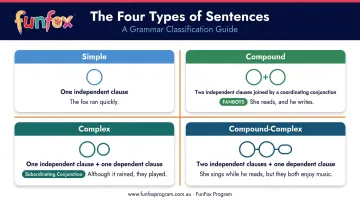
Knowing the four sentence types gives students real tools for improving their writing. Varying sentence construction keeps writing interesting, prevents repetition, builds precision, and helps children express more complex ideas as they move through school.
The Australian Curriculum's National Literacy Learning Progression tracks students from writing simple sentences correctly in early primary through to selecting simple, compound, and complex sentences to express and connect ideas in upper primary.
Simple Sentence Construction
A simple sentence contains one independent clause — a subject and a verb, and sometimes an object. Nothing more is needed.
- The dog barked. (subject + verb)
- She reads every night before bed. (subject + verb + object)
- The old cat slept on the warm mat. (subject + verb + detail)
What makes these "simple" isn't that they're boring — it's that each contains just one complete thought.
Compound Sentence Construction
A compound sentence joins two or more independent clauses using a coordinating conjunction (the FANBOYS: for, and, nor, but, or, yet, so) or a semicolon.
- She wanted to read, but she was too tired.
- The rain started, so we ran inside.
- He finished his homework; then he went outside to play.
Each example could be split into two simple sentences. The conjunction shows the relationship between the two ideas.
Complex Sentence Construction
A complex sentence combines one independent clause with one or more dependent clauses introduced by subordinating conjunctions like because, although, when, unless, or since.
- Although it was raining, they decided to walk to school.
- She practised every day because she wanted to improve.
- When the bell rang, the students packed up their books.
The dependent clause adds detail or context — it can't stand alone as a sentence, but it makes the meaning richer.
Compound-Complex Sentence Construction
This structure has at least two independent clauses and one dependent clause. It's typically introduced in upper primary and secondary school.
Although she was nervous, she gave her speech confidently, and the audience applauded.
- Although she was nervous = dependent clause
- she gave her speech confidently + the audience applauded = two independent clauses
Because the project was due on Friday, Liam worked late, but he still finished on time.
These sentences require careful planning. Students need to track every clause and confirm the overall meaning stays clear — one loose connection can muddy the whole sentence.
Key Elements of a Well-Constructed Sentence
Every well-constructed sentence relies on a handful of core elements: a subject, a verb, and the supporting parts that give it clarity and depth. Knowing how these pieces work together gives students a framework they can apply to any writing task.
Subject and Verb: The Non-Negotiables
Every grammatically complete sentence must have a subject (who or what the sentence is about) and a verb (the action or state). Without both, the sentence is a fragment.
| Incomplete | Complete |
|---|---|
| Running through the park. | She was running through the park. |
| The big brown dog. | The big brown dog barked at the postman. |
Objects and Complements
A direct object receives the action of the verb. An indirect object shows who benefits from that action.
- She threw the ball. — "the ball" is the direct object
- He gave his sister the book. — "his sister" is the indirect object; "the book" is the direct object
Not every verb needs an object — She sleeps is complete. But transitive verbs do require one: She threw leaves the reader waiting for what was thrown.
Complements add information about the subject or object: The soup smells delicious. Here, "delicious" describes the subject.
Modifiers: Adding Detail Without Losing Clarity
Adjectives and adverbs enrich sentences, but placement matters. A modifier must sit close to the word it describes.
- ❌ She almost drove her children to school every day. (Did she almost drive, or did she drive almost every day?)
- ✅ She drove her children to school almost every day.
Parallel Structure
Purdue OWL defines parallel structure as using the same grammatical form for items in a list or series. Parallel structure makes sentences clearer and easier to read.
- ❌ She likes reading, to swim, and running fast.
- ✅ She likes reading, swimming, and running.
Sentence Length Variation
Short sentences create impact. Longer ones allow for nuance, context, and detail — but relying on only one length makes writing feel flat and mechanical. Students should read their work aloud; if every sentence sounds the same, it's time to mix things up.
Tips for Writing Better Sentences
These are practical steps students and parents can apply straight away.
Tip 1 — Name the actor. Always state who or what is performing the action.
- ❌ Mistakes were made in the report.
- ✅ The student made mistakes in the report.
Active sentences are cleaner and easier to follow. Purdue OWL confirms that active voice makes meaning clear and keeps sentences from becoming wordy.
Tip 2 — Cut redundant words. Replace vague intensifiers with specific language.
- ❌ The book was really very good.
- ✅ The book was gripping.
Words like "very," "really," and "absolutely" add nothing. A well-chosen adjective does the job better.
Tip 3 — Revise sentence by sentence. Encourage children to ask three questions about each sentence: Is this clear? Is this necessary? Does this connect to what came before?
Revision is simply how good writing gets made. The What Works Clearinghouse (WWC/IES) recommends teaching the full writing process — planning, drafting, revising, and editing — as standard practice for primary students.
Common Sentence Construction Mistakes to Avoid
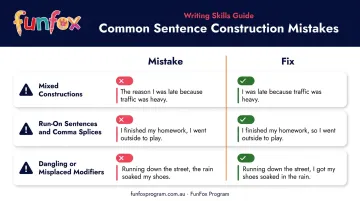
Three mistakes show up constantly in student writing — and all three are easy to fix once you know what to look for.
Mistake 1 — Mixed constructions occur when a sentence starts with one grammatical structure and switches to another mid-way, leaving the reader stranded.
- ❌ For most students who study regularly helps them succeed.
- ✅ Students who study regularly tend to succeed.
The fix: pick one subject and one verb, then build the sentence around them.
Mistake 2 — Run-on sentences and comma splices happen when two independent clauses are joined with only a comma and no conjunction.
- ❌ She finished the test early, she handed it to the teacher.
- ✅ She finished the test early and handed it to the teacher.
- ✅ She finished the test early. She handed it to the teacher.
Mistake 3 — Dangling or misplaced modifiers creep in when a describing phrase sits too far from the word it should modify, making the sentence say something unintended.
- ❌ Running down the street, the bus nearly hit me. (Was the bus running down the street?)
- ✅ Running down the street, I nearly got hit by the bus.
Frequently Asked Questions
How to use "construction" in a sentence?
Use it in the physical sense when referring to building: "The construction of the new school hall will be finished by December." Use it in the grammatical sense when discussing writing: "The sentence construction in her essay was clear and varied." Context determines the correct meaning.
What does "construction" mean in grammar?
In grammar, "construction" refers to the arrangement of words and clauses to form a sentence. A clear construction makes meaning easy to follow — a poorly built sentence can confuse readers even when every individual word is correct.
What is the difference between a simple and a compound sentence?
A simple sentence has one independent clause (The cat sat on the mat.). A compound sentence joins two independent clauses with a coordinating conjunction or semicolon (The cat sat on the mat, but the dog wanted to play.).
What are common sentence construction mistakes to avoid?
The three most common errors are mixed constructions (starting with one grammatical structure and switching mid-sentence), run-on sentences and comma splices (joining two independent clauses with only a comma), and misplaced or dangling modifiers (placing a describing word too far from what it describes).
How can children improve their sentence construction skills?
Regular writing practice, reading varied sentence types, and receiving specific feedback all build skill quickly. Programs like FunFox's Writers Club offer primary school students curriculum-aligned practice in small groups of up to six, with personalised teacher feedback after every session.
What is an example of good sentence construction for kids?
"The fluffy cat sat on the warm windowsill and watched the birds outside." This sentence works because it has a clear subject (the cat), an active verb (sat), descriptive modifiers (fluffy, warm), and a compound structure that flows naturally without becoming complicated.