Introduction
If you've noticed your Year 4 child's spelling homework getting harder — words stretching longer, patterns getting stranger, and "just sound it out" no longer cutting it — you're not imagining it.
Year 4 (ages 8–9) marks a genuine turning point in the Australian Curriculum: English. Spelling stops being about memorising lists and becomes about understanding how words actually work — their structure, origins, and patterns. Children who understand this shift can tackle unfamiliar words with confidence, not just familiar ones.
This guide covers:
- What the Australian Curriculum expects from Year 4 spellers
- The key word categories and examples your child should know
- The trickiest words and memory strategies that actually help
- Practical ways to support spelling at home
- How Year 4 connects to Year 5 NAPLAN
What the Australian Curriculum Expects for Year 4 Spelling
The Australian Curriculum Version 9.0 sets clear expectations for Year 4 spelling. The achievement standard states that students should "spell words including multisyllabic and multimorphemic words with irregular spelling patterns, using phonic, morphemic and grammatical knowledge."
Spelling isn't a standalone subject — it sits within English, treated as a tool for reading, writing, and communication.
Three content descriptions define the Year 4 spelling scope:
Morphological Awareness (AC9E4LY10)
Students use letter patterns, spelling generalisations, morphological word families, and common prefixes and suffixes to spell more complex words.
In practice, this means understanding that "unhappiness" = un + happy + ness. Knowing those building blocks (morphemes) allows a child to spell and decode dozens of words they've never seen before — not just memorise them one by one.
Phonological Awareness (AC9E4LY09)
Students use phonological and morphological knowledge to read and write multisyllabic words with complex letter combinations, vowel sounds, and known prefixes and suffixes.
This underpins accurate spelling of longer words — breaking "adventure" into ad-ven-ture makes it manageable.
Word Patterns, Homophones, and High-Frequency Words (AC9E4LY11)
Students learn to:
- Apply double-letter rules (run → running, begin → beginning)
- Use word origin knowledge to make sense of unusual spellings
- Read and write high-frequency words including homophones
- Use context to identify the correct spelling of words that sound alike
Homophones — words like their/there/they're and affect/effect — are a major source of errors in children's writing, which is why they receive dedicated attention across Year 4.
Year 4 Spelling Words: Key Categories and Examples
Year 4 spelling words in Australia aren't organised alphabetically — they're grouped by pattern. That's deliberate. Pattern-based learning is far more effective because one pattern unlocks many words at once.
The categories below draw from the Australian Curriculum V9 phonics and word knowledge scope and NSW Department of Education Stage 2 spelling sequences.
Greek and Latin Roots
Year 4 introduces students to common word roots, particularly Greek ones. The NSW Stage 2 spelling instructional sequence organises learning around word origins as a key feature of evidence-based spelling instruction.
Sample words:
| Root | Meaning | Example Words |
|---|---|---|
| tele | far | telescope, telephone |
| photo | light | photograph, photosynthesis |
| bio | life | biography, biology |
| geo | earth | geography, geology |
| port | carry | transport, portable |
| vis | see | visible, invisible |
| dict | say | dictate, predict |
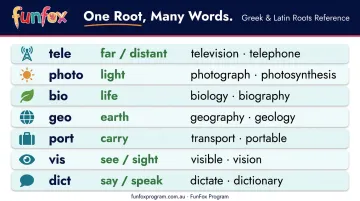
The "one root unlocks many words" principle is powerful here. A child who knows tele means "far" can spell and understand telescope, telephone, and telegram — three words for the price of one.
Prefixes and Suffixes
High-frequency morphemes that Year 4 students work with include:
Common prefixes: sub-, inter-, super-, anti-, auto-, un-, re-
Common suffixes: -ment, -able, -ible, -tion
Sample words: subdivide, international, supermarket, antiseptic, autopilot, government, movement, readable, possible, terrible
Students who know these morphemes can decode and spell hundreds of words they've never explicitly studied — and that transfer is what makes morpheme instruction so efficient.
Multisyllabic Words Commonly Misspelt
Morpheme knowledge helps with many multisyllabic words, but some high-frequency words still trip children up because pronunciation doesn't reliably match spelling:
- adventure, important, interesting, dangerous
- vegetable, beautiful, beginning, probably
- tomorrow, comfortable
Syllable-splitting helps. Veg-e-ta-ble written out in beats is far easier to spell accurately than the word as a single chunk.
Commonly Confused Words (Homophones)
The Australian Government Style Manual confirms several key confusion pairs relevant to Year 4:
| Pair | The Distinction |
|---|---|
| their / there / they're | possession / place / they are |
| affect / effect | verb / noun (usually) |
| accept / except | to receive / to exclude |
| practise / practice | verb / noun (Australian English) |
The practise/practice distinction deserves special mention. In Australian English, practise is a verb (she practises her spellings) and practice is a noun (she goes to spelling practice). It's tested explicitly in NAPLAN — so getting it right in Year 4 means one less trap to navigate later.
The Hardest Year 4 Spelling Words (and How to Remember Them)
Some words consistently catch Year 4 students out — not because children aren't trying, but because the words are irregular, borrowed from other languages, or contain unexpected letter combinations. Here are some commonly challenging examples:
Words worth focusing on:
- beautiful — the eau sequence comes from French
- Wednesday — contains a silent d (Wed-nes-day)
- necessary — one collar, two socks: 1 c, 2 s's
- separate — note the a in the middle, not an e
- February — the first r often gets swallowed in speech
- rhythm — no standard vowels; Greek origin
- conscience — the sc combination is unpredictable
- beginning — double n before the suffix
- comfortable — four syllables, often compressed to three in speech
- government — the n before ment is frequently dropped
Memory Strategies That Work
1. Over-pronunciation Say the word exactly as it's spelled, exaggerating the tricky part. "Wed-nes-day" spoken aloud while writing trains the brain to remember the silent letter. "Feb-ru-ary" with a deliberate second r does the same.
2. Mnemonics A good mnemonic sticks. For beautiful: Big Elephants Are Ugly targets the b-e-a-u sequence. For necessary: "one collar, two socks" captures the 1 c and 2 s's.
3. Colour-coding the tricky cluster Ask your child to write the word normally, then highlight just the difficult letters in a different colour. beauTIFUL in red draws the eye to the unpredictable part, helping the brain lock in the tricky cluster.
The LSCWC Method
These home strategies pair well with what most Australian classrooms already use: Look, Say, Cover, Write, Check. Knowing the method means you can reinforce it at home rather than working against it:
- Look carefully at the word
- Say it aloud
- Cover the word
- Write it from memory
- Check against the original
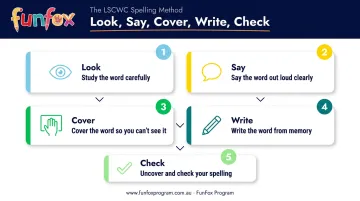
Spelling researchers like Misty Adoniou caution that LSCWC works best when anchored to why a word is spelled that way — the sound, the pattern, the origin — rather than used as pure visual memorisation alone.
How to Help Your Child Practise Spelling at Home
The most effective home support doesn't look like formal drilling. Research and classroom practice both point to the same conclusion: regular reading and short, structured word activities beat intensive cramming. Consistency matters far more than duration.
Read Widely and Often
Wide reading is the single highest-impact habit for spelling development. Children who read regularly encounter correct spellings repeatedly in context, which reinforces both meaning and form far more naturally than word lists.
Let your child choose what they read. Graphic novels, adventure series, football almanacs — if they're engaged, they're absorbing.
Play Word Games
Word-based games build the same pattern recognition skills the curriculum is developing, without feeling like study:
- Scrabble or Bananagrams — reinforces letter combinations and scoring rewards longer, more complex words
- Boggle — fast-paced pattern spotting
- Word building (no equipment needed) — one person says a root word, others race to add prefixes or suffixes: happy → unhappy → unhappiness
Use the "Word of the Day" Habit
Choose one new word daily. Learn its spelling, meaning, and pronunciation together. This takes two minutes, adds up quickly over a term, and is easy to source from whatever your child is currently reading.
Practise in the Audio-First Format
Because NAPLAN tests spelling by reading words aloud, the most effective home practice mirrors this exactly: say the word, then have your child spell it without looking. This builds the recall pathway assessments actually test, which silent list-studying doesn't replicate.
If you'd like more structure than solo home practice allows, a dedicated program can fill the gap. FunFox's Writers Club gives Year 4 students weekly live writing practice in a small-group online environment, with personalised teacher feedback delivered through the Seesaw platform — so parents can see exactly what's being worked on each session.
How Year 4 Spelling Connects to NAPLAN
Year 4 students don't sit NAPLAN — it's assessed in Years 3, 5, 7, and 9. But Year 4 is the direct preparation year for the Year 5 Language Conventions test, which assesses spelling, grammar, and punctuation.
The Year 5 NAPLAN Language Conventions component includes spelling tasks where students identify and correct errors in written sentences. In the online version, some spelling questions use audio — students hear the word read aloud and must respond accordingly.
What This Means for Year 4
The word categories covered in Year 4 — multisyllabic words, homophones, morphological word families, word origins — align directly with the vocabulary scope tested in Year 5 NAPLAN. Children who've built genuine competence across these categories perform well. Those who've only memorised lists often struggle when the words appear in unfamiliar contexts.
What to prioritise in the lead-up to Year 5:
- Audio-first practice with multisyllabic words
- Homophone and commonly confused pair drills in context (not just lists)
- Word-building exercises using prefixes and suffixes
- Reading widely to absorb patterns naturally
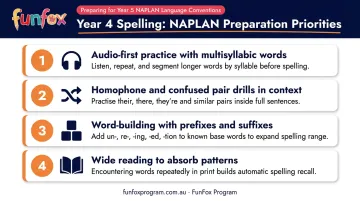
Building real spelling competence is what prepares children for Year 5 assessment — not studying to a test.
Frequently Asked Questions
What are some hard Year 4 spelling words to know?
Commonly challenging words at this level include beautiful, necessary, Wednesday, separate, February, rhythm, conscience, comfortable, beginning, and government. These are worth targeting early — many appear in NAPLAN Language Conventions tasks.
What spelling skills are expected of Year 4 students in Australia?
The Australian Curriculum V9 focuses on four key areas:
- Morphological awareness (prefixes, suffixes, base words)
- Phonological awareness of multisyllabic words
- Spelling patterns and generalisations
- Homophones and high-frequency words in context
How does Year 4 spelling prepare children for NAPLAN?
Year 4 is the year before students sit NAPLAN in Year 5. The word knowledge built during this year — multisyllabic words, word origins, homophones — directly supports the Language Conventions spelling component, which uses audio-based tasks.
What is the difference between "practise" and "practice" in Australian English?
In Australian English, practise is a verb (your child practises spelling) and practice is a noun (they attend spelling practice). This distinction is a standard curriculum expectation from Year 4 and is tested in NAPLAN Language Conventions.
How can I make spelling practice more fun for my 8–9 year old?
Word games like Scrabble, Bananagrams, and Boggle make pattern recognition feel like play. A daily "word of the day" adds vocabulary without pressure. Silly sentence challenges work well too — the more ridiculous the sentence, the better children remember the words.
How many words should a Year 4 student be able to spell?
The Australian Curriculum sets no numeric target. Year 4 students work through high-frequency and pattern-based words across the year — the focus is on building transferable skills, not reaching a specific word count.