Introduction
Year 1 and Year 2 shape how confidently a child approaches every subject that follows. The reading and writing foundations built at ages 5–8 either set children up for independent learning or leave gaps that grow harder to close with each passing term.
The tricky part? Many parents only realise something is off when their child is already visibly struggling. By then, the gap between where they are and where their classmates are has been growing for months.
If you're searching for a Year 1-2 English tutor, you're in the right place. This guide covers what you need to know: the warning signs to watch for, what genuinely good tutoring looks like for this age group, how online and in-person options compare, and how to find the right fit for your child.
Key Takeaways
- Phonics and early reading skills are the strongest predictors of long-term literacy success
- Warning signs show up in both academic performance and emotional responses to reading and writing tasks
- Effective Year 1-2 tutoring delivers structured, explicit literacy instruction rather than generic homework help
- Live online tutoring works well for this age group when delivered by trained educators
- Purpose-built early primary programs typically outperform general tutoring marketplaces
Why Year 1-2 English Skills Build the Foundation for Future Learning
The skills children develop in Year 1 and Year 2 — phonics, decoding, reading fluency, and early writing — underpin a child's ability to access learning across every subject. A student who can't read with fluency by Year 3 will struggle to understand a maths word problem, follow science instructions, or engage with any text-based task.
According to AERO's introduction to the science of reading, proficient reading is fundamental to success at school and later life. The National Reading Panel identifies phonemic awareness and letter knowledge as the two strongest predictors of reading success in the first two years of schooling.
What the Australian Curriculum Expects in Year 1 and Year 2
The Australian Curriculum v9.0 sets clear literacy benchmarks for both year levels:
| Area | Year 1 | Year 2 |
|---|---|---|
| Phonics/Decoding | Blend short and common long vowels, consonants, and digraphs to read one-syllable words | Use phonic and morphemic knowledge to read unfamiliar words and most high-frequency words |
| Comprehension | Monitor meaning and make connections between characters, settings, and events | Identify literal and inferred meaning; compare how similar topics are presented in different texts |
| Fluency | Use sentence boundary punctuation to read with developing phrasing | Use punctuation for phrasing and fluency |
| Writing | Create simple sentences with punctuation; spell an increasing number of high-frequency words | Punctuate simple and compound sentences; attempt spelling of words with less common patterns |
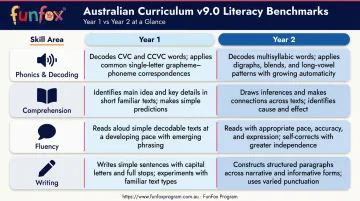
These are not aspirational targets — they're the expected achievement standard for each year level.
The Compounding Gap Problem
Timing matters more than most parents realise. A child who misses foundational phonics in Year 1 doesn't stay at that level; they fall further behind each year as curriculum complexity increases. Research on Matthew effects in reading shows that some early struggling readers grow progressively further behind, not just stagnant. The Grattan Institute's 2024 Reading Guarantee report found that about one in three Australian school students are not mastering the reading skills they need.
Classroom teachers manage large groups of students and cannot always identify or address individual gaps. That's where small-group tutoring — like FunFox's Foundation Club, designed specifically for Year 1–2 students — provides the targeted, personalised attention classroom settings can't always offer.
Signs Your Child May Benefit from a Year 1-2 English Tutor
Needing extra support at this age is far more common than most parents realise. It doesn't mean something is wrong — it means you're paying attention. The earlier action is taken, the smaller the gap to close.
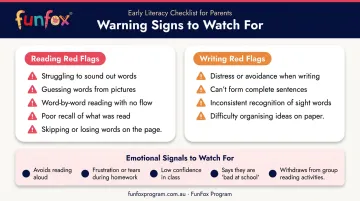
Reading Red Flags to Watch For
Look for these observable behaviours at home or during homework:
- Struggles to sound out new or unfamiliar words, even after repeated exposure
- Relies heavily on guessing from pictures rather than decoding the text
- Reads word-by-word without any natural rhythm or fluency
- Cannot recall what a short passage was about after reading it
- Skips or substitutes words without noticing or self-correcting
Writing Red Flags to Watch For
Writing difficulties are often easier to spot because the evidence is on the page:
- Refuses or becomes distressed when asked to write
- Can't construct a simple sentence independently without heavy prompting
- Spells common sight words inconsistently (words they've seen hundreds of times)
- Has difficulty organising even a single idea on paper
Don't overlook the emotional signals either. A child who becomes unusually quiet during English tasks, who avoids reading aloud, or who says things like "I'm bad at reading" is showing you something important. Confidence damage at this age is as worth addressing as the academic gap itself.
These signs apply to children who are struggling — but tutoring isn't only for them. Year 1-2 students who are capable but understimulated benefit just as much from enrichment and extension work. Building a genuine love of reading and writing early is its own reward.
What to Look for in a Year 1-2 English Tutor
Not all tutors are equipped to work well with 5–8 year olds. Subject knowledge alone isn't enough. Here's what to actually evaluate.
Teaching Approach and Age-Appropriate Methods
Effective Year 1-2 tutoring requires explicit, structured literacy instruction — not general reading practice or worksheets alone. AERO recommends that phonological awareness, phonemic awareness, and phonics be explicitly and directly taught in the early years.
Beyond the method, the delivery matters. Young children disengage quickly from dry, passive instruction. Look for tutors who use story, play, creative tasks, and interactive activities to hold attention while building real skills. Engagement and rigour are not opposites at this age — the best programs achieve both.
Curriculum Alignment and Qualifications
A tutor who understands the Australian Curriculum v9.0 will set goals that are appropriate for the year level — not too easy, not too advanced, and directly relevant to what the classroom teacher is covering. Look for tutors or programs developed by people with early childhood or primary education backgrounds, not just general English tutors.
Both small-group and one-on-one formats have merit. Small groups introduce a social learning element that many young children respond to well:
- Hearing peers think aloud builds comprehension and confidence
- Sharing ideas in a low-stakes setting reduces anxiety around writing
- Group feedback gives children a sense of community around learning
The key requirement is that group sizes stay small enough for each child to receive genuine feedback. Groups of six or fewer tend to deliver the most benefit; larger groups dilute the individual attention significantly.
FunFox's Foundation Club, designed specifically for Year 1 and Year 2, is a practical example of this model done well. Sessions run with a maximum of six students, delivered live online by teachers trained in the FunFox Way. Rather than treating reading and writing as separate tracks, the program weaves them together: reading comprehension supports written expression, and writing tasks reinforce reading understanding.
The four-term curriculum covers descriptive, narrative, persuasive, and informative writing — genres explicitly relevant to the Australian Curriculum at this level.
What Year 1-2 English Tutoring Sessions Typically Cover
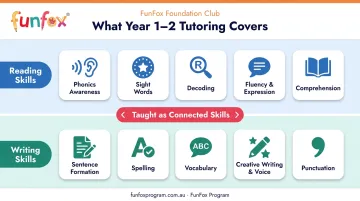
A well-structured Year 1-2 English tutoring session addresses two core streams — reading and writing — taught as connected skills, not isolated drills.
Reading Skills Developed in Tutoring
Reading sessions at this level typically cover:
- Recognising and manipulating sounds in words (phonics and phonemic awareness)
- Building automaticity with high-frequency sight words
- Applying letter patterns and word knowledge to decode unfamiliar text
- Developing phrasing, pace, and expression when reading aloud
- Recalling information, making simple inferences, and connecting ideas across a short text
Writing Skills Developed in Tutoring
Writing-focused work builds skills across several areas:
- Forming simple and compound sentences independently
- Consolidating common words and applying phonics knowledge to new spellings
- Broadening word choice and using language more precisely
- Developing voice, confidence, and the ability to organise ideas on paper through guided creative writing
- Applying capital letters, full stops, and sentence boundaries correctly
The strongest programs don't treat these lists as separate. A child writing a short narrative is practising spelling, sentence structure, vocabulary, and genre comprehension simultaneously. When a session is built around a real writing task rather than isolated exercises, every skill gets reinforced in context — which is how young writers actually improve.
In-Person vs. Online English Tutoring for Year 1-2 Students
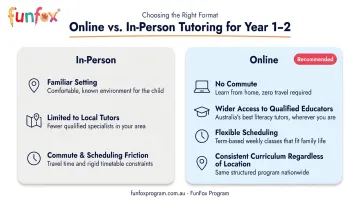
The instinct to search "English tutor near me" makes sense — familiarity and proximity feel safer, especially for young children. But limiting your search to local in-person options significantly narrows the pool of qualified early literacy educators available to you, and introduces logistical friction that often disrupts consistency.
Young children adapt to structured online environments more readily than most parents expect. When sessions are live, interactive, and led by an engaging teacher, the screen is simply the medium — not the obstacle. A randomised controlled trial involving 2,085 K-2 students found that virtual early literacy tutoring increased early literacy skills by 0.05–0.12 standard deviations, with the strongest effects for 1:1 sessions.
That's meaningful movement at an age where even small gains compound quickly.
The real variable isn't location — it's quality. A live, structured online session with a trained early literacy educator will generally produce better outcomes than an unqualified in-person tutor, regardless of where you live.
That principle is exactly what online programs like FunFox are built around. Live sessions run via Zoom, so families in regional Queensland, suburban Perth, or anywhere else in Australia access the same structured program as a family in Sydney. A few practical advantages this creates:
- No commute or travel time between school pickups and sessions
- More session times available across the week, not just local after-school slots
- Consistent access to trained early literacy educators regardless of your postcode
- Easier rescheduling when illness or family commitments come up
How to Find the Right English Tutor for Your Year 1-2 Child
Where to Start Looking
The main channels for finding Year 1-2 English tutors in Australia include:
- Word-of-mouth from other parents in your child's year group
- School recommendations — ask the classroom teacher directly; they often know who works well with this age
- General online tutoring platforms — broad range of tutors, but quality varies considerably
- Specialist literacy programs purpose-built for primary school students
That last option is worth prioritising. Specialist programs designed specifically for early literacy tend to provide more consistent quality, structured curricula, and teachers who understand how young children learn. General tutoring marketplaces leave you evaluating individual tutors without much framework to compare them.
Questions to Ask Before Enrolling
Before committing to any tutor or program, ask:
- How is progress tracked and reported to parents? Look for regular, specific feedback — not just "she's doing well"
- What qualifications and training do your tutors have with Year 1-2 students? Early childhood or primary education backgrounds matter
- How many students are in each session? Six or fewer is the threshold for meaningful individual attention
- Is there a trial session available? Any reputable program should offer this — FunFox, for example, runs a free trial class each term
- Is the program aligned with the Australian Curriculum? This ensures your child is working toward the right year-level benchmarks
How to Evaluate Fit After Starting
Once you've enrolled, don't wait for the end-of-term report to assess whether it's working. After the first 2–3 sessions, look for:
- Your child is willing to attend (and ideally looks forward to it)
- They mention the sessions positively, even casually
- Small shifts in confidence at home — trying new words, writing without prompting, reading aloud more willingly
These early signals matter more than test scores at this age. A child who feels capable and engaged in Year 1 and 2 is far more likely to take on harder challenges — in writing, reading, and school generally — as the years progress.
Frequently Asked Questions
How much does an English tutor cost per hour?
Private tutors in Australia generally charge anywhere from $40 to $100+ per hour depending on qualifications and experience. Structured small-group programs like FunFox's Foundation Club work out to approximately $165 per month for weekly sessions — often better value than individual hourly tutoring, with the added benefit of a purpose-built curriculum.
Should I get a tutor for my 7-year-old?
Age 6–8 (Year 1-2) is an excellent time to start, whether your child is struggling or simply ready for more. Gaps are still small enough to address quickly, and children at this age respond well to structured, engaging literacy support before avoidance habits set in.
What should my child know by the end of Year 2?
Per the Australian Curriculum v9.0, Year 2 students should be able to:
- Read simple texts with fluency and understanding
- Identify both literal and inferred meaning
- Write simple and compound sentences with basic punctuation
- Use phonic knowledge to attempt spelling of less common words
What does an English tutor do in Year 1 and Year 2 sessions?
Sessions typically cover phonics, reading aloud, comprehension, sight words, sentence writing, vocabulary, and guided creative writing — delivered interactively and tailored to where the child currently is, not a fixed script.
Is online tutoring effective for Year 1-2 students?
Yes, provided sessions are live and led by trained educators — not automated or app-based. A randomised controlled trial of K-2 virtual literacy tutoring found consistent positive effects on early literacy skills. Live, interactive tutoring is what drives results; passive digital tools are not a substitute.
How often should a Year 1-2 student have tutoring sessions?
Once per week is the minimum for consistent progress. Regular short sessions outperform sporadic longer ones — consistency between school and tutoring reinforces learning and keeps literacy habits on track.