Introduction
Picture this: your child hands back a school assignment covered in red marks — "their" where "there" should be, a capital letter missing mid-sentence, "beleive" instead of "believe." You've reminded them to check their work. They've used spell-check. And yet the same errors keep appearing.
This is one of the most common frustrations for Australian families supporting primary school students. Spelling and grammar don't improve through good intentions alone — they require understanding why the errors happen and choosing strategies that actually address the root cause.
Part of the problem is English itself — its inconsistencies and exceptions make it difficult to master. But improvement is achievable. The difference between a child who struggles and one who writes with confidence usually comes down to approach, consistency, and catching any underlying challenges early.
This guide covers the causes of poor spelling and grammar, practical strategies that build real skill, and common mistakes to avoid — whether you're supporting a child at home or a student working independently.
Key Takeaways
- Consistent, targeted practice builds spelling and grammar skills far faster than passive exposure.
- Identifying why a child struggles — phonics gaps, learning differences, or limited reading — determines which strategy works.
- Proven techniques include learning spelling rules, using mnemonics, reading widely, and practising grammar through real writing.
- 10–15 minutes of daily practice builds stronger skills over time than occasional longer sessions.
- When home strategies stall, a structured literacy programme can accelerate progress significantly.
Why Spelling and Grammar Skills Matter More Than You Think
Most parents think of spelling and grammar as test requirements. They're actually much more fundamental than that.
Research involving school-aged students found that spelling quality influenced how assessors rated the overall content and style of written texts — meaning errors don't just cost marks for "spelling," they colour how the whole piece is perceived. A child's best ideas can land poorly when buried under avoidable errors.
The Knock-On Effect of Spelling Difficulty
When spelling is effortful, it competes for the same cognitive resources a child needs to organise ideas and construct sentences. Research confirms that spelling makes a statistically significant contribution to written expression even in young children.
Children who find spelling hard often write less, choose simpler words, and produce less developed work — not because they lack ideas, but because the mechanics of getting words onto the page consume so much mental effort.
Spelling vs. Grammar — Two Linked Skills
It helps to treat these as separate but connected:
- Spelling — getting the right letters in the right order
- Grammar — how words are arranged to create sentences that make sense
A child can spell every word correctly but still write a sentence without a verb. Another can have strong grammar instincts but misspell half the words. The two skills reinforce each other — which is why the strategies in this guide address both at once.
What Causes Poor Spelling and Grammar?
Poor spelling is rarely about effort or intelligence. In most cases, there's a specific, identifiable reason, and knowing it determines the right response.
Weak Phonics Foundation
Phonics is the relationship between letters (graphemes) and speech sounds (phonemes). When this foundation is insecure, children struggle to decode words when reading and encode them when writing. They're not guessing randomly; they're working with an incomplete system. Systematic, explicit phonics instruction is well-supported as an essential component for struggling readers, particularly those with dyslexia.
Limited Reading Exposure
Children who read infrequently miss thousands of unconscious encounters with correct spelling, sentence structure, and grammar conventions. Print exposure in primary-aged children correlates significantly with spelling, vocabulary, and word knowledge — a finding backed by foundational literacy research. Wide reading remains one of the most effective responses available.
Learning Differences: Dyslexia and ADHD
Two conditions that frequently affect spelling and grammar deserve specific attention:
- Dyslexia affects approximately 1 in 10 Australians and involves phonological processing difficulties that make spelling persistently challenging regardless of intelligence or effort.
- ADHD creates a different obstacle. Research found that children aged 8–11 with ADHD symptoms produced significantly more spelling errors than controls, particularly under higher working-memory load. Attention demands during writing tasks mean errors accumulate not from ignorance but from cognitive overload.
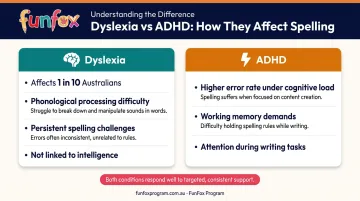
Neither condition reflects low ability — both respond well to targeted, consistent support.
Over-Reliance on Spell-Checkers
Spell-checkers don't catch everything, and they fail most often for children who need them most. A poor speller's attempt at a word may not be close enough to the target for autocorrect to identify it. More critically, spell-checkers cannot flag correct-but-wrong word choices: "their," "there," and "they're" will all pass unchallenged.
Children who never practise independent spelling never build the internal reference system needed when digital tools aren't available — such as in exams.
Proven Strategies to Improve Spelling
Learn Rules With Their Exceptions
Spelling rules give children a system to apply rather than a list to memorise. Useful rules for primary students include:
- Drop the silent "e" before a vowel suffix (hope → hoping)
- Double the final consonant before a vowel suffix in short vowel words (run → running)
- "i before e except after c" — and its many exceptions
Always pair rules with their exceptions. A rule applied blindly becomes a new source of errors.
Use Mnemonics and Visual Associations
A memorable phrase, image, or rhyme attached to a tricky word encodes it more durably. Classic examples include:
- because → "Big Elephants Can Always Understand Small Elephants"
- necessary → "one Collar, two Socks"
- separate → there's "a rat" in sepa rate
Encourage children to invent their own — personally created mnemonics are more memorable than borrowed ones.
Work With Word Families, Prefixes, and Suffixes
Instead of memorising words in isolation, teach children to recognise common building blocks. A child who knows -tion, -ible, re-, and un- can apply that knowledge across dozens of words at once. A meta-analysis of morphological instruction found it improved spelling and vocabulary outcomes for school-age children with literacy difficulties.
Read Widely — and Actively
Regular reading exposes children to correct spelling and word patterns in context. The key word is actively. Encourage children to pause at unfamiliar words, notice their structure, and consider how they're built rather than skipping past them. Even a few seconds spent examining an unfamiliar word — rather than skipping it — compounds into a significant spelling advantage over time.
Keep a Personal Tricky-Words List and Self-Test
Note down every word your child misspells. Revisit the list weekly using look-cover-write-check:
- Look at the word carefully
- Cover it
- Write it from memory
- Check — and repeat if wrong
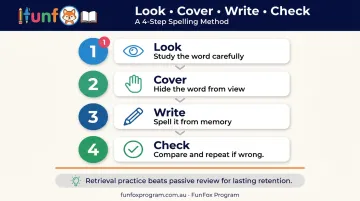
Research comparing retrieval practice with re-reading confirms that testing yourself on previously practised spelling outperforms passive review for retention. The act of trying to recall the word — even when you get it wrong — is what builds memory.
Key Grammar Strategies and How to Practise Them
Start With What a Sentence Actually Does
Before introducing terms like "subject" and "predicate," help children feel what a complete sentence is: a clear thought with someone doing something. "The dog barked" works. "Because the dog" doesn't. Starting with meaning rather than terminology gives children an intuitive anchor before the labels arrive.
Target the Errors That Appear Most Often
Primary students tend to repeat a predictable set of grammar errors. These are worth addressing directly:
- Subject-verb agreement — "The children was" vs. "The children were"
- Apostrophe confusion — it's/its, you're/your
- Homophones — there/their/they're, to/too/two
- Inconsistent verb tense — switching between past and present mid-paragraph
The NAPLAN Narrative Writing Marking Guide assesses sentence structure, punctuation, spelling, paragraphing, vocabulary, and cohesion — a useful framework for knowing which conventions matter most in primary assessment.
Practise Grammar Through Real Writing
Grammar rules learned on worksheets rarely transfer automatically to original writing. Applying rules in actual sentences — short stories, letters, journal entries, creative prompts — sticks far better. When a child writes a story and then checks their own verb tenses, the rule becomes functional knowledge rather than abstract information.
Use Reading as a Grammar Model
Teach children to notice how published authors construct sentences. A few things worth pointing out during reading sessions:
- Where the author places commas and why
- How sentence length varies to control pace
- How paragraphs open — with action, description, or dialogue
- How tense stays consistent throughout a scene
Books a child already loves work particularly well — they'll read more carefully when they care about the story.
Building Daily Habits That Support Long-Term Improvement
Short, Consistent Practice Over Long, Infrequent Sessions
Spaced, repeated practice consistently outperforms cramming in literacy learning. Ten to fifteen minutes a day — after school, before reading, or during homework time — beats a single one-hour session on weekends. The key is regularity, not duration.
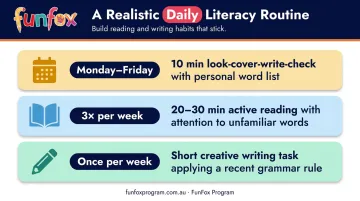
A realistic daily routine might look like:
- Monday–Friday: 10 minutes of look-cover-write-check using your child's personal word list
- Three times per week: 20–30 minutes of reading with active attention to unfamiliar words
- Once per week: A short creative writing task applying a recently learned grammar rule
Make It Playful
Word games build the same skills as formal practice without the anxiety. Options that suit primary students include:
- Wordle and its variants (free, daily, 5-letter word focus)
- Scrabble or Bananagrams (word building, pattern recognition)
- Crossword puzzles matched to reading level
A 12-week randomised study found that digital game-based spelling intervention improved outcomes for children with spelling difficulties compared to an active control group — strong evidence that structured, engaging practice works even in game format.
When Home Practice Isn't Enough
Some children make solid progress with consistent home routines. Others need more — particularly if a learning difference is involved, or if the gap between their skills and their year level has widened.
Structured support from a guided literacy programme offers what home practice can't easily replicate: consistent teacher feedback, scaffolded instruction, and accountability. FunFox's Writers Club is an online small-group programme for Years 2–6, capped at six students so teachers can give genuine, personalised feedback on written work. Weekly Zoom sessions and between-class feedback via Seesaw make it a practical option for busy Australian families.
Common Mistakes to Avoid
Over-Relying on Spell-Checkers
Spell-checkers are useful editing tools, not spelling teachers. They miss context-dependent errors entirely and may fail to suggest the correct word when a child's attempt is too far from the target. Children who depend on them in drafting never develop the independent spelling intuition they'll need in handwritten assessments.
Practising Without Feedback
Re-reading your own writing rarely catches errors your brain has already accepted as correct. More effective alternatives:
- Read the work aloud (errors that look right often sound wrong)
- Ask a parent or peer to review it
- Use look-cover-write-check rather than passive review
Treating Spelling and Grammar as Isolated Drills
Completing a word list or grammar worksheet is not the same as being able to use those words and rules in writing. Skills need to transfer into real contexts:
- Use newly learned spelling words in original sentences
- Apply grammar rules in creative writing pieces, not just worksheet exercises
Frequently Asked Questions
What causes poor spelling skills?
The most common causes are a weak phonics foundation, limited reading exposure, and inconsistent practice. In some children, learning differences like dyslexia create specific phonological processing difficulties. Poor spelling is rarely a sign of low intelligence — it's usually a sign that a particular skill hasn't been taught or consolidated yet.
Is spelling hard for ADHD?
Yes — research shows children with ADHD make significantly more spelling errors than their peers, especially when tasks require sustained mental effort. Short, active practice sessions — look-cover-write-check, word games — tend to work better than passive study for children who find it hard to sustain focus.
How long does it take to improve spelling and grammar?
It depends on the child's starting point and the consistency of practice. Peer-reviewed studies have shown measurable gains in as little as three weeks of daily targeted practice, with more substantial improvement appearing after ten to twelve weeks. Fluency and automatic recall build over several months of sustained effort.
What are the best daily habits for primary school children?
The essentials are a short look-cover-write-check session with a personal word list, 20–30 minutes of reading, and one creative writing activity per week. Consistency matters more than duration — ten minutes every day outperforms an hour once a week.
How can parents help their child improve spelling at home?
Read together regularly, play word games, maintain a personal tricky-words list, and praise effort rather than error-free results. If progress stalls despite consistent effort, consider structured support from a literacy programme with teacher feedback built in.
What is the difference between spelling rules and spelling patterns?
Rules are explicit guidelines with stated exceptions — for example, drop the silent "e" before a vowel suffix. Patterns are recurring letter combinations a child learns to recognise through exposure, such as -tion, -ight, or -ough. Teaching both together gives children a system to apply and the visual fluency to recognise common word structures quickly.