Introduction
Your child hands you their homework. You glance down and notice "beleive" instead of "believe," or "Febuary" instead of "February." It happens to almost every Year 4 family — and the question that follows is usually the same: What exactly should my nine-year-old be able to spell by now?
Year 4 is a genuine turning point in spelling development. According to the Australian Curriculum Version 9.0, Year 4 students are expected to move well beyond sounding out simple words. The focus shifts to multi-syllabic words, morphemic knowledge (prefixes, suffixes, root words), spelling generalisations, and high-frequency homophones.
This guide walks through a categorised Year 4 spelling word list aligned with the Australian Curriculum, covers the key spelling rules taught at this level, and shows practical ways to support your child at home.
What Year 4 Spelling Looks Like in Australia
The Curriculum Shift
Ages 9–10 mark a significant change in how children engage with spelling. The Australian Curriculum (Version 8.4) specifies that Year 4 students should use knowledge of letter patterns to spell more complex words. That includes:
- Double letters and spelling generalisations
- Morphemic word families
- Common prefixes and suffixes
- Word origins
Dictionaries become regular classroom tools at this stage.
The NAPLAN Connection
Year 4 students don't sit NAPLAN — that's Years 3, 5, 7, and 9. But Year 5 is just around the corner, and the NAPLAN Language Conventions component directly assesses spelling, grammar, and punctuation. In the Year 5 example test, students must identify and correct spelling errors in sentences — a task that requires both automatic recall and an understanding of spelling patterns.
Strong foundations built in Year 4 directly prepare children for this assessment.
From Phonics to Morphology
The NSW Department of Education's Stage 2 spelling guidance notes that evidence-based spelling instruction at this level explicitly teaches three distinct features of words:
- Phonological — how words sound
- Orthographic — how letters and patterns combine on the page
- Morphological — how word parts like prefixes, suffixes, and roots carry meaning
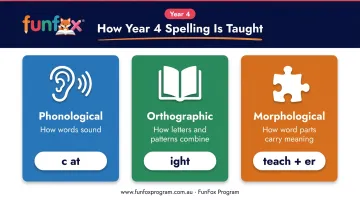
Children aren't just sounding out words anymore. They're learning how those parts work together.
Year 4 Spelling Word List: Grouped by Category
The Australian Curriculum requires knowledge of letter patterns, morphemic word families, and word origins — so grouping spelling words by category directly supports what students are expected to learn.
Commonly Misspelled Words in Year 4
These high-frequency words appear regularly in student writing but are frequently spelled incorrectly:
- believe, business, describe, separate, knowledge
- library, medicine, necessary, February, calendar
- address, grammar, surprise, height, exercise
- island, imagine, position, pressure, promise
- quarter, straight, various, accident, opposite
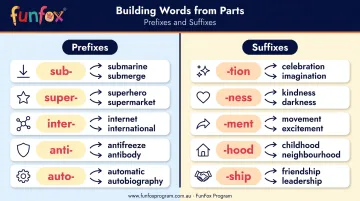
Words with Prefixes
Learning prefixes helps students decode and spell dozens of related words at once.
sub- (meaning: under/below)
- subdivide, subheading, subscribe, subway, subtraction
super- (meaning: above/beyond)
- supermarket, superstar, supersonic, supervisor, superman
inter- (meaning: between)
- international, interact, internet, interrelated, intercity
anti- (meaning: against)
- antisocial, antiseptic, anticlockwise, antidote
auto- (meaning: self)
- autograph, autobiography, automatic, autopilot
Words with Common Suffixes
-tion / -sion
- action, mention, tension, invasion, confusion, decision, permission, expression, ambition
-ness
- kindness, happiness, darkness, tidiness, silliness, nastiness
-ment
- movement, enjoyment, employment, replacement
-hood
- childhood, neighbourhood, brotherhood, knighthood
-ship
- friendship, membership, partnership, championship
Multi-Syllabic and Challenging Words
Try breaking these into syllables when practising: par-tic-u-lar, oc-ca-sion-al-ly, en-vi-ron-ment.
- particular, occasionally, experience, especially
- environment, imagination, determination, celebration
- education, transportation, organisation, automatically
Subject-Specific Vocabulary
Science: organism, gravity, experiment, evaporation
Humanities: government, colony, capital, civilisation, explorer
Maths: subtraction, multiplication, division, fraction, decimal
Key Spelling Rules and Patterns Taught in Year 4
Year 4 introduces several spelling rules that recur across hundreds of words. Once children understand these patterns, they can apply them independently rather than memorising each word in isolation.
The Drop-the-E Rule
When adding a suffix that begins with a vowel, drop the silent e from the base word:
- hope → hoping, write → writing, make → making, dance → dancing
Keep the e when the suffix begins with a consonant:
- hope → hopeful, care → careless, safe → safely, like → likely
The Doubling Rule
When a short vowel is followed by a single consonant, double that consonant before adding a vowel suffix:
- run → running, hop → hopping, grab → grabbing, sit → sitting
When the vowel is long (or there are two vowels), no doubling occurs:
- read → reading, rain → raining, sleep → sleeping
How Prefixes and Suffixes Work
Prefixes and suffixes change meaning without altering the spelling of the root word. Once a child knows a root word, they can spell an entire family of words:
- happy → unhappy → unhappiness
- organise → organisation → disorganised
- employ → employment → unemployed
Silent Letters
The Australian curriculum addresses these patterns explicitly in Year 4:
Silent k: knife, knight, know, knot, knock
Silent w: write, wrist, wrinkle, wrote, wrap
Silent b: lamb, thumb, doubt, climb, comb
Homophones and Tricky Exception Words in Year 4
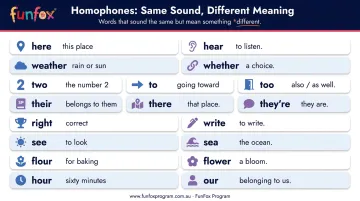
Homophones are one of the trickiest areas of Year 4 spelling — words that sound identical but carry entirely different meanings depending on context. The Victorian Curriculum (VCELA296) explicitly requires Year 4 students to recognise homophones and use context to select the correct spelling.
Key Homophones to Know
| Homophones | Quick Distinction |
|---|---|
| there / their / they're | place / belonging / they are |
| your / you're | belonging to you / you are |
| its / it's | belonging to it / it is |
| hear / here | listen / location |
| wear / where / we're | clothing / place / we are |
| write / right | to write / correct |
| knew / new | past tense of know / not old |
| break / brake | to shatter / to stop |
| weather / whether | climate / if |
| peace / piece | calm / a portion |
| steal / steel | to take / a metal |
| weight / wait | how heavy / to pause |
High-Frequency Words That Don't Follow Rules
Some words resist spelling rules entirely and must be committed to memory. Australian classrooms often call these "tricky words":
- because
- thought
- through
- enough
- although
- caught
- taught
- beautiful
- people
- once
Fun Ways to Help Your Child Practise Spelling at Home
Look, Say, Cover, Write, Check
This is the most widely recommended technique in Australian primary classrooms — described in both NSW government school parent resources and Victorian education materials. Here's how it works:
- Look at the word carefully — notice patterns, tricky parts, letter groups
- Say the word aloud, listening to each syllable
- Cover the word completely
- Write the word from memory
- Check by uncovering — if wrong, go back to step one
Use it with any word from the lists in this article.
Game-Based Practice
Short, regular sessions beat marathon study — research on spaced practice from The Learning Scientists consistently supports spreading practice over time rather than cramming. Ten to fifteen minutes daily works better than an hour on Sunday.
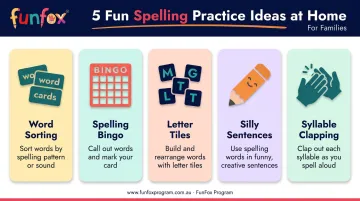
Some effective approaches:
- Word sorting — group words by prefix, suffix, or silent letter pattern
- Spelling Bingo — call definitions or give clues instead of spelling the word
- Letter tiles — magnetic letters on the fridge for physical word-building
- Silly sentences — challenge your child to use five spelling words in one ridiculous sentence
- Syllable clapping — clap out each syllable of multi-syllabic words before writing them
Reading Together
Shared reading is one of the easiest habits to build. The Australian Literacy Hub encourages families to make daily reading a habit. Victorian research has found that how often children are read to has a direct causal effect on schooling outcomes — and when kids encounter words repeatedly in context, spelling patterns become familiar naturally.
For Year 4, aim for chapter books and age-appropriate non-fiction — both expose children to the multi-syllabic and subject-specific vocabulary they're working on at school.
Structured Support Beyond Home Practice
Sometimes children need more than home practice can offer — especially when spelling confidence is lagging or writing anxiety starts creeping in. That's where structured, expert-led support makes a difference.
The FunFox Writers Club runs live online sessions for Australian primary school students, with classes capped at six students. Spelling sits within a broader curriculum covering vocabulary, sentence structure, and genre writing across all four school terms. Sessions run weekly via Zoom from anywhere in Australia, and parents receive personalised feedback through Seesaw plus one-on-one teacher meetings each term.
Frequently Asked Questions
What words should a Year 4 student be able to spell?
Year 4 students are expected to spell high-frequency words, homophones, words with common prefixes (sub-, super-, inter-, anti-, auto-) and suffixes (-tion, -ness, -ment), and subject-specific vocabulary. The categorised lists above cover the full range of what's expected under the Australian Curriculum.
What are the 10 hardest spelling words for Year 4 students?
The toughest words tend to involve silent letters, double letters, or unexpected vowels: necessary (one collar, two socks), February (silent first r), separate (not seperate), occasion, embarrass, peculiar, conscience, discipline, environment, and occasionally.
How many spelling words should a Year 4 child know?
The Australian Curriculum doesn't mandate a specific number, but Year 4 students are typically expected to master 100+ words across categories by year's end — built up progressively from prior years. The focus is on pattern knowledge, not just word counts.
Are Year 4 spelling words in Australia different from those in the UK?
There's significant overlap, but the Australian Curriculum has its own scope and sequence. Australian spelling conventions apply — colour, favourite, organise — and NAPLAN (not the UK's SATs) is the relevant national assessment. The Macquarie Dictionary is the authoritative guide for preferred Australian spellings.
How can I tell if my Year 4 child is falling behind in spelling?
Watch for consistent errors on words from earlier year levels, reluctance to write, or high-frequency words misspelled repeatedly in free writing. If you're concerned, speak with the class teacher first — and consider whether structured practice or external support might help bridge the gap before Year 5 NAPLAN.