Introduction
Most children can memorise a word list the night before a test and forget every word by Friday morning. Sound familiar? Traditional word-list memorisation simply doesn't stick — and for many kids, it actively puts them off language learning.
A rich vocabulary isn't just an English skill. It shapes how confidently a child reads, writes, follows instructions, and communicates ideas across every subject.
Research tracking over 14,000 students from Kindergarten to Year 4 found strong reciprocal links between vocabulary knowledge and reading comprehension — meaning the words children know directly influence how well they understand what they read.
The good news? Children don't need flashcard drills to build a strong vocabulary. The 15 activities below — spanning games, creative challenges, and everyday reading habits — are designed to make word learning feel like play rather than homework. Most take just a few minutes and work with routines your family already has.
Key Takeaways
- A strong vocabulary supports reading comprehension, writing confidence, and success across every school subject.
- Children retain words far better when they encounter them through play, creativity, and conversation rather than passive memorisation.
- The activities here span three categories: games, creative writing, and reading and everyday life.
- Short, regular practice sessions outperform occasional long ones every time.
Why Building Vocabulary Matters for Primary School Children
It Goes Well Beyond English Class
Many parents think of vocabulary as an English concern. It isn't. A 2025 study of Year 3 students with maths difficulty found that mathematics vocabulary knowledge significantly predicted word-problem performance — children who didn't know words like "altogether" or "difference" struggled even when their number skills were solid. Science shows the same pattern: productive science vocabulary was the strongest predictor of science knowledge in a separate study of primary-aged children.
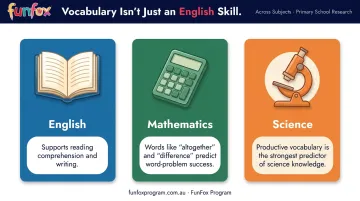
Vocabulary is the foundation underneath every subject.
The Primary Years Are the Window
School-aged children can grow their vocabularies by thousands of words per year, and they learn many of those words incidentally — through reading, conversation, and context. But incidental learning only works if children are regularly exposed to rich, varied language. Without deliberate effort during these years, the vocabulary gap between children widens quickly.
The Australian Curriculum (ACARA) acknowledges this directly. From Year 1 onward, students are expected to draw on vocabulary to build literal and inferred meaning from texts. By Year 6, they're expected to make deliberate vocabulary choices when creating their own writing.
What Children Actually Need
Recognising a word on a list is not the same as knowing it. Children need to:
- Encounter words in multiple, varied contexts
- Use words in their own speaking and writing
- Understand how words relate to each other (synonyms, antonyms, nuance)
That's what the activities below are designed to build.
Vocabulary Games and Challenges (Activities 1–5)
Game-based activities tap into children's natural love of play and competition, making new words stick. The key is that good vocabulary games require children to use and manipulate words — not just match them.
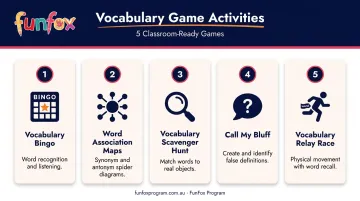
Activity 1: Vocabulary Bingo
Create bingo cards with target words written in each square. The caller reads out definitions or contextual clues, and players mark off the word that matches. For younger children, use pictures instead of written words.
Why it works: It builds word recognition and active listening simultaneously, and the competitive element keeps children focused.
Activity 2: Word Association Maps
Children write a target word in the centre of a page, then branch outward with synonyms, antonyms, related words, and an example sentence. The result is a spider diagram — a visual map of how one word connects to many others.
Why it works: This approach helps children see words as part of a connected network rather than isolated items — which is exactly how fluent readers process vocabulary.
Activity 3: Vocabulary Scavenger Hunt
Give children a list of descriptive words — "something rough," "something luminous," "something miniature" — and send them to find matching objects around the house or garden.
Why it works: Anchoring abstract vocabulary to real, tangible objects makes definitions genuinely memorable rather than arbitrary.
Activity 4: Call My Bluff
Present one real definition and two plausible-but-wrong definitions for a target word. Children vote on which they think is correct. Then swap roles — children create the fake definitions themselves.
What makes it effective: Crafting convincing false definitions forces children to think carefully about what a word actually means — that's higher-order reasoning wrapped inside a guessing game.
Activity 5: Vocabulary Relay Race
Place word flashcards at one end of a room or garden. One at a time, children run to pick a card and must use the word in a sentence (or give its definition) before the next player goes.
Why it works: Pairing physical movement with word recall boosts engagement and helps memory encoding — and it turns vocabulary practice into something children genuinely want to repeat.
Creative and Writing-Based Vocabulary Activities (Activities 6–10)
When children use new words in imaginative contexts — writing stories, inventing lyrics, designing posters — they process those words far more deeply than they would by reading a definition twice. These activities connect vocabulary to creativity, which deepens both understanding and retention.
Activity 6: Story Dice
Write six vocabulary words on the faces of a cube (or use a free online dice roller). Children roll and must use the word that appears in an original sentence or short story. Multiple rolls build connected narratives.
Works well for: Both spoken and written practice, and easily adjusted for difficulty by changing the word list.
Activity 7: Lyric Summaries
Children build sentences using target vocabulary words, then rewrite those sentences as lyrics to a tune they already know — a nursery rhyme, a pop song, anything familiar. Rhythm and repetition are genuine memory aids, and children are often surprised by how much they retain from a song they wrote.
Activity 8: Word Art Posters
Children write a vocabulary word in large letters, then fill the letters and surrounding space with drawings, synonyms, and example phrases that illustrate the word's meaning. The result is a reference poster they've made themselves.
Why it works: The visual-creative combination strengthens the connection between a word and its meaning in a way that copying definitions simply cannot.
Activity 9: Vocabulary Dialogue Writing
Children write a short conversation between two characters that naturally uses a set of target vocabulary words. The characters could be animals, astronauts, historical figures — whatever sparks their interest.
Why it works: This builds vocabulary and writing skills together, pushing children to think about how words work within voice, tone, and actual conversation.
Activity 10: Personal Vocabulary Journal
Children keep an ongoing notebook where they record new words from reading or conversation — including the original sentence where they found the word, a kid-friendly definition they've written themselves, and a drawing or personal example.
Revisiting this journal regularly — even briefly — turns passive exposure into active retention. A case study on vocabulary retention in primary school students found that meaning-focused vocabulary notebooks, when paired with regular review, supported stronger long-term word knowledge than definition-copying alone.
One parent of a FunFox student noticed exactly this kind of growth, describing how her daughter began using words "even I am not aware of" after consistent engagement with rich language programs.
Reading and Everyday Life Vocabulary Activities (Activities 11–15)
Some of the most powerful vocabulary activities require no preparation at all. They happen through books, conversations, and small daily habits that parents can weave into routines already in place.
Activity 11: Read-Aloud Word Spotting
During shared reading, pause when an interesting or unfamiliar word appears. Ask your child what they think it means from context, then offer a simple definition and connect it to something they already know.
The Education Endowment Foundation reports that oral language interventions — including structured read-alouds — produce an average of six months' additional progress for children. The key is that the reading is interactive: discussion, prediction, and word exploration matter more than pages covered.
Activity 12: Quote of the Day Word Hunt
Each day, share a short famous quote with your child. Together, pick one or two interesting words, discuss what they mean, and challenge your child to use them naturally in conversation before the day ends. Best suited to children aged 7 and above.
Activity 13: Synonym Clines (Word Scales)
Set up a simple spectrum — a "washing line" with pegs, or just a drawn line on paper. Give children synonyms for a common word and ask them to arrange the words in order of intensity.
Example: happy → pleased → content → joyful → elated → ecstatic
This teaches children not just that words have similar meanings, but that precise word choice matters — which is one of the most transferable writing skills a primary student can develop.
Activity 14: Nonfiction Vocabulary Explore
Fiction is wonderful, but nonfiction is where children meet the specific vocabulary used in science, geography, and history — words that rarely appear in stories.
Bring in nonfiction books, magazines, or encyclopaedias on topics your child genuinely cares about — animals, sport, space, cooking — and pause to discuss unfamiliar terms, connecting them to what they already know.
Activity 15: Vocabulary Flashcards at Home
Write a word on one side of a card and a picture or definition on the other. Use them in short daily bursts — five minutes before bed or after school — rather than long occasional sessions.
Research on spaced practice shows that spreading repetition across days improves word recognition more than massed practice in a single sitting. Flashcards work best when combined with other meaning-making activities — not used alone.
To get the most out of them:
- Review 5–10 cards daily rather than a large stack once a week
- Mix new words with recently learned ones to reinforce memory
- Let your child quiz you — retrieval from both sides strengthens recall
- Pair each word with a sentence your child creates themselves
How to Keep Vocabulary Learning Fun and Consistent
The single biggest factor in vocabulary growth isn't which activity you choose — it's whether children encounter words repeatedly, across varied contexts, over time.
The Multiple Encounters Principle
According to ASCD, citing McKeown and colleagues, students may need 12 to 20 meaningful exposures to a word before it becomes truly known. A single definition reading doesn't come close. This is why rotating activities matters: a word met in a bingo game, used in a dialogue, spotted in a read-aloud, and revisited in a vocabulary journal is a word a child will actually own.
Practical Tips for Sustaining the Habit
Keeping that rotation going at home doesn't require much — just a few small habits applied consistently:
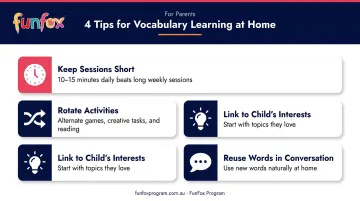
- Keep sessions short. Ten to fifteen minutes of engaged vocabulary practice most days is more valuable than a two-hour session on Sundays.
- Rotate activities. Doing the same exercise repeatedly produces boredom, not learning. Alternate between games, creative activities, and reading-based approaches.
- Link new words to your child's interests. A child obsessed with marine biology will learn bioluminescent faster than luminous — start where their curiosity already lives.
- Reuse new words in ordinary conversation. If your child learnt "elated" on Monday, use it yourself when you're happy on Wednesday. Hearing words in natural context cements them far faster than any worksheet.
The Role of Structured Programs
At-home activities work best when they complement structured, regular exposure to rich language in reading and writing. FunFox Program's Readers Club and Writers Club are built for primary school students across Australia, weaving vocabulary development into live online reading comprehension and creative writing sessions that children can join from anywhere in the country.
Conclusion
Building vocabulary doesn't have to mean word lists and spelling tests. When the right activities are folded into daily routines — a read-aloud before bed, a vocabulary journal on the bedside table — children start to notice, collect, and genuinely enjoy new words. That curiosity, once sparked, compounds across every subject they study.
Parents shape that language-rich environment more than any classroom can. For families who want structured support to build on these activities, FunFox Program runs small-group live online reading and writing classes for primary school students across Australia — curriculum-aligned, and designed to build real vocabulary and literacy skills term by term. You can explore the programs at funfoxprogram.com.au.
Frequently Asked Questions
What are the activities to expand vocabulary?
The most effective types include games (such as bingo and word association maps), creative writing tasks, interactive read-alouds, and regular flashcard review. No single method is best — results come from variety and consistent repetition across different contexts.
How do you teach vocabulary words in a fun way?
Connect words to play, movement, and creativity rather than definitions alone. Vocabulary bingo turns word recognition into a game, while story dice challenges children to use new words in imaginative mini-stories they create themselves.
How many new words should a primary school child aim to learn each week?
Literacy research generally points to 8 to 10 carefully chosen words per week as a realistic target for deep understanding. Quality matters more than quantity — a child who truly knows 8 words will benefit more than one who half-knows 30.
Can reading aloud every day really help build a child's vocabulary?
Yes. Books expose children to words they simply wouldn't encounter in everyday conversation, and pausing to discuss unfamiliar words during reading deepens both comprehension and retention. The key is making read-alouds interactive, not passive.
How do I know if my child's vocabulary is developing well for their age?
Practical signs include using varied, specific words in speech and writing, asking about unfamiliar words unprompted, and following instructions clearly across subjects. If you have concerns, their classroom teacher or a structured literacy program like FunFox is a good starting point.