Introduction
Think about the last story that gripped a child you know — one they couldn't put down, or one they retold at dinner with every detail intact. That satisfaction they felt? It came from shape. The story had a beginning that pulled them in, a middle that built tension, and an ending that felt earned. That shape is story structure, and it works whether the reader notices it or not.
Story structure is a flexible toolkit. Writers who understand it know where they're headed — they don't start strong and stall by page three. For young writers especially, having a structural map before (or during) writing makes the whole process less overwhelming and more satisfying.
This post covers the 7 core story structures, what makes each one distinct, and which might suit your child's next writing project best.
Key Takeaways
- Story structure is the organised sequence of events that gives a narrative its shape and direction
- Every story shares core building blocks: a beginning, rising tension, a climax, and a resolution
- This guide covers 7 proven story structures — from Freytag's Pyramid to the Save the Cat Beat Sheet
- Different structures suit different genres, lengths, and writing experience levels
- Structures are guides, not rules — adapt them to suit your story
What Is Story Structure?
Story structure is the framework that determines how a story's events are arranged and revealed. Plot is what happens; structure is how and when those events are presented to the reader. The distinction matters more than it first appears.
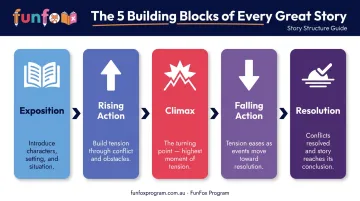
Regardless of which structure a writer uses, most narratives share five universal building blocks:
- Exposition — introduces the characters, world, and situation
- Rising action — tension builds through conflict and complications
- Climax — the story's turning point, where the stakes peak
- Falling action — the consequences of the climax play out
- Resolution — a new normal is established
Australian Curriculum resources confirm that students are expected to create narratives with a clear orientation, series of events, complication, and resolution — language that maps closely onto these universal elements.
Structure gives a writer decisions to make before the first draft begins. Without it, strong openings frequently drift into unfocused middles — not from lack of ideas, but from lack of a plan for where those ideas should land.
The 7 Types of Story Structure Every Writer Should Know
No single structure works for every story. Each one emphasises different elements — character change, pacing, tension, theme — and suits different genres and writing goals. Here's what each one offers.
Freytag's Pyramid
Developed by Gustav Freytag in his 1863 work Die Technik des Dramas, this five-act structure follows a distinct rise-and-fall shape: Introduction → Rising Action → Climax → Falling Action → Catastrophe.
The key distinction from most modern frameworks: Freytag's Pyramid typically ends in tragedy or significant loss. It was designed to analyse classical drama, and Freytag's own translation draws heavily on Shakespeare — Macbeth, Hamlet, and Romeo and Juliet are among the clearest examples of it in action.
Best suited for: Writers exploring themes of consequence, moral failure, or tragic fate. It's less common in children's adventure fiction, but understanding it helps young readers recognise why certain stories don't wrap up happily.
Key strength: Trains writers to think about cause and effect across an entire story arc.
Limitation: Its tragic resolution makes it a poor fit for uplifting or adventure stories most young writers want to tell.
The Hero's Journey
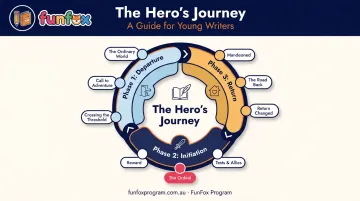
Joseph Campbell introduced the monomyth in The Hero with a Thousand Faces (1949), identifying 17 stages grouped into three phases: Departure, Initiation, and Return. Christopher Vogler later adapted this into a 12-stage framework for writers and screenwriters in The Writer's Journey.
The structure is circular: a hero leaves their ordinary world, faces escalating challenges, transforms through a defining ordeal, and returns changed. It's the world's most recognisable narrative pattern — visible in Star Wars, The Lion King, Harry Potter, and The Wizard of Oz.
Best suited for: Adventure, fantasy, and quest stories — the genres many primary school children are most excited to write. It's particularly valuable for building genuine character transformation alongside plot events.
Key strength: The journey's stages map naturally to exciting storytelling moments — the call to adventure, tests and allies, the ordeal — giving young writers a clear sequence of escalating action.
Practical tip for beginners: The full 12 steps can feel overwhelming. Simplifying to the three broad phases (departure, initiation, return) works well as a starting point.
Three-Act Structure
Rooted in Aristotle's observation that a story needs "a beginning, a middle, and an end," Three-Act Structure divides a narrative into:
- Act 1 (Setup) — establish characters, world, and inciting incident
- Act 2 (Confrontation) — rising conflict, midpoint twist, all-is-lost moment
- Act 3 (Resolution) — climax and denouement
It underpins the vast majority of films, novels, and school creative writing tasks — and it's the framework most closely aligned with what NAPLAN assesses: orientation, complication, and resolution.
Best suited for: Virtually any genre and any length, from a short story written in class to a full novel. It's the go-to framework for writers who want something reliable and adaptable.
Key strength: Its simplicity makes it the best starting point for young or first-time writers. Once mastered, it also serves as the backbone from which any other structure on this list can be layered or adapted.
Dan Harmon's Story Circle
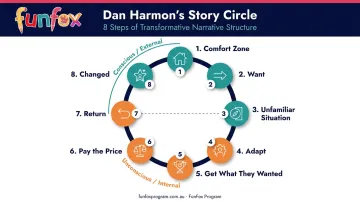
Developed by the creator of Rick and Morty, the Story Circle is an 8-step circular structure uniquely focused on character psychology. The eight steps are:
- A character is in their comfort zone
- They want something
- They enter an unfamiliar situation
- They adapt
- They get what they wanted
- They pay a heavy price for it
- They return to their familiar situation
- Having changed
The core insight is the distinction between what a character wants (their stated goal) and what they need (the deeper lesson they must learn). That gap is where the real story lives.
This structure works especially well for character-driven stories, short stories, and episodic writing where internal transformation matters as much as plot events. It's also a strong choice for writers who find other frameworks too focused on action — the Story Circle keeps feelings and motivation at the centre of every decision.
The Fichtean Curve
Where most structures ease readers in with exposition, the Fichtean Curve skips the preamble entirely. It launches the story straight into rising action — a series of escalating mini-crises — before reaching a single major climax, followed by a brief resolution. Backstory isn't given upfront; it's woven through the crises themselves.
The Book Designer attributes the term to John Gardner's The Art of Fiction (1983), though the origin is somewhat debated across writing-craft sources.
Mystery, thriller, and high-tension drama are natural fits — any genre where gripping the reader from line one matters most. For short stories where there's no room for a lengthy setup, the Fichtean Curve is especially effective.
The payoff is immediate momentum. Readers are asking "what happens next?" before they've finished the first paragraph.
Save the Cat Beat Sheet
Created by screenwriter Blake Snyder and published in 2005, Save the Cat prescribes 15 specific beats — not just what should happen in a story, but roughly when. The full beat sheet includes:
- Opening Image
- Theme Stated
- Set-Up
- Catalyst
- Debate
- Break into Act 2
- B Story
- Fun and Games
- Midpoint
- Bad Guys Close In
- All Is Lost
- Dark Night of the Soul
- Break into Act 3
- Finale
- Closing Image
Originally a screenwriting tool, it's now widely used by novelists too. The official Save the Cat site notes the method applies across screenplays, novels, memoirs, stage plays, and more.
Best suited for: Writers who prefer detailed planning before they start. Particularly effective for commercial fiction and adventure stories where pacing and reader engagement at specific moments matter.
For young writers: Most useful as a checklist after drafting rather than a rigid plan before writing. Even knowing a handful of the beats — catalyst, midpoint, all-is-lost moment — can meaningfully improve a story's structure.
Seven-Point Story Structure
Dan Wells popularised this structure through talks and writing-education media around 2010. Its central idea: start with the ending and work backwards. Writers define their resolution first, then create a hook that is its direct opposite — making the character's transformation visible from the very first page.
The seven points are:
| Point | Role |
|---|---|
| Hook | Starting state — opposite of the resolution |
| Plot Point 1 | The event that locks the character into the story |
| Pinch Point 1 | First real taste of the antagonist's power |
| Midpoint | Character shifts from reactive to active |
| Pinch Point 2 | The stakes are at their worst |
| Plot Point 2 | Character discovers what they need to win |
| Resolution | The ending — planned from the start |
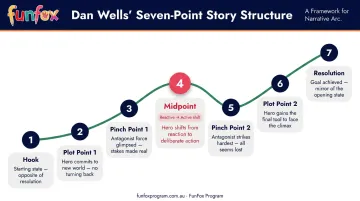
Best suited for: Writers who know how they want their story to end but aren't sure how to begin, or those who want a tightly plotted arc that clearly shows character change from start to finish.
The backwards-planning method is particularly effective for young writers who tend to start writing without knowing where they're going.
How to Choose the Right Story Structure
There's no universally correct answer — it depends on the story type, the writer's experience, and the effect they want to create. These questions help narrow it down:
What genre is the story?
- Adventure or fantasy → Hero's Journey or Three-Act Structure
- Mystery or thriller → Fichtean Curve
- Character study → Dan Harmon's Story Circle
How long is the story?
- Short story → Three-Act Structure or Fichtean Curve
- Novel → Hero's Journey or Save the Cat Beat Sheet
Is the writer a planner or a "write and see" type?
- Planners → Save the Cat or Seven-Point Structure
- Explorers → Three-Act or Story Circle as a loose revision guide after the first draft
Structures can also be combined. Many children's novels use Three-Act Structure as the spine while incorporating Hero's Journey elements. The framework that fits the story is the right one — rigid adherence to any single model tends to flatten the writing.
Experimenting with different structures is far easier when there's room to get things wrong and try again. In the FunFox Writers Club, students work in small groups of up to six, testing approaches across drafts and getting direct feedback from teachers in live sessions. Trying a Fichtean Curve, noticing it doesn't fit, and switching to a Three-Act Structure mid-project is how writers — young or otherwise — actually develop judgment about structure.
Common Story Structure Mistakes to Avoid
The most frequent mistake young writers make is choosing no structure at all — writing scene by scene without any sense of where the story is heading. Strong openings that run out of steam in the middle, or endings that arrive abruptly, are almost always the result.
Two further pitfalls are worth flagging:
- Treating structure as a rigid formula — forcing every scene to "fit" even when it damages the story. Structures serve the story; it's never the other way around.
- Rushing or skipping the resolution — the climax might be thrilling, but without a satisfying resolution, readers feel cheated even if they can't explain why.
NAPLAN's narrative marking guide specifically assesses text structure, including whether a story has a clear orientation, complication, and resolution — so weak endings have a direct impact on how school writing tasks are assessed.
Even published authors revise structure after the first draft. Write freely, then apply structural thinking during revision to spot where the story loses momentum or where the ending doesn't feel earned.
Conclusion
Story structure is one of the most practical tools any writer can use, whether they're just starting out or years into their craft. The seven frameworks covered here each offer a different lens:
- Freytag's Pyramid — cause and consequence
- The Hero's Journey — transformation and identity
- Three-Act Structure — reliable, flexible pacing
- Harmon's Story Circle — character psychology
- The Fichtean Curve — immediate, sustained tension
- Save the Cat — precise beat-by-beat control
- Seven-Point Structure — building backwards from a strong ending
Understanding these structures doesn't limit creativity. It gives creativity a shape to work within. The more students practise applying different frameworks to their stories, the more naturally storytelling instincts develop — and that confidence shows up in creative writing tasks, school assessments, and well beyond.
Frequently Asked Questions
What is the structure for creative writing?
Creative writing typically follows a narrative arc with five core elements — exposition, rising action, climax, falling action, and resolution. Writers apply one of many frameworks (such as Three-Act Structure or the Hero's Journey) to organise these elements into a satisfying story. In Australian schools, NAPLAN assesses narrative structure through orientation, complication, and resolution.
What is the simplest story structure for beginners?
Three-Act Structure (setup, confrontation, resolution) is widely considered the most accessible starting point for new or young writers. It mirrors how stories are naturally told and is flexible enough for any genre or length.
What is the most popular story structure?
The Hero's Journey and Three-Act Structure are the two most widely used frameworks globally. The Hero's Journey dominates adventure, fantasy, and film, while Three-Act Structure underpins most novels, screenplays, and school writing tasks.
What is the difference between Freytag's Pyramid and Three-Act Structure?
Both follow a rise-and-fall shape, but Freytag's Pyramid ends in catastrophe or tragedy, derived from classical drama. Three-Act Structure typically ends in resolution and some form of transformation, making it far better suited to modern fiction and school writing tasks.
Can young writers use story structures in school writing tasks?
Yes — understanding story structure directly supports school writing, particularly NAPLAN narrative writing tasks. A clear orientation, complication, and resolution map precisely onto what markers assess under text structure and plot development criteria.
Do you have to follow a story structure exactly?
No structure needs to be followed rigidly. A story needs a discernible shape: something changes, tension builds, and the ending feels earned. Structures simply help writers achieve this more deliberately.