The right prompt changes everything. A well-chosen writing prompt gives a child a foothold — a reason to put the first word down — and suddenly the page fills up.
This post delivers a curated collection of writing prompts across five categories: narrative, creative, opinion, descriptive, and reflective. You'll also find practical tips for using them at home without it feeling like extra homework. The prompts are designed for Year 3 students (typically ages 8–9) but are built to grow — revisit them in Years 4 and 5 with added complexity and they still hold up.
Key Takeaways
- Year 3 is when children shift from learning to write to writing to express — varied prompts support this transition
- Prompts across different genres build the full range of skills required by the Australian Curriculum v9.0
- Research across 56 K–5 studies confirms that choice and personally relevant topics are the strongest motivators for young writers
- Scaffolding (a quick chat, a drawing, a sentence starter) matters more than the prompt itself for reluctant writers
- A few short writing sessions each week builds stronger habits than occasional long ones
What Year 3 Writing Should Look Like
The Australian Curriculum Expectations
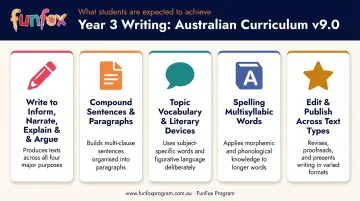
Under the Australian Curriculum v9.0, Year 3 students are expected to write with greater purpose and audience awareness. Specifically, they should be:
- Writing to inform, narrate, explain, and argue for a range of audiences
- Using compound sentences and organising ideas into simple paragraphs
- Extending their topic-specific vocabulary and experimenting with literary devices
- Spelling multisyllabic words with growing accuracy
- Editing and publishing their own work across imaginative, informative, and persuasive text types
This is more than just getting sentences on the page. The curriculum (particularly codes AC9E3LY06 and AC9E3LA04) expects students to think about who they're writing for and why — a cognitive leap that goes well beyond mechanics.
Why Year 3 Is a Turning Point
Those curriculum expectations explain why Year 3 sits at a crossroads. Children have mostly acquired the mechanical basics — letter formation, basic sentence structure, phonics — and are now being asked to use writing as a tool for thinking and communicating. That's a different cognitive demand, and it's why so many children hit a wall around this age.
Engaging prompts matter here because they remove the burden of what to write, leaving a child free to focus on how to write it well. When the idea is already there, expression can take centre stage.
What "And Beyond" Actually Means
The prompts in this post aren't locked to Year 3. They're written with enough flexibility that a Year 4 or Year 5 student can revisit the same prompt with greater sophistication — adding dialogue, varying sentence structure, or incorporating figurative language. A single prompt can grow with a child across multiple years of schooling.
Narrative and Personal Writing Prompts for Year 3
Narrative writing is the natural entry point for Year 3 children. It connects to personal experience, which means children already have the raw material — they just need help shaping it into a story. Storytelling sharpens sequencing, character development, and emotional expression in ways that other genres take much longer to teach.
These prompts work best when children start with real experience, then stretch into imagination. For a child stuck on where to begin, that starting point makes all the difference.
10 Narrative and Personal Writing Prompts
- Write about a time you felt really proud of yourself. What happened, and how did it feel?
- Tell the story of the best day you've ever had — from the moment you woke up.
- You wake up one morning and discover you can talk to animals. What happens next?
- Write about a time you had to be brave, even when you didn't feel it.
- Create a story about two unlikely friends who go on an unexpected adventure together.
- You find a mysterious letter in your letterbox addressed to you, but there's no sender. What does it say?
- Write about a time something went wrong that actually turned out to be funny.
- You swap lives with your pet for a day. Describe your experience.
- Tell the story of a moment when you changed your mind about something important.
- Write about a journey — real or imagined — where something unexpected happened along the way.
Once children are comfortable with the basics, these prompts can stretch further. For Years 4–5: encourage dialogue between characters, deliberate sentence length variation, or retelling the same story from a different point of view — say, from another character who was present in the scene.
Creative and Imaginative Writing Prompts
Creative prompts remove the pressure of "getting it right." When anything can happen in a story, children feel free to experiment with unusual words, strange ideas, and surprising plot turns. That freedom matters — it's often how children first discover they actually enjoy writing.
For children who struggle to generate ideas, story starters (sentence completions) work well as a scaffold. A prompt like "The door had never been there before, but now it was — and it was glowing..." gives a child a specific image to work from. It's a low-barrier way to get words on the page quickly, especially when paired with a brief planning conversation.
10 Creative and Imaginative Writing Prompts
- If you could invent any machine in the world, what would it do? Describe it and tell the story of the day you first used it.
- You find a door in your bedroom wall that was never there before. Where does it lead?
- Write a story from the point of view of your school bag — what does it see, hear, and feel every day?
- A dragon moves into your neighbourhood. Is it friendly or dangerous? What do you do?
- If you could spend a day inside your favourite book, what would happen to the story?
- You discover a map buried in the backyard. What does it lead to, and who drew it?
- Write a story that begins: "The last thing I expected to find on the school oval was a spaceship."
- A scientist shrinks you to the size of an ant for one afternoon. Describe your adventure.
- Your shadow starts doing things you didn't tell it to. What happens next?
- If animals could vote, what changes would they make to the world?
Make it harder (Years 4–5): Challenge older students to include a clear problem, a turning point, and a resolution. They should also weave in at least one simile and one example of personification — then read back through their draft to check whether both feel natural rather than forced.
Opinion, Persuasive, and Descriptive Writing Prompts
Persuasive and Opinion Prompts
Persuasive writing is explicitly required under AC9E3LY06, and it appears in both the Year 3 curriculum and the NAPLAN writing assessment, which gives Year 3 students 42 minutes to produce either a narrative or persuasive piece.
Starting with familiar, low-stakes topics makes it easier for children to form an opinion and back it up. At this age, the hardest part of persuasive writing isn't the argument structure — it's having something to say.
When using these prompts, ask your child: What do you think? Why? Who needs to hear this? Those three questions are the foundation of a persuasive piece.
5 Opinion and Persuasive Writing Prompts:
- Should students have homework? Write a persuasive letter to your teacher explaining your view and giving at least three reasons.
- Which is better — cats or dogs? Make your case with specific reasons and examples.
- Should school finish earlier on Fridays? Persuade your principal to agree with you.
- What is the most important subject at school, and why should every student have to study it?
- Should children be allowed to choose what they eat for dinner? Write a persuasive piece for a parent audience.
Descriptive Writing Prompts
Descriptive writing isn't a separate text type in the Australian Curriculum — it's embedded in narrative and explanatory writing as a language skill. The goal is to develop precise vocabulary and sensory detail, which strengthens every text type a child writes.
Encourage children to go beyond what they see and think about sound, smell, texture, and feeling. The best descriptive writing makes a reader feel present in the scene.
5 Descriptive Writing Prompts:
- Describe your favourite place using all five senses. Make the reader feel like they're actually there.
- Imagine you're standing at the edge of a magical forest at dusk. What do you see, hear, and smell?
- Describe the most delicious meal you can imagine — from the first smell to the last bite.
- Write a description of a thunderstorm from inside a cosy house. What does it sound like? How does the air feel?
- Describe a busy market or fair — the colours, the noise, the smells, the movement.
Journal and Reflective Writing Prompts
Reflective writing builds a different kind of writing muscle. Rather than crafting a story or making an argument, children are processing their own thoughts and experiences — which supports literacy development and the habit of expressing their inner life on the page.
Reading Rockets describes journal writing as a way to build writing fluency, communicate through writing, and reflect on learning. It's low-stakes by design, which makes it ideal for children who freeze up under more formal writing tasks.
That low-stakes quality makes journal writing easy to try at home. Set up a dedicated notebook and use these prompts for 10 minutes a few evenings a week — consistency over time builds the habit far more effectively than occasional long sessions.
8 Journal and Reflective Prompts
- What made you smile today, and why did it feel good?
- What is one thing you wish you were better at? What's one small step you could take to improve?
- Describe a goal and the steps you'd need to reach it.
- What is something you're grateful for that you don't often think about?
- If you could give your younger self one piece of advice, what would it be?
- Write about a person who makes you feel confident. What do they do that helps you?
- What is something you used to think was too hard that you can do now?
- Describe a moment this week when you felt really like yourself.
Tips for Using These Writing Prompts at Home
Make It Feel Like Storytelling, Not School
The single biggest thing parents can do is change the frame. Don't say "time to practise writing" — say "pick a prompt and tell me a story." Let your child choose which prompt excites them rather than assigning one. Research from a 2024 systematic review found that students identified choice and personally interesting topics as key motivators — so a small menu of options is more effective than a single directive.
That same principle applies once writing starts. Resist the urge to correct spelling or grammar mid-flow. If a child is in the middle of a thought and gets stopped to fix a comma, they lose the thread. Let the ideas come first; editing is a separate step.
Be a Genuine Audience
When your child finishes writing, respond with real curiosity rather than evaluation. "I loved this part — what happens to the dragon after that?" signals that writing has genuine value and a real reader. It's a more powerful motivator than praise alone because it treats the child as an actual author.
Scaffolding for Reluctant Writers
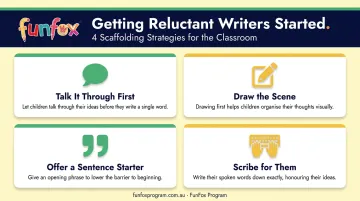
Some children need a bridge between the prompt and the first word. Try these:
- Talk it through first — spend two minutes discussing the prompt verbally before anyone picks up a pencil
- Draw the scene — let them sketch the character or setting, then write about what they've drawn
- Offer a sentence starter — "The day I felt most proud was..." removes the hardest part (the beginning)
- Scribe for them — if they're genuinely stuck, write while they dictate; the words are still theirs
Each of these strategies gives reluctant writers a way in — and most children need them less and less over time.
When You Want More Than Prompts
For families who want regular, structured practice beyond open-ended prompts, the FunFox Writers Club runs live online sessions where qualified teachers guide Year 3 (and older) students through different text types in small groups of no more than six.
Sessions are term-based and run weekly, which suits parents who want writing practice woven consistently into the week rather than left to chance.
Frequently Asked Questions
What are some good writing prompts for Year 3 students?
The most versatile prompts for Year 3 combine narrative, creative, and opinion writing — such as "Write about a time you had to be brave," "A dragon moves into your neighbourhood," or "Should students have homework?" The lists in this article cover all major text types required at this level.
What should Year 3 writing look like?
Year 3 students should be writing with awareness of audience and purpose, using compound sentences, organising ideas into simple paragraphs, and extending their vocabulary. The Australian Curriculum v9.0 expects them to write across narrative, informative, and persuasive text types.
How do I improve writing skills in Year 3?
Three things matter most: regular practice with varied prompts, wide reading, and encouraging feedback that responds to ideas before it comments on spelling and grammar. Consistency over a term makes more difference than occasional intensive sessions.
How often should Year 3 students practise writing at home?
A few short sessions per week — even 10–15 minutes each — is more effective than daily pressure. The goal is building a sustainable habit that children associate with something enjoyable, not a chore that has to be finished.
What types of writing are taught in Year 3 in Australia?
Year 3 students work across narrative, informative/explanatory, and persuasive/opinion writing. Descriptive language skills are embedded within these text types rather than treated as a separate genre.
How do I help my Year 3 child if they get stuck on a prompt?
Talk through the prompt out loud before they write, let them draw their ideas first, or offer a specific sentence starter to break the ice. Getting the first sentence down is almost always the hardest part — once that's there, most children find their way.