Introduction
"She walked into the bakery." Now read this: "The warm, sugary air wrapped around her the moment she stepped inside, the sharp tang of cinnamon cutting through the sweetness."
Same scene. Completely different experience. That's what sensory imagery does — it transforms a flat report into something a reader can feel.
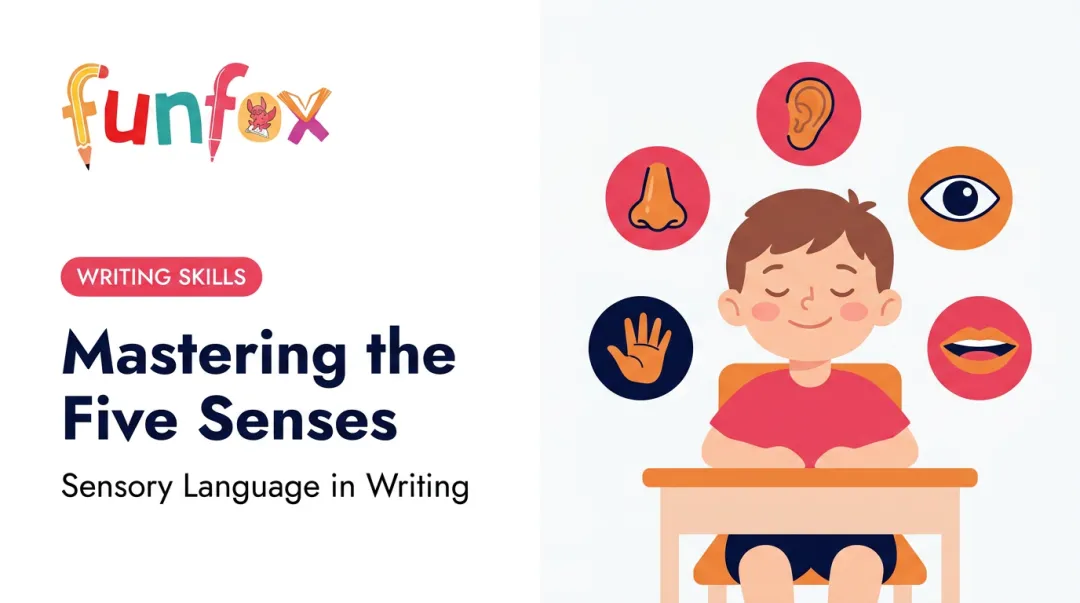
Sensory imagery is a core tool in creative writing. By targeting the reader's senses — sight, sound, touch, smell, taste, movement, and internal feeling — writers turn words into experiences. Readers stop observing the story and start living inside it.
This article covers what sensory imagery is, all seven recognised types with clear examples, how great authors use it, and practical ways student writers can start applying it straight away.
Key Takeaways
- Sensory imagery is descriptive language that engages one or more senses to create a vivid mental experience
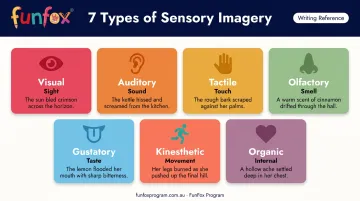
- Seven types exist: visual, auditory, tactile, olfactory, gustatory, kinesthetic, and organic
- Good imagery does more than describe — it evokes emotion and builds atmosphere
- Choosing the right sense for a moment is more effective than cramming all seven into a single scene
- Writers who notice sensory details in daily life produce more convincing, grounded imagery on the page
What Is Sensory Imagery in Creative Writing?
Imagery, as defined by LitCharts, is "descriptive language that engages the human senses." Sensory imagery is the specific branch of this that anchors writing in physical, perceivable experience — what a place looks, sounds, smells, feels, and tastes like, as well as how movement and internal states feel in the body.
Sensory imagery and imagery broadly defined are related but not identical. All sensory imagery is imagery, but imagery can also include emotional or abstract description. Sensory imagery specifically deals with what can be perceived — by the body, from the outside or the inside.
The "Show, Don't Tell" Connection
Sensory imagery is "show, don't tell" in practice. Rather than telling readers a character is nervous, a writer might describe:
- A dry mouth that makes swallowing difficult
- Hands that won't stay still
- A heartbeat loud enough to feel in the throat
That physical, perceivable experience lands differently than the word "nervous" ever could. Excelsior OWL's guidance on descriptive writing connects this directly to the five senses — the goal is for readers to feel present, not just informed.
One misconception worth clearing up: sensory imagery doesn't have to be figurative. A sentence like "the sand was hot and coarse underfoot" is literal, not metaphorical — and it's still strong sensory imagery. Similes and metaphors are tools that can create sensory imagery, but they're not required.
The 7 Types of Sensory Imagery
Sensory imagery isn't one technique — it's a family of seven distinct types, each targeting a different sense. According to EBSCO's literary research resources, many school curricula teach five traditional types; expanded literary-writing frameworks add kinesthetic and organic imagery to make seven.
Skilled writers draw on whichever type best serves the scene they're building.
Visual Imagery
Visual imagery appeals to sight — colour, shape, light, shadow, and movement. It's the most commonly used type in creative writing, largely because humans process the world so heavily through sight.
Example: Instead of "the garden was pretty," write: "Orange and purple flowers blazed along the fence, their petals glowing in the afternoon sun."
The colour contrast, the verb "blazed," and the specific quality of light do more than decorate — they put the reader inside the scene.
Auditory Imagery
Auditory imagery appeals to hearing — sounds, rhythms, volumes, and silences. It includes onomatopoeia and alliteration but goes further, describing how something sounds through comparison and detail.
Example: Instead of "the classroom was noisy," write: "Pencils scraped against paper and chairs screeched across the floor, a chaotic symphony of the school day."
Each specific sound — scraping, screeching — makes the noise tangible.
Tactile Imagery
Tactile imagery appeals to touch — textures, temperatures, pressure, and physical sensations on the skin. (Internal sensations like nausea belong to organic imagery; tactile imagery stays at the surface.)
Example: Instead of "the ice cream was cold," write: "The icy sweetness sent a sharp chill from her tongue all the way to her teeth."
That specific pathway — tongue to teeth — gives the sensation physical reality.
Olfactory Imagery
Olfactory imagery appeals to smell — and smell is worth treating differently from the other senses. Because olfactory signals connect directly to the brain's memory and emotion centres, a single well-placed scent can anchor a reader in a time, a place, or a feeling more powerfully than almost any other detail.
Example: "The library smelled of old paper and dust, a scent that always reminded her of rainy Saturday mornings."
One sentence. Two effects: it describes the space and creates an emotional association.
Gustatory Imagery
Gustatory imagery appeals to taste — flavour, sweetness, bitterness, saltiness, texture, and the physical act of eating or drinking. It's the rarest type in fiction, but powerful in food scenes or moments of cultural connection.
Example: Instead of "the soup was good," write: "The broth was rich and salty, with a warmth that seemed to spread from her chest to her fingertips."
Taste bleeds into physical sensation here. That crossover is what makes gustatory imagery stick.
Kinesthetic Imagery
Kinesthetic imagery captures the feeling of movement — running, falling, spinning, swaying — and the bodily sensations that come with physical action. It's distinct from tactile imagery: a bee sting is tactile; sprinting with burning lungs is kinesthetic.
Example: "Her legs pumped harder and harder, the ground blurring beneath her feet as the finish line rushed toward her."
The reader is inside the movement, not watching from the sideline.
Organic Imagery
Organic imagery describes internal sensations — emotions, hunger, nausea, fear, exhaustion — the things felt from the inside out. It's the most abstract of the seven types, and the one writers reach for when they want readers to feel what a character feels rather than simply understand it.
Example: Instead of "she was sad," write: "A heavy emptiness settled in her chest, the kind that made every breath feel a little too slow."
The emotion is never named. The physical internal experience communicates it far more powerfully.
Sensory Imagery Examples from Literature
Studying sensory imagery in published writing is one of the most effective ways to understand how it actually works. Great writers choose specific types of imagery deliberately — the sense selected always serves the emotional truth of the moment.
Visual Imagery: The Yellow Wallpaper by Charlotte Perkins Gilman
"The color is repellant, almost revolting; a smouldering unclean yellow, strangely faded by the slow-turning sunlight."
Published in 1892 and available via Project Gutenberg, this description does something remarkable with colour. The wallpaper isn't just yellow — it's "smouldering," "unclean," faded in a way that suggests slow decay. The visual detail carries the narrator's psychological state without stating it directly.
Kinesthetic Imagery: The Wonderful Wizard of Oz by L. Frank Baum
"The house whirled around two or three times and rose slowly through the air. Dorothy felt as if she were going up in a balloon."
From the first chapter of Baum's 1900 classic (Project Gutenberg text), the "whirling" and "rising" give motion a physical weight. The balloon comparison works because it translates an impossible situation into a sensation readers already know — landing them inside Dorothy's disorientation rather than above it.
Olfactory Imagery: A Room with a View by E.M. Forster
"A smell! a true Florentine smell! Every city, let me teach you, has its own smell."
From Forster's 1908 novel (Project Gutenberg text), a single smell becomes a portal to place, culture, and memory. Notice, too, that Forster barely describes the smell itself — the narrator's excited reaction to it does the work. A writer's response to a sensory detail can carry just as much power as the detail alone.
In each example, the author selected the sense that fit the emotional moment — not just the most obvious one. That deliberate choice is what separates functional description from imagery that stays with the reader.
How to Use Sensory Imagery in Your Writing
Expand and Specify
First drafts often produce flat, generic descriptions: "she sat on the bed." That's a starting point, not a finished image.
Young writers should learn to pause after writing a scene and ask: What does this look, sound, smell, feel, or taste like? Even one specific detail transforms the sentence — the scratchy woollen blanket, the squeak of bedsprings, the smell of clean sheets still warm from the dryer.
The method is simple:
- Write the draft sentence
- Pick the one or two senses most relevant to the moment
- Add a specific physical detail for each
- Cut anything that feels forced
Choose One or Two Senses — Not All Five
More senses don't always mean better writing. Listing all five in sequence feels mechanical and exhausting to read. Instead, match the sense to the scene:
- Kitchen or food scene → olfactory or gustatory
- Chase or action sequence → kinesthetic
- Emotional confrontation → organic imagery
- Atmosphere or place description → visual or auditory
Quality beats quantity every time. Excelsior OWL warns that too much sensory detail can become tedious — balance is the goal.
Use Fresh, Specific Comparisons
Clichés weaken sensory imagery. "Cold as ice," "white as snow," "sweet as honey" — readers skim past these without registering them.
The UNC Writing Center advises avoiding clichés and revising toward specificity. Instead of reaching for a familiar phrase, ask: What does this actually remind me of? What unexpected comparison is accurate?
Compare:
- ❌ "The snow sparkled like diamonds."
- ✅ "The snow settled like ash, cold and impossibly quiet."
The second version is unexpected, but precise — and that precision is what makes it stick.
Build the Skill Progressively
Sensory imagery improves through repeated, structured practice — not by studying definitions in isolation. The FunFox Writers Club builds this directly into its Term 1 Descriptive Writing unit, where students focus on "creating vivid imagery using sensory details and strong word choices."
In small groups of no more than six, children work through structured worksheets, receive personalised written feedback via Seesaw, and practise these techniques inside real descriptive writing tasks. Over time, reaching for the right sensory detail stops being a conscious step — it becomes instinct.

Frequently Asked Questions
What is imagery in creative writing?
Imagery is descriptive language used to represent experiences through the senses or emotions, helping readers form vivid mental pictures. Strong imagery puts readers inside a scene rather than simply describing it from a distance.
What are the 7 types of imagery?
The seven types are: visual (sight), auditory (sound), tactile (touch), olfactory (smell), gustatory (taste), kinesthetic (movement and physical action), and organic (internal sensations and emotions). Most school curricula focus on the first five, with kinesthetic and organic covered in expanded literary frameworks.
What are the 5 C's of creative writing?
Several versions circulate online — common ones include Character, Conflict, Context, Clarity, and Creativity, or similar groupings. No single version is universally agreed upon, so treat any list as a helpful guide rather than a fixed rule. Sensory imagery supports most versions, particularly creativity and clarity.
What is the difference between sensory imagery and figurative language?
Sensory imagery is the effect — description that engages the reader's senses. Figurative language (similes, metaphors, personification) is one toolbox for creating it, but not the only one. "The gravel crunched underfoot" is sensory imagery with no figurative language involved.
How can children practise sensory imagery in their writing?
Three practical activities:
- Pick a familiar object and describe it using three different senses
- Take a bland sentence ("the park was nice") and rewrite it using one specific sensory detail
- Open a favourite book to any page and identify which type of imagery the author used and why