Introduction
Picture this: a child finishes their story about a trip to the park and writes, "The park was fun. We played games. It was a good day." Technically correct. Completely forgettable.
The missing ingredient isn't more words — it's sensory language. Writing that doesn't just describe what happened, but pulls readers into the scene so they feel the sun on their shoulders, hear the shriek of kids on the swings, smell the cut grass underfoot.
Sensory language is the difference between writing that gets read and writing that gets felt. It's also directly tied to how Australian students are assessed — NAPLAN's Narrative marking guide rewards precise vocabulary, imagery, atmosphere, and reader effect, all of which sensory detail supports.
This guide breaks down what sensory language is, how each of the five senses works in writing, and practical techniques students can apply straight away — including before-and-after examples that show the difference in action.
Key Takeaways
- Sensory language uses sight, sound, smell, taste, and touch to help readers experience a scene, not just read about it.
- Most young writers rely heavily on sight — layering in other senses is what makes writing stand out.
- Two to three well-chosen sensory details per scene beat a long list every time.
- Drop "I could see/hear/smell" — let the description stand alone and the writing immediately gets stronger.
- A five-sense brainstorm table before writing is one of the best tools for beating a blank page.
What Is Sensory Language in Writing?
Sensory language is writing that deliberately appeals to one or more of the five senses — sight, sound, smell, taste, and touch — so readers don't just understand a scene but genuinely experience it.
It's the practical engine behind the "show, don't tell" principle. Telling a reader "the kitchen was warm and comforting" gives them information. Showing them "the smell of butter and cinnamon curled through the air, and the oven hummed low and steady" puts them inside the room.
Where Sensory Language Appears
That same skill transfers across nearly every writing task students encounter. Sensory language appears in:
- Narrative fiction — building setting, atmosphere, and character
- Personal recounts — making memories vivid and immediate
- Descriptive compositions — creating a dominant impression of a place or person
- Poetry — using sound, imagery, and texture to create emotional effect
Reading Rockets describes descriptive writing as writing that forms "a picture in the reader's mind" by connecting to sensory input across all five senses — a framework used by literacy teachers across Australian classrooms.
Five Characteristics of Strong Descriptive Writing
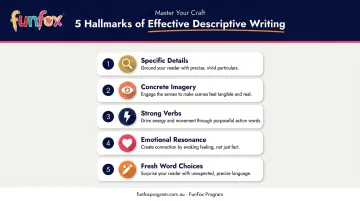
Sensory language supports all five hallmarks of effective descriptive writing:
- Chooses specific details over vague generalisations
- Uses concrete imagery readers can picture, hear, or feel
- Relies on strong verbs that carry action and sensation
- Builds emotional resonance, not just information
- Reaches for fresh, precise word choices rather than clichés
Why Sensory Language Makes Writing Come Alive
When a writer describes something using only facts — "the dog was big and brown" — the reader processes it and moves on. But when the description activates a sense — "the dog shook water from its coat, spattering cold drops across her ankles" — something different happens.
Research published in PMC found that understanding action-based and textural language activates sensory-motor areas of the brain — meaning vivid, physical language prompts a kind of mental simulation. Readers don't just decode the words; they simulate the experience. That's why sensory writing feels more real and stays with readers long after they've finished the page.
The Sight-Only Habit
Most young writers start from what they can see. Colours, shapes, sizes — these come naturally because sight is the dominant sense in everyday life. But sight-heavy writing tends to feel flat because it keeps the reader at a distance, observing rather than inhabiting the scene.
The shift from ordinary to impressive descriptive writing usually comes from adding one unexpected sensory layer. A description of a crowded market isn't transformed by more colour detail. It's transformed by the smell of roasting nuts, the press of strangers' shoulders, or the tinny sound of a radio drifting from somewhere inside a stall.
Teachers and markers notice the difference immediately. NAPLAN's Narrative guide assesses "sense of place, time and atmosphere" — and those qualities only emerge when students reach beyond what they can see.
The Five Senses in Writing: A Guide for Young Writers
Good descriptive writing doesn't rely on one or two senses — it uses all five. Reading Rockets' Five Senses Graphic Organiser organises brainstorming across every sense before students write a single sentence. The reason? Each sense does a different job in writing — and knowing what that job is helps writers use each one deliberately.
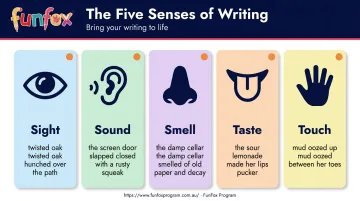
Sight
Sight is the natural starting point — colour, light, shape, movement, contrast. The problem isn't that writers use it; it's that they use it vaguely.
Weak: "There was a big, old tree." Strong: "A twisted oak hunched over the path, its bark cracked and dark like dried mud."
The second version uses the same sense but does twice the work. Specificity is everything. Replace "beautiful" with what makes it beautiful. Replace "big" with scale that readers can picture.
Sound
Sound sets mood faster than almost any other sense. A scene described as silent feels eerie. One filled with noise feels chaotic or joyful. Onomatopoeia — words like buzz, crash, rustle, squelch — is a child-friendly technique because the word itself performs the sound.
Flat: "There was noise in the kitchen." Alive: "Pots clanged, oil hissed, and someone laughed too loudly above it all."
The Australian Curriculum introduces onomatopoeia formally in Year 3, so primary-age students are ready to use it.
Smell
Smell is the most underused sense in student writing — and the most powerful. Research linking odour with autobiographical memory and emotion is well established; a 2023 review in PubMed found that smell- and taste-triggered memories are especially self-relevant and emotionally arousing.
In practice, this means smell details make settings feel instantly real and familiar to readers.
Without smell: "They walked into the bakery." With smell: "The moment the door opened, warm sugar and toasted bread wrapped around them like a second coat."
Taste
Taste is the rarest sense in student writing, but it doesn't require food to be effective. Think of the metallic edge of nerves before a performance, or the salt of sea air on the lips. Taste works best in moments of high emotion or strong sensory environments — a birthday, a competition, a storm.
Example: "She licked her lips and tasted sunscreen and salt from the afternoon sea."
Touch
Touch covers texture, temperature, pressure, and physical sensation. Young writers often forget that characters have bodies — hands that feel things, feet that register surfaces, skin that responds to weather.
A useful prompt: ask students, "What does your character's body feel right now?" That single question tends to unlock description they'd otherwise skip entirely.
- Texture: rough, slick, gritty, smooth
- Temperature: stinging cold, humid warmth, the shock of ice water
- Pressure: the weight of a school bag, a hand gripping a wrist
- Physical sensation: dizzy, breathless, the sting of a graze
Before: "The ground was wet." After: "Mud oozed up between her toes with every squelching step, cold and thick."
From Flat to Vivid: Sensory Writing Examples for Kids
The easiest way to understand sensory language is to see it doing its job. Here's the same scene written two ways.
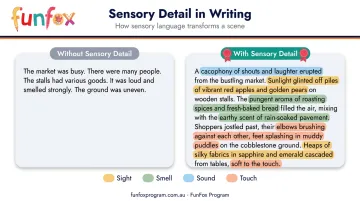
Version 1 — No Sensory Detail
It was sports day. We went outside and there were lots of activities. People were cheering. I ran in the race and came third. It was a fun day.
Accurate. Forgettable.
Version 2 — With Sensory Detail Layered In
*The oval baked under a white sky, and the smell of sunscreen and dry grass hung in the hot air [smell]. Everywhere, kids shouted and whistled, their voices bouncing off the portable classrooms [sound]. When the starter called "Go!" the ground thundered under her feet [touch + sound], and she ran until her lungs burned and her legs felt like wet sand [touch].*
The facts are the same. The experience is completely different.
Breaking It Down
| Detail | Sense |
|---|---|
| "baked under a white sky" | Sight |
| "smell of sunscreen and dry grass" | Smell |
| "kids shouted and whistled" | Sound |
| "ground thundered under her feet" | Touch + Sound |
| "lungs burned," "legs felt like wet sand" | Touch |
The Sense Verb Trap
Many young writers fall into this habit:
- "I could see the sun setting."
- "I could hear birds in the trees."
- "I could smell something burning."
These phrases slow writing down and keep the reader at arm's length. The fix is simple: remove the filter and let the description land directly.
- ❌ "I could hear birds in the trees."
- ✅ "Birds called from somewhere above, unseen but close."
NAPLAN Narrative marking criteria specifically reward writing where language choices serve the reader's experience. Cutting the sense verb is one small edit — one small cut, and the writing immediately feels more immersive.
Practical Tips to Help Young Writers Use All Five Senses
Tip 1 — Build a Sensory Word List Before You Write
Before touching the actual piece, spend five minutes brainstorming. Draw five columns labelled Sight, Sound, Smell, Taste, and Touch, then fill each one with words that belong to the scene.
A student writing about a rainy afternoon at home might list: grey light, drumming on the roof, wet dog smell, warm cocoa taste, cold windowpane under fingertips. That list becomes a word bank. The blank page stops being so blank.
Tip 2 — Choose Two or Three Senses Per Scene
Using all five senses in every paragraph doesn't create richer writing — it creates an exhausting checklist. The goal is precision, not completeness. Pick the two or three senses that matter most to the moment and use them well.
A scary scene might only need sound and touch. A happy memory might live entirely in smell and taste. Two senses used with intention will always outwork five senses used carelessly.
Tip 3 — Pair Figurative Language with Sensory Detail
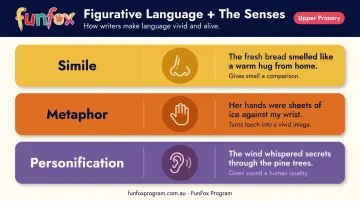
Sensory details get sharper when paired with figurative language. A simile gives a smell something to compare to; a metaphor makes a texture hit harder; personification gives a sound a personality. Students who practise both together develop a noticeably stronger writing voice.
Here are three combinations worth trying:
- Simile + smell: "The locker room smelled like old socks left in a puddle."
- Metaphor + touch: "The sand was fire under her bare feet."
- Personification + sound: "The wind argued with the trees all night."
Tip 4 — Practise with Real-World Observation
The best sensory writers are observant people. Encourage children to sit somewhere interesting — a café, a park, a school canteen — and spend a few minutes writing down what each sense picks up. Not sentences yet, just words and fragments. This trains children to notice details they'd normally filter out.
Programs like FunFox's Writers Club build structured observation and descriptive writing practice into regular weekly sessions, with personalised feedback helping students refine their sensory language over time.
Common Mistakes to Avoid
Overloading Every Sentence
Sensory language works through precision, not volume. A sentence crammed with smell, texture, sound, and colour all at once overwhelms the reader and feels laboured. If you've described the same moment using four senses in one sentence, trim it to two. Two well-chosen senses land harder than four competing ones.
Relying Only on Sight
A quick self-edit check: read through a piece of writing and mark every detail that only describes what something looks like. If every mark is a sight detail, ask: what does it sound like here? What does the character feel physically? One additional sense, in the right place, changes everything.
Vague or Clichéd Sensory Words
Some words have been repeated so often they no longer create any real effect:
| Cliché | More Vivid Alternative |
|---|---|
| "Nice smell" | "Warm, buttery, like popcorn at the bottom of the bag" |
| "Loud noise" | "A crack that split the air and left her ears ringing" |
| "Cold touch" | "Ice-water cold, sharp enough to make her gasp" |
The NAPLAN Vocabulary criterion rewards range and precision. A student who reaches for a specific, fresh word will always score above one who reaches for the first word that comes to mind.
Frequently Asked Questions
What are the 5 senses in descriptive writing?
The five senses are sight, sound, smell, taste, and touch. In descriptive writing, each sense is used to help readers experience a scene directly — rather than just being told what happened, they feel, hear, or smell it alongside the character.
What are the 5 characteristics of descriptive writing?
Strong descriptive writing typically combines sensory detail, precise and specific language, concrete imagery, figurative language (similes and metaphors), and a clear emotional impression.
What is an example of sensory language in a sentence?
"Rain hammered the tin roof [sound] while she pressed her back against the cold brick wall [touch], waiting." The drumming rain creates sound; the cold brick grounds the character physically. Two senses, one sentence, immediate atmosphere.
How do you teach children to use sensory language in writing?
Start with a five-sense brainstorm before any writing begins, then use annotated model texts to show students what sensory detail looks like in practice. Real-world observation exercises — describing a familiar place using all five columns — build the habit of noticing before writing.
How do you avoid overusing sensory details in writing?
Limit each scene to two or three senses, and make sure each detail earns its place — it should tell us something about mood, character, or place. Reading the paragraph aloud helps: if it feels cluttered or slow, cut the weakest detail first.
Why is sensory language important in creative writing?
Sensory language makes writing immersive and emotionally resonant. It draws readers into the scene so they experience characters and settings directly — and it aligns with Australian Curriculum expectations across year levels, from onomatopoeia in Year 3 to imagery and figurative language in Years 5 and 6.