
Introduction
Year 5 is many children's second encounter with NAPLAN — and the spelling component catches families off guard more often than you'd expect.
The vocabulary jump from Year 3 is real. Where Year 3 tested consonant blends and short-word patterns, Year 5 introduces multi-syllabic words, complex suffixes, silent letters, and words like separate, conscience, and necessary — words where sounding it out simply won't save you.
This blog gives you a ready-to-use list of 100 NAPLAN-aligned Year 5 spelling practice words, organised by spelling pattern rather than alphabetically. That structure mirrors how the Australian Curriculum builds spelling skills, making home practice far more targeted than a random list.
You'll also find which patterns trip students up most, how NAPLAN tests spelling, and practical strategies for practising at home.
Disclaimer: This is a practice list aligned to Australian Curriculum v9.0 expectations, not an official NAPLAN document. NAPLAN does not publish its word lists in advance.
Key Takeaways
- Year 5 NAPLAN spelling draws on phonic, morphemic, and vocabulary knowledge together — not just sound-it-out strategies
- The 100 words below are grouped by pattern for more efficient, targeted practice
- NAPLAN tests spelling through audio dictation, so practise by hearing words aloud, not just reading them on a page
- Short daily sessions (10–15 minutes) beat one long cramming session
- Memory tricks and word families help far more than rote memorisation
What Year 5 Students Are Expected to Spell
The Australian Curriculum v9.0 content description AC9E5LY08 states that Year 5 students should "use phonic, morphemic and vocabulary knowledge to read and spell words that share common letter patterns but have different pronunciations."
This is a step up from earlier years. Sounding words out is no longer enough — students need to understand how word parts carry meaning to spell accurately.
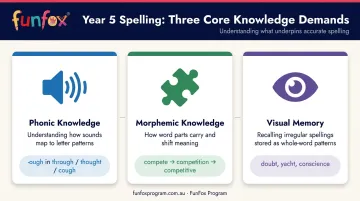
The Three Core Demands at Year 5
- Phonic knowledge — recognising that the same letter string (like -ough) can produce multiple sounds (through, thought, cough)
- Morphemic knowledge — using base words, prefixes, and suffixes to spell unfamiliar words (knowing compete helps with competition and competitive)
- Visual memory — storing the shape of words where pronunciation is no guide (doubt, yacht, conscience)
NAPLAN's proficiency level descriptions confirm this progression: students at the Exceeding level can spell difficult patterns and commonly misspelled words like business and receive, while students still developing are limited to frequent one-syllable words.
Year 3 NAPLAN sits at the simpler end of that scale — which is why the word list below focuses specifically on the patterns and exceptions that trip up Year 5 students most.
100 Year 5 NAPLAN Spelling Practice Words
Group 1: -tion, -ture, and -sure Endings (20 words)
These endings all produce a "shun," "chuh," or "zhuh" sound, making them easy to confuse. Students need to memorise which ending belongs to which word visually — sounding them out won't reliably distinguish between them.
- station
- motion
- fraction
- action
- mention
- fracture
- picture
- mixture
- adventure
- creature
- nature
- capture
- feature
- culture
- pasture
- measure
- treasure
- pressure
- pleasure
- closure
Group 2: Prefixes and Suffixes (20 words)
Words built from common prefixes and suffixes (-ful, -less, -ness, -ment, -ly, -er, -able) follow predictable patterns once students understand how suffixes attach to base words. Knowing the base word is the key.
- careless
- hopeful
- restless
- payment
- movement
- quickly
- safely
- teacher
- builder
- visitor
- readable
- washable
- playful
- darkness
- kindness
- helpful
- truthful
- fearless
- endless
- useful
Group 3: Tricky High-Frequency Words (20 words)
These are commonly misspelled because pronunciation doesn't reliably match spelling. Many contain unstressed vowel sounds (schwa) that students tend to omit or swap.
| Word | Example sentence |
|---|---|
| calendar | Check the calendar for the date. |
| biscuit | She ate one biscuit after lunch. |
| library | We returned the books to the library. |
| business | Running a business takes planning. |
| straight | Draw a straight line across the page. |
| neighbour | Our neighbour waved from the fence. |
| colour | Choose your favourite colour. |
| favourite | Blue is his favourite shade. |
| through | She walked through the door. |
| thought | He thought carefully before answering. |
| bought | They bought new shoes yesterday. |
| enough | There was just enough time. |
| answer | She knew the answer immediately. |
| minute | Wait one minute, please. |
| remember | Did you remember your lunch? |
| separate | Keep the two piles separate. |
| sentence | Write the sentence correctly. |
| different | This book is different from the last. |
| probably | She will probably arrive early. |
| necessary | It is necessary to check your work. |
Group 4: ie/ei Patterns and Homophones (20 words)
The ie/ei rule (i before e except after c) has enough exceptions to cause real confusion. Homophones are tested because students must choose the correctly spelled word for a given meaning.
ie/ei words:
- achieve
- believe
- deceive
- receive
- ceiling
- piece
- field
- friend
- ancient
- science
Homophones (with brief clarifications):
- advice (noun: She gave good advice) / advise (verb: I advise you to check)
- practise (verb: Practise your spelling) / practice (noun: spelling practice)
- stationary (not moving: The car was stationary) / stationery (paper and pens: Buy stationery)
- principle (a rule or belief: Follow the principle) / principal (head of a school, or main: The principal spoke)
- their (belonging to them) / there (a place or used to introduce: There is a dog) / they're (they are: They're coming)
Group 5: Silent Letters, Challenging Patterns, and Stretch Words (20 words)
These words contain unpronounced letters or spelling patterns that phonics alone can't decode. Students who encounter these in a NAPLAN dictation need prior visual exposure, since there's no way to work them out on the spot.
- conscience
- conscious
- government
- environment
- knowledge
- muscle
- queue
- rhythm
- yacht
- subtle
- doubt
- debt
- sign
- foreign
- campaign
- guard
- parliament
- exaggerate
- February
- curiosity
Bonus stretch words (96–100):
- dictionary
- immediately
- accommodation
- particularly
- occasionally
Spelling Patterns That Trip Up Year 5 Students
The -tion / -ture / -sure Problem
All three endings produce similar sounds but belong to different word types:
- -tion follows verbs and Latin roots (motion, action, fraction)
- -ture appears in concrete nouns (picture, creature, mixture)
- -sure is rarer and often follows plea-, trea-, mea- (pleasure, treasure, measure)
Visual memorisation of word shape is more reliable than any rule for these endings. Group them together in practice so students see the contrast.
The ie/ei Rule (and When It Fails)
The core pattern: i before e (achieve, believe, field). After c, reverse it: ceiling, receive, deceive.
The catch? Words like science and ancient break both rules. Treat those as visual exceptions to memorise separately rather than forcing them into a rule that doesn't hold.
Silent Letters: Why Etymology Helps
Words like debt, doubt, yacht, muscle, and knowledge contain letters that are never pronounced. Students cannot decode their way to correct spelling here.
A brief etymology note can help with retention: the words debt and doubt both had their silent b restored in the Middle Ages to reflect their Latin roots (debitum and dubitare). That's a strange fact — but strange facts stick.
Schwa Sounds in High-Frequency Words
Silent letters aren't the only phonetic trap. The schwa — that weak, unstressed "uh" — creates a different problem: words that sound perfectly normal but hide their vowels in the middle. Reading Rockets notes that understanding schwa helps students see why words like necessary, separate, and February don't spell the way they sound. Students routinely omit or swap those vowels as a result.
Three memory tricks that work:
- Necessary: "one Collar and two Socks" — one c, two s's
- Separate: "there is a RAT in sepaRAte"
- February: say it as Feb-RU-ary to remind yourself of the hidden r
Word Families as a Spelling Strategy
Understanding roots multiplies what students can spell. One root unlocks a cluster of related words — for example:
- compete → competition, competitive, competitor
- sign → signal, signature, significant
- struct → structure, construct, instruction

Recognising the shared root also helps students read unfamiliar words — they can work out meaning from structure rather than guessing from context alone.
How NAPLAN Actually Tests Year 5 Spelling
NAPLAN's Conventions of Language test includes spelling questions delivered as audio dictation — a word is spoken aloud in context, and students must type the correct spelling with no visual prompt or multiple-choice options, so headphones are required.
The test also includes a proofreading format: a misspelled word is circled in a sentence and students write the correct spelling in a box. The official Year 5 example paper uses both formats.
Students who have only studied word lists visually often struggle when a word arrives as sound. That's the actual skill being tested: hearing a word and recalling its spelling. Visual-only practice doesn't build it.
Year 5 spelling is assessed across three areas:
- Spelling one- and two-syllable words following regular patterns
- Identifying errors in less frequently used words with double letters or tricky patterns
- Handling multi-syllabic words with silent consonants and unstressed syllables
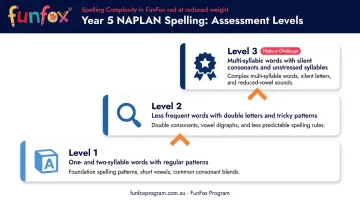
The test also uses a tailored design, meaning question difficulty shifts based on a student's earlier responses. Students with genuine word knowledge across spelling patterns — rather than memorised lists — are better placed to handle that adaptability.
How to Help Your Child Practise These 100 Words at Home
See–Cover–Write–Check
This is one of the most well-researched at-home spelling methods. The process:
- See — look at the word carefully, noting the tricky part
- Cover — hide the word
- Write — spell it from memory
- Check — compare against the original and correct if needed
Work through one pattern group per week (roughly 20 words), rather than attempting all 100 at once. That pace is manageable and far more effective than a pre-test cram.
Dictation Practice
Read a sentence aloud and have your child write it down, spelling the target word correctly in context. This directly mirrors the NAPLAN audio format — it trains listening, word retention, and accurate recall under pressure. Use the example sentences from earlier groups, or make up your own. Always use words in full sentences, not in isolation.
Spaced Repetition
After each practice session, your child will miss some words. Write those down in a dedicated "tricky words" notebook. Review them:
- After 1 day
- After 3 days
- After a week
Research on massed versus distributed practice consistently shows that spaced review outperforms a single long study session. The night-before approach doesn't work for spelling.
Fun Activities That Actually Stick
Short sessions beat long ones. Ten to fifteen minutes daily in the four to six weeks before NAPLAN outperforms a couple of hours the week before. Keep it varied:
- Word sorts — group words by pattern (mix up Groups 1 and 3, then sort them back)
- Spelling bees — spoken aloud, replicating the NAPLAN audio format
- Silly sentences — use three challenge words in one ridiculous sentence
- Beat the timer — write as many words correctly as possible in two minutes
Structured Support Beyond Home Practice
For families who want curriculum-aligned teaching alongside at-home practice, FunFox Program's Writers Club offers weekly live online sessions in small groups (maximum six students), delivered by teachers trained in the FunFox Way. Sessions run via Zoom with personalised feedback through Seesaw — practical for families anywhere in Australia, covering Years 1–6 and aligned to the Australian Curriculum.
Frequently Asked Questions
What words should a Year 5 be able to spell?
Year 5 students are expected to spell multi-syllabic words with complex suffixes, common exception words like necessary, environment, and conscience, and words with silent letters and ie/ei patterns. The 100 words above reflect those expectations directly.
What are tricky words for Year 5–6?
The most commonly misspelled words at this level include necessary, separate, accommodate, exaggerate, conscience, rhythm, February, and neighbour. They're difficult because pronunciation doesn't reliably guide spelling — unstressed vowels get dropped and silent letters get ignored.
How is Year 5 NAPLAN spelling harder than Year 3?
Year 3 tests simple phonics and short-word patterns. Year 5 moves into multi-syllabic words, complex suffix combinations, silent letters, and words where the spelling genuinely can't be predicted from how the word sounds. NAPLAN's proficiency descriptors detail exactly where each year level sits on that progression.
Are these the official NAPLAN Year 5 spelling words?
No. NAPLAN does not publish its word lists in advance. This is a practice list compiled to reflect Australian Curriculum v9.0 expectations and the spelling patterns typically assessed at Year 5 level.
How many minutes a day should my child practise spelling before NAPLAN?
Ten to fifteen minutes of focused, audio-based practice daily beats longer infrequent sessions, provided it's consistent over four to six weeks. Format matters as much as duration: hearing the word and then spelling it is exactly the skill NAPLAN tests.