Introduction
Picture this: your child comes home from school buzzing about "that tall glass building" they passed on the way to the excursion — but when it comes to writing about it in class, the words just won't come. Or they're working on a story set in a village and want to describe where the characters live, but "cottage" and "terraced house" aren't in their vocabulary yet.
This is a gap worth closing. The Australian Curriculum links literacy directly to topic-specific vocabulary — including words for places, constructed features, and the built environment — across English, HASS, and other subjects.
Knowing the right building words helps children read faster and write with greater precision.
This guide brings it all together: types of homes, community buildings, descriptive words, and building parts — each with child-friendly definitions, example sentences, and practical tips for making the vocabulary stick.
Key Takeaways
- Buildings vocabulary spans four categories: residential buildings, community places, descriptive language, and structural features
- Words like cottage, skyscraper, cathedral, and façade appear regularly in school reading and writing tasks
- NAPLAN writing guides reward range and precision of vocabulary, so building-specific words directly support better marks
- Words stick best when children encounter them repeatedly — through reading, writing, and noticing buildings in the real world
Words for Different Types of Buildings
Knowing the right word for a building — rather than just calling everything a "house" or a "building" — sharpens a child's writing immediately. The sections below cover the two most useful groups: homes and historic structures.
Homes and Residential Buildings
| Word | Definition | Example Sentence |
|---|---|---|
| House | A building where people (usually one family) live | We moved into a new house at the end of the street. |
| Flat / Apartment | Rooms for living on a single floor within a larger building | Our flat is on the third floor with a view of the park. |
| Bungalow | A house with only one storey | Gran's bungalow has no stairs — everything is on the ground floor. |
| Cottage | A small, simple house, often in the countryside | Grandma lives in a cosy cottage near the sea, with roses climbing up the front wall. |
| Terraced house | A house that shares walls with neighbours on both sides | Every terraced house on our street looks almost identical from the outside. |
| Semi-detached house | A house joined to one other house on a single shared wall | The semi-detached house next door has a mirror-image layout to ours. |
| Detached house | A house that stands alone with no shared walls | Their detached house has a garden all the way around it. |
| Block of flats | A large building divided into many separate flats | The old block of flats was renovated and now has twelve modern apartments. |
| Duplex | A building divided into two separate homes | The duplex was split down the middle — one family upstairs, one downstairs. |
| Penthouse | An expensive apartment at the very top of a tall building | The penthouse had floor-to-ceiling windows and views across the whole city. |
A note on Australian vs. American English: In Australia and the UK, we say flat — apartment is the American term. Similarly, a terraced house in Australia becomes a townhouse in American English. This distinction comes up regularly when children read popular American series like Diary of a Wimpy Kid or The Boxcar Children, where housing terms differ from what they know.
Historic and Special Buildings
These words appear in history tasks, comprehension passages, and descriptive writing prompts:
- Castle — a large, strong building designed to protect people from attack
- Manor house — a large old country house, typically with surrounding land
- Palace — the official home of a monarch or very senior official (e.g., Buckingham Palace)
- Cathedral — the principal large church of a diocese (e.g., St Mary's Cathedral, Sydney)
- Monastery — a building where monks live, work, and worship together
- Ruin — the broken remains of an ancient building
- Monument — a structure built to honour an important person or event
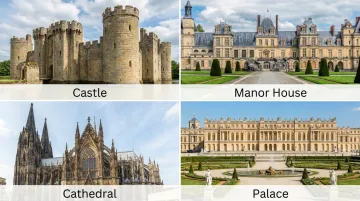
Mini activity: Ask your child to choose one famous building they know — the Sydney Opera House, a castle they've seen in a book, or the Colosseum — and write two sentences describing it using at least one word from this list.
Buildings in the Community: Places Kids Should Know
Community buildings appear constantly in comprehension passages and writing prompts. Recognising them quickly builds reading speed — and knowing how to use them well sharpens written expression.
Public and Government Buildings
| Word | Child-Friendly Definition |
|---|---|
| School | A place where children go to be educated |
| Library | A building where books and other resources are kept for borrowing |
| Hospital | A place where ill or injured people are treated by doctors and nurses |
| Fire station | Where firefighters and their trucks are kept, ready to respond to emergencies |
| Police station | The local office where police officers work |
| Post office | A place where stamps are sold and letters or parcels are sent |
| Town hall | Where local government officials work and hold public meetings |
| Courthouse | A building containing law courts |
| Museum | A building where historical, scientific, or artistic objects are displayed |
Example sentence: "The town hall stood at the centre of the main square, its stone columns making it look more like a palace than a meeting place."
Places for Shopping and Eating
- Supermarket — a large shop selling food and household goods
- Bakery — a place where bread, cakes, and pastries are made and sold
- Butcher's — a shop where meat is sold (the butcher is the person who sells it)
- Department store — a large shop divided into sections selling different types of goods
- Restaurant — a place where meals are prepared and served to customers
- Café — a relaxed space serving drinks, snacks, and simple meals
- Market — an open area or event where people buy and sell fresh food and goods
- Shopping centre — a large indoor complex housing many shops (called a shopping mall in American English)
Writing prompt: Ask your child to write a short paragraph about a familiar shopping area — their local shopping centre, market, or main street — using at least four of these words.
Places of Worship and Culture
Students encounter these buildings in both fiction stories and non-fiction reading tasks — knowing the words helps with comprehension and adds detail to descriptive writing:
- Church — a building for Christian religious gatherings
- Mosque — a building where Muslims gather for worship
- Synagogue — a building where Jewish people worship and study
- Temple — a building used for worship in Buddhist, Hindu, and other faith traditions
- Theatre — a building with seats arranged for watching live performances
- Cinema — a theatre where films are shown
- Art gallery — a building where artworks are displayed for the public
Words to Describe Buildings
A child who can only say "the building was big and nice" is missing a real opportunity. Descriptive vocabulary transforms flat observations into vivid writing, and NAPLAN narrative writing guides explicitly assess the range and precision of words students use to create meaning and atmosphere.
Positive Describing Words
| Word | Definition | Model Sentence |
|---|---|---|
| Elegant | Graceful and attractive | The elegant white columns framed the entrance perfectly. |
| Stunning | Extremely beautiful or striking | The new library had a stunning glass front that gleamed in the afternoon sun. |
| Grand | Impressively large and important | They climbed the grand staircase slowly, taking in every detail. |
| Spacious | Large, with plenty of room | The spacious hall could fit the entire school for assembly. |
| Iconic | Famous and instantly recognisable | The iconic dome made the building visible from kilometres away. |
| Symmetrical | Both sides match exactly, like a mirror image | The symmetrical façade made the building look perfectly balanced. |
| Ornate | Decorated with complicated, detailed patterns | The ornate archway was carved from white marble. |
| Eye-catching | Immediately noticeable; draws the eye | An eye-catching mosaic covered the entire front wall. |
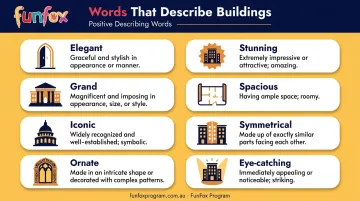
Before and after: Compare "The building was nice" with "The grand, symmetrical façade gleamed in the sunlight, its ornate columns stretching up to a domed roof." Same subject. Completely different picture.
Negative and Neutral Describing Words
Negative descriptions are just as powerful in storytelling. A crumbling ruin creates mystery; a derelict factory signals danger.
- Derelict — not cared for, in bad condition, often abandoned
- Run-down — in poor condition through neglect
- Cramped — uncomfortably small, without enough space
- Towering — very high, often looming over surrounding buildings
- Ancient — from a very long time ago; extremely old
- Crumbling — slowly falling apart, breaking into small pieces
- Monstrosity — something very large and very ugly
Vocabulary activity: Write a short description of an abandoned building using three words from the positive list and three from the negative list — then read both halves aloud and notice how the mood shifts.
Words for Building Materials and Construction
Students meet these terms in science and HASS lessons — and they're just as useful when writing detailed descriptions of buildings:
Materials:
- Brick — a rectangular block of hardened clay used to build walls
- Concrete — a hard material made from cement, sand, stones, and water
- Timber — wood that has been cut and prepared for building
- Steel — a strong metal made from iron and carbon, used in large structures
- Glass — a hard, clear material used for windows and modern facades
- Stone — hard natural material from the ground, used in older and heritage buildings
- Marble — a hard, decorative stone, often white with coloured veining
Key construction verbs (one line each):
- Build / Construct — to make something by putting materials together
- Demolish — to completely destroy a building
- Restore — to return a building to its earlier good condition
- Renovate — to repair and improve a building
Parts of a Building: Vocabulary for Features Inside and Out
Knowing the names of building parts helps children describe settings precisely — the difference between "she walked through the door" and "she passed beneath the carved stone arch into the shadowed corridor."
Exterior Features
| Feature | Definition |
|---|---|
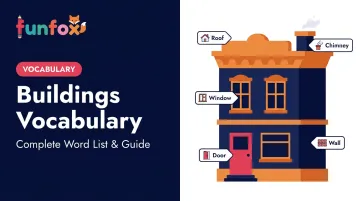
| Roof | The covering forming the top of a building |
| Wall | A vertical structure forming the sides of a building |
| Window | An opening in a wall, fitted with glass |
| Door | A flat panel used to close an entrance |
| Balcony | A raised platform attached to the outside of a building |
| Chimney | A hollow vertical structure that carries smoke from a fire upward |
| Arch | A curved structure spanning an opening |
| Column | A tall vertical support, often decorative as well as structural |
| Dome | A large rounded roof |
| Steeple | A tall pointed tower on a church |
| Spire | A tall, slender pointed structure rising from a roof or tower |
| Tower | A tall, narrow structure or part of a building |
| Façade | The front face of a building (commonly appears in reading comprehension tasks) |
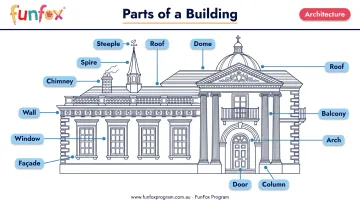
Parent tip: Next time you're near an interesting building, take a photo and challenge your child to label as many exterior features as they can. It takes two minutes and makes the vocabulary concrete. Façade is one worth pointing out — it comes up regularly in reading tasks.
Interior Features
- Floor — the flat surface of a room that people walk on
- Ceiling — the inside top surface of a room
- Staircase — the complete set of stairs and the structure surrounding them
- Corridor / Hallway — a long, narrow passage connecting rooms
- Fireplace — the space in a wall where a fire can burn safely
- Storey / Floor level — the level within a building (ground floor, first floor, top floor)
Australian/British vs. American: In Australia and the UK, street level is the ground floor and the level above is the first floor. In America, street level is the first floor. Children reading American books should know this to avoid confusion.
Fun Ways to Help Kids Learn Buildings Vocabulary
The Education Endowment Foundation recommends explicitly teaching new words, providing repeated exposure, and giving students opportunities to apply words in context. A word list alone won't cut it — children need to use words to own them.
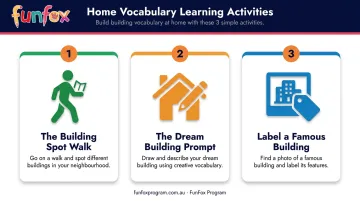
Three activities that work well at home:
The Building Spot Walk — On any outing, challenge your child to name every building type they pass. Can they spot a detached house, a terrace, a church, and a café all in one street? Keep score.
The Dream Building Prompt — Ask your child to write a description of their dream home or the most exciting building they've ever seen, using at least five vocabulary words from this guide. The personal connection makes the words memorable.
Label a Famous Building — Find a photo of the Sydney Opera House, a cathedral, or a historic castle. How many exterior features can your child label: dome, façade, arch, column, spire?
Programs like FunFox's Writers Club take a similar approach, building vocabulary through creative writing sessions where children learn new words and use them straight away in their own stories and descriptions. That immediate application is what makes the words stick.
Frequently Asked Questions
What are the most important buildings vocabulary words for primary school students?
Focus on four categories: types of homes (cottage, bungalow, terraced house), community buildings (library, fire station, museum), descriptive words (derelict, grand, ornate, façade), and building parts (arch, dome, steeple). Words like apartment, cathedral, skyscraper, renovate, and façade appear most often in school reading and writing tasks.
How can I help my child learn buildings vocabulary at home?
Combine real-world observation with writing practice: name building types on walks, discuss unfamiliar words in books, and use writing prompts that ask for descriptive language about settings. Short, regular exposure builds retention far faster than a single study session.
What is the difference between a "house" and a "home"?
A house refers to the physical structure — the building itself. Home refers to where someone lives and carries an emotional sense of belonging. A person can make a home in a flat, cottage, or any type of dwelling — the word is about feeling, not bricks.
What does "architecture" mean, and do kids need to know it?
Architecture means both the practice of designing buildings and the style in which they're built. It appears in upper primary reading tasks, so it's worth learning alongside architect (someone who designs buildings) and architectural (relating to building design).
Why do descriptive building words matter for kids' writing?
Precise vocabulary — crumbling, towering, ornate — transforms flat descriptions into engaging storytelling. NAPLAN writing assessments explicitly reward range and precision of vocabulary, so these words have direct, practical value for school results..