Introduction
Picture this: your child sits down, reads an entire page aloud without stumbling on a single word, then looks up and says, "I don't know what it was about." Sound familiar? This experience frustrates parents and children alike — and it's far more common than most people realise.
Reading comprehension difficulties affect an estimated 10% to 15% of children despite normal decoding ability. That's one or two children in every classroom who can technically "read" but struggle to make meaning from text. Critically, this doesn't reflect intelligence or effort — it reflects a gap in a specific, teachable set of skills.
This article covers exactly why comprehension breaks down, how cognitive factors like memory and stress play a role, and what practical strategies genuinely help. Whether your child is in Year 2 or Year 8, the strategies ahead are practical, evidence-based, and teachable at home.
Key Takeaways
- Fluency and comprehension are different skills — a child can read every word correctly and still miss the meaning entirely.
- Limited vocabulary, weak background knowledge, and poor working memory are the most common comprehension blockers.
- Attention, stress, and tiredness directly reduce comprehension — brain-based factors, not character flaws.
- Active strategies — predicting, visualising, summarising — are proven to improve comprehension and can be taught.
- Early support matters: fewer than 1 in 5 Australian students below NAPLAN minimums catch up without targeted intervention.
What Reading Comprehension Really Means (and Why It Matters)
Many parents focus on whether their child can read the words. That's a reasonable starting point — but it's only half the picture.
Decoding answers: Can my child read the words? Comprehension answers: Can my child make meaning from those words?
These are genuinely separate skills. A child can have strong decoding and weak comprehension — researchers call this Specific Reading Comprehension Deficit. It's real, it's diagnosable, and it has nothing to do with how smart a child is.
Why It Affects Every Subject, Not Just English
Reading comprehension isn't a literacy-only concern. Research tracking 554 academically at-risk children from Grade 1 to Grade 4 found that stronger reading directly predicted faster maths growth, with children scoring one standard deviation above average in reading growing 0.165 SD faster in maths per year. Science learning follows a similar pattern.
When comprehension is weak, the effects ripple well beyond English class:
- A child misreading a maths word problem may get the arithmetic right but the answer wrong
- Science passages require students to extract cause-and-effect relationships from dense text
- History and HSIE tasks rely on summarising and inferring — both comprehension skills
- Even creative writing tasks ask students to respond to a prompt they must first interpret correctly
A child struggling in these areas often isn't failing the subject — they're hitting a reading barrier first.
That barrier can be lowered. The IES What Works Clearinghouse rates explicit comprehension strategy instruction as Strong Evidence for improvement in early primary students. With the right teaching approach, comprehension responds quickly to targeted practice.
Common Causes of Poor Reading Comprehension
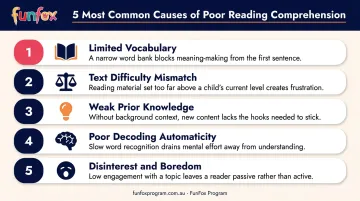
Most reading comprehension problems trace back to one of five causes — and nearly all of them respond well to targeted support.
Limited Vocabulary
When a reader encounters too many unfamiliar words, the brain shifts its energy toward figuring out what each word means rather than building a picture of the whole text. Research on lexical coverage shows that readers generally need to know 95%–98% of words in a text for adequate comprehension. That's roughly one unknown word in every 20–50.
If a book has several unfamiliar words per page, comprehension collapses — even when decoding is strong.
Text Difficulty Mismatch
When the gap between a child's reading level and the text's difficulty is too wide, understanding breaks down. This isn't about pushing harder — it's about finding the right entry point. A text that's slightly challenging builds skills; one that's overwhelming builds avoidance.
Weak Prior Knowledge
Comprehension depends on connecting new information to what a reader already knows. When a topic is entirely unfamiliar, there's no mental framework to attach meaning to. Research consistently shows that background knowledge is one of the strongest predictors of reading comprehension in primary-aged students — often more so than reading skill alone.
Poor Decoding Automaticity
Children who still consciously work through sounding out words — even partially — use up mental bandwidth that should go toward understanding. Once word recognition becomes automatic, cognitive space opens up for meaning-making.
Disinterest and Boredom
Motivation is not a character trait — it's heavily shaped by what's being read. When material feels irrelevant or dull, attention drifts and surface-level eye movement replaces genuine engagement. Letting children choose their own books — even within a guided range — can shift this more quickly than any comprehension worksheet.
How Focus, Memory, and Mental State Affect Comprehension
Some of the most overlooked barriers to reading comprehension have nothing to do with the text — they're happening inside the reader's brain.
Working Memory
Think of working memory as the brain's mental scratchpad. While reading, a child must hold the beginning of a sentence in mind while processing the end, remember earlier plot events while encountering new ones, and track multiple characters or arguments at once.
Working memory is a well-established predictor of reading comprehension. When it's overloaded or underdeveloped, readers lose track of earlier information before they can integrate it with what comes next — and comprehension breaks down without the child even noticing it's happened.
ADHD and Attention
Children with ADHD face a double challenge: difficulty sustaining attention and underdeveloped working memory. These two factors co-occur frequently and directly impair reading comprehension. This has nothing to do with effort — their brain's attentional systems simply work differently. Structured environments, shorter reading sessions, and breaking tasks into chunks can make a real difference.
Stress and Fatigue
Research from Harvard Health confirms that stress interferes with cognition, attention, and memory. Neuroscience research adds that stress suppresses the prefrontal cortex — precisely the brain region responsible for higher-order tasks like inference, comprehension monitoring, and connecting ideas across a text.
A tired, anxious, or emotionally dysregulated child will not comprehend well. Reading conditions matter just as much as reading ability.
Lack of Comprehension Monitoring
Skilled readers notice when they've lost the thread and re-read. Many poor comprehenders don't realise they haven't understood until much later — or not at all. This self-monitoring skill is teachable, and it's one of the highest-value habits a reader can develop.
Proven Strategies to Improve Reading Comprehension
These strategies have a solid evidence base. They're also practical enough for parents to use at home without any specialist training.
Build Vocabulary Deliberately
Rather than memorising word lists in isolation, encourage learning words in context:
- Break unfamiliar words into roots and prefixes
- Keep a simple vocabulary journal (the word, its meaning, and one example sentence)
- Read aloud together and pause to discuss new words naturally
- Use conversation — dinner table discussions build vocabulary more than most people expect
Use Active Reading Techniques
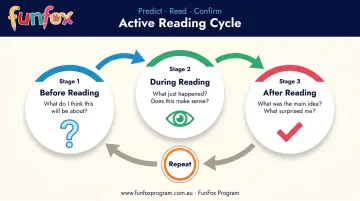
Passive reading is when your eyes move across the page without your brain engaging. Active reading means the reader is working the whole time:
- Before reading — ask: "What do I think this will be about?"
- During reading — ask: "What just happened? Does this make sense?"
- After reading — ask: "What was the main idea? What surprised me?"
The predict-read-confirm cycle is particularly effective: make a prediction, read a short section, then confirm or revise the prediction. It keeps the brain actively invested.
Visualise the Text
Encourage readers to build a mental image of what's happening — like watching a movie in their head. For narrative texts especially, this keeps engagement high and improves retention.
This is a teachable skill, not something children either have or don't. Ask your child to describe what they're "seeing" as they read — the more specific, the better.
Summarise After Each Section
After reading a page or paragraph, pause and summarise in one or two sentences. This forces processing and immediately reveals gaps in understanding. For younger children, oral summarising works just as well as written.
A simple framework: Somebody wanted… but… so… then… (works well for stories)
Break Reading into Chunks
Long reading sessions, especially for struggling readers, produce fatigue before they produce understanding. Short, focused sessions with brief mental check-ins outperform marathon sittings every time. For children who find reading difficult, shorter sessions with clear stopping points make the task feel manageable — and that matters more than total time spent.
Building a Reading-Supportive Environment at Home
Strategy alone isn't enough if the reading environment works against comprehension. Small environmental changes make a genuine difference.
Create a Consistent Routine
Devices, background noise, and interruptions eat directly into the attentional resources needed for understanding. Even 15–20 minutes of quiet, dedicated reading time built into the daily routine has a compounding effect over weeks and terms.
Let Children Choose Their Books
Children who choose their own books read with more engagement, and engagement gives comprehension strategies more time to work. This doesn't mean "anything goes" — it means working within an appropriate reading level while following the child's interests. A book about Minecraft mechanics that a child has chosen will get more cognitive investment than a "good for them" book they resent.
Reading aloud together also builds comprehension through shared discussion. Talking about characters, predicting what happens next, and asking open-ended questions after each chapter are all high-value, low-effort strategies.
Consider Structured Reading Support
For children who continue to struggle despite home strategies, guided practice with expert feedback is often what makes the difference. FunFox's Readers Club is built for exactly this situation: small groups of no more than six students in live online classes, aligned to the Australian Curriculum. Sessions cover skills like inferring, skimming, scanning, and text analysis across genres from short stories to classic literature.
Parents of Readers Club students have reported that children who previously found reading intimidating have become genuinely engaged. The small-group format lets teachers spot individual comprehension gaps and address them directly — something a standard classroom simply can't offer.

When to Seek Extra Help
Home strategies and routine adjustments help most children. But some comprehension difficulties go beyond typical developmental variation and benefit from professional attention.
Consider speaking to a teacher or specialist if your child:
- Can read aloud accurately but consistently cannot retell what they've read
- Has a noticeable gap between verbal ability (what they can say and discuss) and reading performance
- Actively avoids all reading, not just challenging texts
- Is reading noticeably behind peers after several months of targeted home support
- Cannot answer basic literal questions about a text they've just read
Conditions like dyslexia, ADHD, and Specific Reading Comprehension Deficit are real and diagnosable. Early identification meaningfully improves outcomes. Australian data from AERO makes the stakes clear: fewer than 1 in 5 students below Year 3 NAPLAN minimum standards catch up and stay caught up without targeted intervention. Waiting is rarely the right call.
If you're concerned, start with your child's classroom teacher. They can refer you to a learning specialist or educational psychologist if needed. In the meantime, a structured reading program, like FunFox's Readers Club, can provide consistent, targeted comprehension practice while you work through next steps.
Frequently Asked Questions
Why do I not understand what I am reading?
The most common causes are limited vocabulary, attention lapses, working memory overload, or a mismatch between your reading level and the text's difficulty. All of these are fixable with targeted strategies — they don't reflect intelligence or effort.
Do people with ADHD struggle with reading comprehension?
Yes. ADHD affects comprehension primarily through difficulties sustaining attention and managing working memory — both essential for following meaning across a text. Structured environments, shorter sessions, and chunking tasks help considerably.
What is the difference between reading fluency and reading comprehension?
Fluency is about how smoothly and accurately someone reads aloud. Comprehension is about understanding what the text means. A reader can be fluent — decoding every word correctly — and still have poor comprehension. They are separate skills.
Can poor reading comprehension improve with practice?
Yes — comprehension is a learnable skill, not a fixed trait. Consistent practice with active reading strategies, vocabulary building, and appropriately levelled texts leads to measurable improvement. The IES rates explicit comprehension strategy instruction as strong evidence for K–3 students.
How can parents help their child improve reading comprehension at home?
The highest-impact strategies include:
- Reading aloud together and discussing the text
- Asking open-ended questions after each section
- Letting children choose books that interest them
- Keeping a consistent, quiet reading routine of 15–20 minutes daily
At what age should I be concerned about my child's reading comprehension?
Children should be making clear comprehension progress through early primary school. If your child is 7–8 years old and consistently cannot retell simple stories or answer basic questions about texts they've read, it's worth raising with their teacher rather than waiting to see if they grow out of it.