This is not a glimpse into the future. This is childhood in Australia right now.
Yet almost every policy conversation about AI education focuses on Year 7, Year 10, high school pathways, and university pipelines. The 2025 US executive order on AI education, for example, explicitly targets kindergarten through twelfth grade — with no mention of pre-K. Australia's own framework for generative AI is written for schools, not early childhood services.
The argument here is straightforward: we are starting too late. The most consequential window for building the foundations of AI literacy is the pre-kindergarten years, when children are already forming beliefs about what machines can and cannot do — and when no one is guiding that process.
Key Takeaways
- Children aged 3–5 are already daily users of AI-powered devices, forming beliefs about machines before any adult explains how they work
- Harvard's Center on the Developing Child reports that more than 1 million new neural connections form every second in early childhood — the highest-plasticity window for building critical thinking
- Early AI literacy is not coding or extra screen time — it is curiosity, questioning habits, and the distinction between helpers and humans
- Australia's EYLF already supports the outcomes needed; AI literacy concepts can be embedded, not added
- Parents and early childhood educators are the first and most important teachers — no technical expertise required
Toddlers Are Already AI Natives — Whether We Like It or Not
The phrase "digital native" has been applied to millennials and Gen Z. For children born in the 2020s, something more specific is true: they are AI natives. Before they can read, before they start school, they are already living inside systems that learn, recommend, and respond.
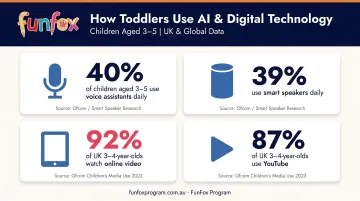
A 2024 Digital Wellness Lab survey of parents with children aged 3–5 found that 40% of those children use smartphones to access voice assistants daily, and 39% use smart speakers daily. In the UK, Ofcom's 2023 children's media report found that 92% of 3–4-year-olds went online to watch videos, with 87% using YouTube — a platform driven entirely by recommendation algorithms.
The Trust Problem No One Is Talking About
The risk is not device exposure. It is what happens to a child's understanding of reality when no adult explains what these systems are.
Without guidance, young children default to treating AI outputs as authoritative. Voice assistants sound confident even when they are wrong. Recommendation engines feel like they "know" what you want.
Research by Festerling and colleagues on children and digital voice assistants identifies ages 3–6 as a critical period when children are forming their concepts of life, technology, and social agency. The social cues built into voice AI — conversational turn-taking, a friendly tone, immediate responses — can make machines seem more socially alive than they are.
A 4-year-old who believes Alexa "knows" things the way a teacher knows things is not being foolish. They are doing exactly what their developing brain is supposed to do: making sense of their world using whatever information is available. That is precisely why the adults around them need to be the ones who provide it.
The Policy Gap
Major AI education initiatives consistently start at school entry — and Australia is no exception. The Australian Government's generative AI in schools framework focuses on classroom-age students. Internationally, the picture is the same:
- Australia's generative AI framework for schools addresses classroom use but not early childhood settings
- The 2025 US executive order on AI education begins at kindergarten
- The AI4K12 grade-band guidelines include kindergarten and early elementary — but exclude the birth-to-five window entirely
Early childhood educators are not just under-resourced in this area. They are structurally excluded from the conversation.
The Brain Development Window We Can't Afford to Miss
The neuroscience case for early intervention is not subtle. The Harvard Center on the Developing Child states that in the first few years of life, more than 1 million new neural connections form every second. No other period of human life comes close.
The neural pathways forming during these years are precisely the ones that underpin AI literacy:
- Curiosity and the drive to ask "why"
- Cause-and-effect reasoning
- The habit of questioning information
- Empathy and perspective-taking
- The ability to distinguish between types of sources and authority
These skills don't switch on at school entry. They begin forming in the toddler and preschool years — through play, conversation, and the thousands of small interactions that make up early childhood. Waiting until Year 1 means working against the grain of how development actually unfolds.
The Economic Argument for Acting Early
The case for investing in early childhood is also one of the strongest in economics. Research linked to Nobel laureate economist James Heckman found that high-quality early childhood programs generate a return of 13% per annum, with a benefit-cost ratio of 6.3. The earlier the investment, the greater the compounding effect on every learning outcome that follows.
Early AI literacy grounding fits the same logic. Children who arrive at school already practising healthy scepticism — including scepticism of machine-generated information — carry that habit into reading, writing, and reasoning tasks throughout their schooling.
Countering the "It's Too Soon" Objection
That economic case only strengthens when you consider how little early AI literacy actually asks of young children. They are not cognitively fragile. They handle complex ideas every day. Parents and educators routinely discuss death, illness, climate, and conflict with preschoolers — using age-appropriate language, concrete examples, and honest conversations.
AI literacy at this age asks for nothing more than that. Not technical explanations. Not device proficiency. Just the same kind of simple, honest conversation: "The machine guessed." "Machines can get things wrong." "This is a helper, not a friend."
What AI Literacy Actually Means for Young Children
The most common mistake in early AI education is taking a K-12 or adult framework and shrinking it. The result is goals that are developmentally unrealistic, culturally one-size-fits-all, and likely to put both children and educators off the topic entirely.
A 2023 scoping review by Su and Yang examining 16 studies on AI literacy in early childhood identified the core barriers as a lack of teacher AI knowledge, weak curriculum design, and an absence of practical teaching guidance — not a lack of willing children.
What AI Literacy Is Not for Under-5s
- Not coding
- Not programming robots
- Not extended screen time
- Not a simplified version of a primary school AI curriculum
What It Actually Is: The KSA Framework for Early Childhood
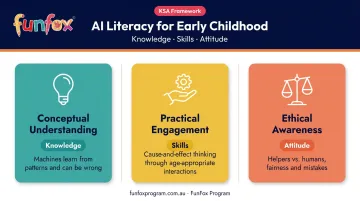
Researchers working in this field have adapted a Knowledge–Skills–Attitude (KSA) framework for young children. For the under-5 age group, this translates to three practical areas:
- Conceptual understanding — a basic, child-level sense that machines learn from patterns and can be wrong
- Practical engagement — age-appropriate interactions that build cause-and-effect thinking, not device proficiency
- Ethical awareness — early conversations about fairness, mistakes, and the difference between helpers and humans
The most important distinction to build early is this: technology is a helper, not a human. Machines do not feel, they do not understand context, and they do not know right from wrong. Children who internalise this early are far more resilient as AI becomes more embedded in their schooling and social lives.
None of this requires more screen time. The most valuable early AI instruction often happens entirely away from devices — through conversation, storytelling, and play.
Age-Appropriate Ways to Introduce AI Literacy Early
No special equipment needed. No curriculum overhaul. The most effective approaches for 3–5-year-olds use what is already happening in their lives.
Everyday Moments as Teaching Opportunities
Children already encounter AI dozens of times a day. Each encounter is a ready-made conversation starter:
- "Why did the tablet suggest that video? What do you think it noticed?"
- "The GPS took a different road today — why might it have done that?"
- "Alexa got that wrong. What do you think happened?"
These are not technical questions. They are questions about cause and effect, about making mistakes, and about the difference between a machine response and a human one. Each one takes under a minute and builds critical thinking habits that carry forward.
Questions Over Answers
Early AI literacy is less about delivering information and more about cultivating a habit of questioning. Three prompts worth keeping in rotation:
- What can machines do?
- What can't they do?
- Why do they sometimes get things wrong?
Children who learn to question technology before school starts bring that habit into every classroom, every search, and every piece of AI-generated content they encounter later.
Embedding AI Literacy Within the EYLF
Australia does not need a new preschool coding curriculum. The Early Years Learning Framework V2.0 (2022) already contains the right foundations:
- Outcome 1 — Children's emerging autonomy, resilience, and agency
- Outcome 4 — Curiosity, creativity, problem-solving, inquiry, and investigation
- Outcome 5 — Children as effective communicators, including using digital technologies to access information and represent thinking
AI literacy concepts fit naturally within all three. Educators do not need to add a new subject. They need language, confidence, and a few practical prompts to connect what is already in the framework to the AI-related experiences children bring to preschool every day.
Why Early Childhood Educators Hold the Key
Most national AI education infrastructure is built for school teachers. The US executive order, AI4K12, TeachAI, and Australia's own generative AI framework are all designed for school settings. Early childhood educators — who work with children during the brain's highest-plasticity years — are not mentioned.
This is a structural gap, not an incidental one.
What Educators Actually Need
The barrier is not expertise. Research shows that teacher confidence, not technical knowledge, is the strongest predictor of whether AI literacy conversations happen in the classroom. Early childhood educators who feel they "don't know enough about AI" to raise the topic have been let down by professional development systems — not by their own competence.
What they need:
- Age-appropriate language for talking about machines with 3–5-year-olds
- Simple discussion frameworks (the three questions above are a start)
- Professional development that positions them as co-learners alongside children, not as technical experts
Why Preschool Is Actually the Ideal Setting
A quality preschool or kindy — play-based, inquiry-driven, built around trusted adult relationships — is in many respects better suited to early AI literacy than a formal classroom. There's no fixed curriculum to interrupt. Conversations can happen naturally. And when a trusted educator guides that conversation, children don't just hear a fact — they start building a habit of thinking critically about the world around them.
How Parents Can Lay the Foundation at Home
Parents do not need a technology background to do this well. The most impactful things are conversational and habitual — and most take less than two minutes.
Three Simple Home Habits
- Name it when it appears. "The app is suggesting this because it noticed what you liked before." Naming it removes the magic and starts the conversation.
- Predict and check. Ask your child what they think the AI will suggest, then see if they were right. Was the answer good? Was it wrong? Why?
- Celebrate machine mistakes. When a child notices a voice assistant got something wrong, treat it as good thinking — not a malfunction to brush past. "You noticed! You were smarter than the machine this time."
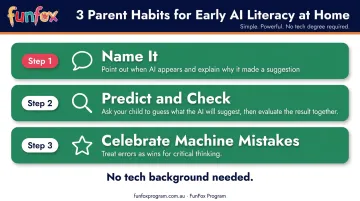
These habits build something specific: a child who approaches technology as a tool to evaluate, not an authority to obey.
The Literacy Connection
As children move into primary school, the critical thinking, reading comprehension, and communication skills they develop become the human foundation of deeper AI literacy. A child who can read carefully, question what they read, and express their own ideas clearly is far better equipped to engage with AI-generated content — rather than simply accepting it.
That analytical and expressive groundwork starts in Year 1 and 2. Programs like FunFox build exactly those skills — reading comprehension, questioning, and structured writing — in small-group online sessions aligned to the Australian Curriculum. Strong literacy at this stage isn't a parallel track to AI readiness. It's what makes AI readiness possible.
Frequently Asked Questions
What are the main components of AI literacy for young children?
For under-5s, AI literacy covers three areas: conceptual understanding (knowing machines learn from patterns and can be wrong), practical engagement (age-appropriate interactions that build cause-and-effect thinking), and ethical awareness (early conversations about the difference between helpers and humans, and why AI outputs deserve questioning). The emphasis is on habits of mind, not technical knowledge.
How do you teach AI literacy to young kids?
For children aged 3–5, it works best through play-based conversations, everyday moments (asking why an app made a suggestion), and storytelling that shows machines making mistakes — not through devices, coding tools, or formal lessons. The goal is a questioning habit, not technical knowledge.
At what age should AI literacy education begin?
As early as ages 3–4. Children at this stage are already forming beliefs about what machines can and can't do — and those beliefs are easier to shape now than to correct later. Early exposure builds awareness; technical understanding comes much later.
Does teaching AI literacy to toddlers mean more screen time?
No. Early AI literacy is primarily about building human skills — curiosity, empathy, critical questioning, and resilience — through conversation and play. The most valuable instruction often happens away from devices entirely.
What role do parents play in early AI literacy?
Parents are the first and most important teachers here. Simple habits — naming AI when it appears, encouraging children to question its outputs, and celebrating when a child catches a machine making a mistake — are more impactful than any app or program. No technical background is needed.
How does Australia's EYLF support AI literacy?
Australia's Early Years Learning Framework already prioritises critical thinking, agency, inquiry, and digital literacy as core outcomes for children from birth to five. AI literacy concepts fit naturally within Outcomes 1, 4, and 5 — no curriculum redesign required, just a shift in language and confidence from educators and parents alike.