Persuasive writing works the same way — just with more intention. Whether your child is writing a NAPLAN essay, a letter to the school principal, or a speech for class, the ability to persuade is one of the most transferable skills they'll build.
This post breaks down the four key persuasive appeals — ethos, pathos, logos, and kairos — what they mean, how they work, and how young writers can start using them straight away.
Key Takeaways
- Aristotle's ethos, pathos, and logos have underpinned persuasive writing for over 2,500 years
- Ethos builds trust, pathos creates emotional connection, logos provides evidence-based reasoning
- Kairos is about timing: placing your strongest points where they land hardest
- Effective persuasion blends all three appeals rather than relying on just one
- Students who practise these appeals regularly learn to use them naturally in essays
What Are Persuasive Appeals?
Persuasive appeals are deliberate strategies writers use to influence how their audience thinks, feels, or acts. They aren't tricks — they're tools, and knowing which one to reach for (and when) separates a flat essay from a genuinely convincing one.
Aristotle's Rhetoric, written around 350 BCE, defines rhetoric as "the faculty of observing the available means of persuasion" and identifies three core modes: persuasion through the speaker's character, through the audience's emotions, and through proof in the speech itself. These became ethos, pathos, and logos.
The Rhetorical Triangle
Most writing teachers represent these three appeals as a triangle:
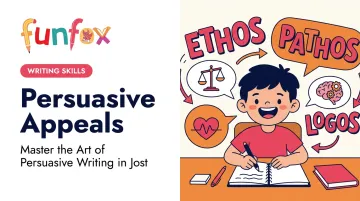
- Ethos — the writer (Are you trustworthy?)
- Pathos — the audience (Do they feel something?)
- Logos — the message (Does the argument hold up?)
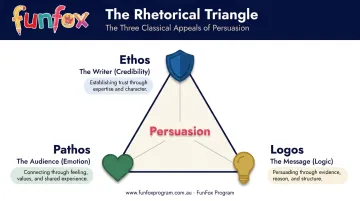
As Purdue OWL explains, the strongest persuasive writing balances all three points of the triangle rather than leaning entirely on one.
A fourth concept — kairos — deals with timing and context. It's not one of Aristotle's original three appeals, but secondary and university-level rhetoric courses treat it as essential: an argument that's factually sound and emotionally resonant can still fall flat if the moment is wrong.
Ethos: The Appeal to Credibility
Ethos asks your reader a simple question: Why should I trust you?
When writers use ethos, they demonstrate that they know what they're talking about — through expertise, relevant experience, or credible sources. The NAPLAN Persuasive Writing Marking Guide describes ethos as "persuading by appealing to the readers' values," which goes slightly beyond credentials — it includes showing that you share your reader's concerns.
Ethos in Everyday Writing
Students encounter ethos constantly:
- A science essay that opens with "According to the Australian Academy of Science..."
- A teacher who says "In my fifteen years in the classroom, I've seen this work"
- An advertisement featuring a dentist recommending toothpaste
Each example signals: this person has standing to speak on this topic.
How Students Can Build Ethos
Three practical ways to establish credibility in a school essay:
- Cite credible sources using phrases like "According to..." or "Research by..." and name the source explicitly
- Reference relevant experience briefly — if you've lived something connected to your argument, say so
- Write with a confident, informed tone: hedging every claim with "maybe" or "I think possibly" chips away at credibility
One trap to avoid while building ethos is what's called fallacious ethos — citing a source that sounds impressive but isn't actually relevant. Using a celebrity's opinion as evidence for a scientific claim doesn't strengthen an argument; it weakens it.
Pathos: The Appeal to Emotion
Pathos is the appeal that makes readers feel something. Aristotle noted that judgments shift when audiences are moved by joy, grief, or anger — and that emotional engagement is a legitimate and powerful part of persuasion.
The NAPLAN marking guide lists "emotive language" and "direct appeal to the reader" as pathos features assessed in student writing.
Pathos in Action
Students see it everywhere:
- A charity ad with slow music and a close-up of one child's face
- A school speech that opens with a story about a student who learned to read in the library you're trying to save
- A persuasive essay that describes littered beaches in sensory detail
The Tools of Pathos
| Tool | Example |
|---|---|
| Emotive word choice | "suffering" vs "difficulty" |
| Vivid imagery | describing the smell of smoke, not just "the fire" |
| Personal storytelling | one child's experience rather than a broad statistic |
| Direct address | "Imagine waking up tomorrow and..." |
Notice the difference between these two sentences:
- Flat: "Many animals are abandoned each year."
- With pathos: "Last winter, a three-year-old border collie named Scout was left tied to a fence in the rain."
The second doesn't have more data. It has a face. Specific, grounded stories often land harder than broad statistics, though statistics still matter — that's where logos comes in.
Pathos becomes manipulative when it's all an argument has. Scare tactics (exaggerating danger to force a response) and bandwagon appeals ("everyone is doing it") are examples of pathos used dishonestly. Readers notice when emotion is being used as a substitute for reasoning, not a complement to it.
Logos: The Appeal to Logic
Logos persuades through evidence, reasoning, and sound argument structure. Where ethos builds trust and pathos stirs emotion, logos makes the case — it's the appeal that lives or dies on the strength of your reasoning.
The NAPLAN guide defines logos as "persuading by the means of logical reasoning."
Logical Reasoning Tools for Students
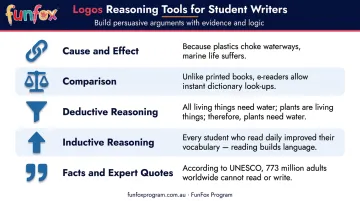
Students can draw on several types of reasoning:
- Cause and effect — "When schools cut sport programs, student focus in class declines"
- Comparison — "Countries with compulsory reading programs have stronger literacy rates than those without"
- Deductive reasoning — starting from a general principle and applying it to a specific case
- Inductive reasoning — drawing a broader conclusion from specific examples
- Facts and expert quotes — grounding the argument in verifiable evidence
Evidence Isn't Enough on Its Own
A statistic alone doesn't constitute logos. Consider:
- Weak: "65% of students report screen time affects their sleep."
- With logos: "65% of students report screen time affects their sleep — which means most classrooms contain tired learners who struggle to concentrate. Limiting devices before bedtime isn't a parenting preference; it's a learning intervention."
The second version interprets the evidence and connects it to the argument. The data doesn't persuade on its own — the reasoning around it does.
BBC Bitesize describes "Point, Evidence and Explain" as a reliable paragraph structure for keeping logos tight — make your claim, cite your evidence, then explain what it means.
Common Logical Fallacies to Avoid
Three fallacies that regularly undermine student arguments:
- Hasty generalisation — drawing a sweeping conclusion from one or two examples
- Circular reasoning — restating the claim as if that proves it ("Social media is bad because it's harmful")
- Either/or fallacy — presenting only two options when many exist ("You're either for screen-free schools or you don't care about students")
Kairos: The Power of Timing in Persuasive Writing
Kairos — from the Greek for "opportune moment" — refers to when you say something and how the context surrounding your argument shapes whether it lands. The same words, positioned differently, can persuade or alienate.
Even a perfectly constructed argument can fall flat if it's positioned badly. Starting a persuasive essay by hitting readers with your strongest, most controversial claim before they have any context is a kairos mistake — you've asked them to agree before you've given them a reason to listen.
Practical Kairos Tips for Student Essays
- Establish context first — give readers background before you introduce your thesis, so they're already oriented when the argument arrives
- Place your strongest evidence mid-to-late in the piece, once the reader is already engaged
- Match your topic to your audience's current concerns — a persuasive letter about school canteen food lands differently in Term 1 than after a student health survey
Timing matters at the paragraph level too. A strong structure introduces the claim, acknowledges the counterargument, then closes with your evidence — not the other way around. Readers are more open to conceding a point once you've shown them you understand their objection.
How to Combine Persuasive Appeals to Write More Convincingly
Single-appeal writing rarely persuades. Here's why:
| Version | What it does | What's missing |
|---|---|---|
| Pathos only | "The library is a magical place full of wonder and childhood memories." | No evidence. Feels sentimental. |
| Logos only | "Library usage increased 34% after extended hours were introduced." | No emotional investment. Feels dry. |
| Combined | "Library usage rose 34% when hours were extended — because for students like Year 5 student Priya, who reads for two hours after school, the library isn't a resource. It's a refuge." | Evidence + story + credible framing = persuasive. |
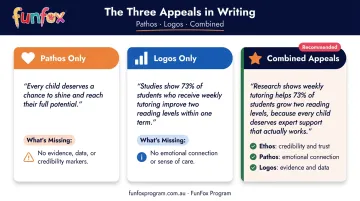
The combined version uses a real statistic (logos), a specific character (pathos), and a confident, informed voice (ethos). Together, they give the reader both a reason to believe and a reason to care.
Pre-Writing Checklist
Before drafting any persuasive piece, students can ask:
- Have I established why I'm qualified to write about this? (ethos)
- Have I connected emotionally with my reader through a story or vivid detail? (pathos)
- Have I supported my argument with facts, evidence, or clear reasoning? (logos)
- Does my structure and timing work for this audience? (kairos)
Programs like the FunFox Writers Club give primary school students in Years 2–6 regular opportunities to practise these techniques across different writing genres. Weekly live sessions, guided worksheets, and personalised teacher feedback help students move from understanding the appeals in theory to applying them confidently on the page.
Frequently Asked Questions
What are the 4 appeals of persuasion?
The four persuasive appeals are ethos (credibility), pathos (emotion), logos (logic and evidence), and kairos (timing and context). The first three form the classical rhetorical triangle identified by Aristotle around 350 BCE; kairos is a broader Greek rhetorical concept added to many modern teaching frameworks.
What are examples of persuasive appeals?
A doctor endorsing a health product uses ethos. An emotional charity advertisement uses pathos. An argument backed by research statistics uses logos. A speech timed to respond to a current community issue uses kairos — the right message at the right moment.
What is the difference between ethos, pathos, and logos?
Ethos builds trust through credibility and shared values, pathos creates connection through emotion, and logos persuades through evidence and logical reasoning. Skilled writers use all three together because each appeal reinforces the others.
How do you use persuasive appeals in a school essay?
Establish your credibility early by citing a reliable source or relevant experience (ethos), include a compelling example or brief story (pathos), and back your main claim with facts or clear reasoning (logos). Plan which appeal to emphasise in each paragraph — don't front-load emotion before you've built any trust.
What are 10 persuasive techniques?
Ten common techniques across the appeals include:
- Storytelling and vivid imagery
- Use of statistics and expert quotes
- Rhetorical questions and repetition
- Appeal to shared values
- Counterargument acknowledgement
- Cause-and-effect reasoning and emotive vocabulary
Most techniques serve more than one appeal depending on how they're used.