Introduction
Your child reads every word correctly. Fluent. Confident. But ask them what the story was about, and you get a blank stare.
This gap — between decoding words and actually understanding them — is more common than most parents realise. Research suggests that around 10–15% of children show poor comprehension despite reading accurately and fluently. Without identifying this gap early, support stays generic while the real problem quietly grows.
That's what reading comprehension assessment is designed to uncover. As primary school texts grow more complex — demanding inference, analysis, and critical thinking — an undetected comprehension gap compounds quickly.
This guide covers what reading comprehension assessment actually is, the four main types, the warning signs worth watching for, how the process unfolds step by step, and how to act on results at home.
Key Takeaways
- Comprehension assessment measures meaning-making — not just whether a child can decode or pronounce words correctly.
- Four assessment types serve different purposes: screening, diagnostic, progress-monitoring, and outcomes-based.
- Fluent reading doesn't guarantee strong understanding. Comprehension difficulties are often invisible without targeted assessment.
- Act on results by pairing school-based support with consistent habits at home.
- Build comprehension between formal assessments through simple, consistent daily reading habits.
What Is Reading Comprehension Assessment?
Reading comprehension assessment is any structured or observational method used to evaluate how well a child constructs meaning from a text. It goes beyond surface-level word recognition — measuring not just what a child reads, but how well they understand, interpret, and engage with it.
Two Strands, Not One
Scarborough's Reading Rope separates reading into two major strands:
- Word recognition: decoding, phonics, and automatic word reading
- Language comprehension: vocabulary, background knowledge, inference, verbal reasoning, and language structures
Both strands matter. A child can decode every word on the page and still grasp very little of the meaning. Effective assessment looks at both, not just whether a child reads without error.
Where Assessment Happens
Reading comprehension assessment takes many forms, including:
- Classroom observation during reading tasks
- One-on-one oral questioning after reading
- Written responses to comprehension prompts
- Standardised tests like NAPLAN or tools such as TORCH (Tests of Reading Comprehension) and YARC Australia
This applies from early primary through to upper primary and beyond. As texts grow longer and more complex, comprehension demands grow with them.
The 4 Types of Reading Comprehension Assessments
No single test gives a complete picture. An effective approach combines four complementary assessment types, each answering a different question about a child's reading.
Screening Assessments
Screening assessments are broad, quick checks used in the early primary years — typically Kindergarten through Year 3 — to identify children who may be at risk for reading difficulties before problems become entrenched.
They are designed to flag, not diagnose. A screener tells you whether further investigation is warranted, not exactly what the problem is. Think of it as a first filter.
What to ask: If your child's school mentions screening results, ask: "What skill was screened, and what happens next if a concern is flagged?"
Diagnostic Assessments
Diagnostic assessments go deeper. They target specific components — phonemic awareness, phonics, fluency, vocabulary, or inference — to pinpoint exactly where comprehension is breaking down.
These are typically administered after screening raises a concern. The results directly inform targeted instruction or intervention planning. Rather than a single score, a good diagnostic gives you a skill profile: strong in some areas, needing support in others.
Progress-Monitoring (Formative) Assessments
Once a skill profile exists, the next question is: is the child making progress? That's where formative assessment comes in.
Formative assessments are the ongoing, embedded checks woven into regular classroom life — retelling tasks, written responses, teacher observations, and reading discussions. They allow teachers to adjust instruction in real time rather than waiting for a formal result.
This is the most frequent form of assessment and the most connected to day-to-day learning. Parents often don't see this data, but it's worth asking about.
What to ask: "What formative evidence are you collecting, and how is it shaping what happens in class?"
Outcomes-Based (Summative) Assessments
Summative assessments are the endpoint evaluations — NAPLAN in Australia, end-of-term tests, or structured reading evaluations — that measure what a student has achieved over a period of time.
According to ACARA's 2025 NAPLAN national results, 65.7% of Year 3 students and 72.9% of Year 5 students were at Exceeding or Strong in reading — but 10.8% of Year 3 and 7.5% of Year 5 students still needed additional support.
The key limitation: summative results arrive too late to change instruction in the moment. They're one data point, not a complete diagnosis. Treat them as a prompt to review — not a verdict to act on alone.
Warning Signs: Is Your Child Struggling with Reading Comprehension?
Comprehension difficulties aren't always obvious. A child can read aloud smoothly without understanding a word — which means parents need to look beyond accuracy and speed.
Signs Worth Watching For
- Cannot retell what they've just read, even immediately after finishing
- Gives only literal answers and struggles with "why" or "how" questions
- Has difficulty making inferences or predicting what might happen next
- Misses character motivations, cause-and-effect relationships, or sequence
- Loses interest in longer texts or avoids reading independently
- Reads "perfectly" but cannot answer questions about the content
Decoding Problems vs. Comprehension Problems
These two struggles look different and need different responses:
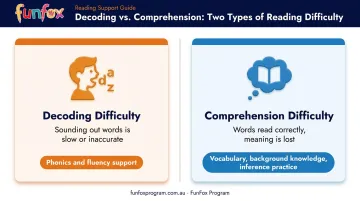
| Type | What it looks like | What helps |
|---|---|---|
| Decoding difficulty | Sounding out words is slow or inaccurate | Phonics and fluency support |
| Comprehension difficulty | Words read correctly, meaning is lost | Vocabulary, background knowledge, inference practice |
Some children have both. But knowing which issue is driving the struggle matters — extra phonics practice won't fix a vocabulary gap, and vice versa.
Why "Perfect" Readers Sometimes Can't Answer Questions
Limited vocabulary or background knowledge can make a text feel meaningless — even when every word is decoded correctly. A child reading a passage about the water cycle may hit every word without any grasp of what evaporation actually means. That's a knowledge gap, not a reading deficit — and it calls for different support: pre-reading discussion, exposure to non-fiction, or simply building context before the page is opened.
How Reading Comprehension Assessment Works: A Step-by-Step Guide
Here's how a reading comprehension assessment typically unfolds in a primary school context — useful for parents who want to understand the process, not just the outcome.
Step 1 – Define the Purpose
Before any assessment begins, the purpose must be clear. Is this about identifying risk (screening), uncovering a specific gap (diagnostic), tracking growth (progress monitoring), or measuring achievement (summative)? The purpose shapes everything — which tool is chosen, how it's administered, and how results are used.
Step 2 – Select the Right Assessment Method
Different question formats reveal different things:
- Open-ended questions — most sensitive to actual comprehension, but time-intensive; reveal how a child reasons and uses text evidence
- Multiple-choice questions — widely used and efficient, but can allow guessing; results depend heavily on distractor quality
- Cloze tasks (fill-in-the-blank) — test both local and global text coherence; useful as one indicator among several
- True/false judgements — quick for classroom checks, but limited for nuanced skills like inference
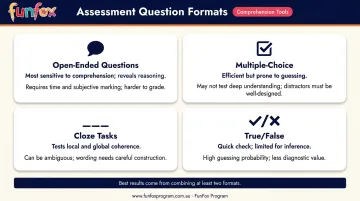
No single format captures the full picture — the most reliable comprehension data comes from combining at least two formats.
Step 3 – Administer and Observe
Administration isn't just about giving a test. Skilled educators also observe how a child engages:
- Does the child self-correct during oral reading?
- Do they use text evidence in answers, or guess and fabricate?
- Where do they hesitate or slow down?
Oral questioning after a read-aloud is one of the most informative sources of comprehension data available — and it costs nothing.
Step 4 – Interpret Results with Context
Raw scores alone don't tell the full story. A child who answers poorly on a topic they know nothing about may not have a comprehension problem at all. Teachers should interpret results alongside decoding ability, vocabulary knowledge, background knowledge, and fluency — a low score on one measure is a starting point, not a verdict.
Step 5 – Act on Findings
Results are only useful when they drive action:
- Targeted small-group instruction at school
- Vocabulary and background knowledge building
- Inference and prediction practice
- Referral for further diagnostic assessment if needed
- Specific strategies parents can use at home
What to Do After an Assessment: Supporting Your Child at Home
Parents don't need to wait for a school action plan. There are practical, evidence-backed ways to reinforce comprehension every day — none of which require worksheets or formal homework sessions.
At-Home Strategies That Work
- Ask open-ended questions during and after reading — "What do you think will happen next?" or "Why did the character make that choice?" These questions build inference skills without feeling like a test.
- Read aloud together — even for older primary students. Reading books above a child's independent level builds vocabulary and exposes them to complex language structures they wouldn't encounter on their own.
- Build background knowledge through conversation — discuss news, documentaries, nature, history, or whatever interests your child. Background knowledge is one of the strongest predictors of comprehension.
- Ask for a retell — "Tell me what happened in your own words." This simple task reveals far more about comprehension than whether a child finished the book.
After a Formal Assessment: What to Ask the Teacher
Request a brief meeting and come with specific questions:
- What do these results mean for my child's reading, in plain language?
- What is the school doing to address any identified gaps?
- What can I do at home to support what you're working on in class?
When home and school are working toward the same goals, children tend to make faster, more sustained progress.
Structured Support Between Assessments
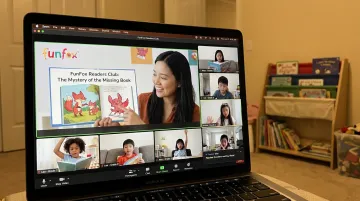
For families who want ongoing, guided comprehension practice — particularly after a screening or summative result raises concerns — FunFox's Readers Club offers a structured option. Each week, students join live online classes in small groups of 3–6, with trained teachers who track individual progress over time.
The program covers:
- Inference and critical thinking
- Vocabulary and text structure
- A wide range of text types — novels, poetry, and plays
Parents receive direct teacher feedback each term, so there are no guesses about how their child is tracking. With over 1,500 students across five countries, it's a practical next step for families who want consistent, guided practice — not just periodic test results.
How FunFox's Readers Club Supports Reading Comprehension
FunFox's Readers Club is built around the same comprehension skills that formal reading assessments target — inference, vocabulary, text structure, and critical thinking — delivered in small online groups aligned to the Australian curriculum.
What the program looks like in practice:
- Weekly 60-minute live sessions on Zoom, capped at 3–6 students per group
- Exposure to diverse text types: classic literature, novels, short stories, poetry, and plays
- Pre-session digital worksheets students complete independently, so live class time goes straight into guided practice
- Brain teasers and collaborative discussion designed to build critical thinking alongside comprehension
- Process-based feedback built into every session, plus individualised parent–teacher meetings each term
- School holiday office hours tailored to each student's areas of need
These features make the program well-suited to children across a range of abilities — including those flagged as at risk during screening or scoring below expectations on formative and summative assessments. As one parent noted, their child found reading "intimidating" before joining; structured, consistent practice changed that.
Since 2020, FunFox has supported over 1,500 students across more than five countries. For Australian families whose children need more targeted comprehension practice than a classroom can offer, that track record speaks for itself.
Frequently Asked Questions
What is a reading comprehension assessment?
It's any evaluation — formal or informal — used to measure how well a child understands what they read. It goes beyond decoding to assess inference, vocabulary, and comprehension across different question types and text formats.
What are the 4 types of reading assessments?
The four types are screening, diagnostic, progress-monitoring (formative), and outcomes-based (summative). Each serves a distinct purpose — from flagging early risk to pinpointing specific gaps to tracking growth over time.
What is the best assessment for reading comprehension?
There's no single best assessment. The most effective approach combines multiple types, with open-ended questioning and teacher observation typically providing the richest insight into how a child comprehends and reasons through a text.
What are the 5 questions for reading comprehension?
Strong comprehension questions cover five areas: literal understanding, inference, vocabulary, text structure, and personal response or evaluation. Together, these move students from surface-level recall to deeper critical thinking about a text.
At what age should reading comprehension be assessed?
Screening for reading risk typically begins in the Foundation year through Year 3. Comprehension-focused assessment becomes more central from around Year 2–3 once basic decoding is established, and continues throughout primary school as text demands increase.
How can parents support reading comprehension at home?
Read together regularly, ask open-ended questions about texts, build vocabulary through conversation, and follow up with teachers after any formal assessment to understand results and align home support with what their teacher is working on.