Introduction
Picture this: a child has written a persuasive essay arguing that school should start later. Their reasons are solid — more sleep means better focus, happier students, and improved results. But when you read it, something feels off. Each point lands with a thud, disconnected from the next, more like a list than an argument.
That's the problem transitional words solve. A single phrase like "as a result" or "furthermore" can transform a collection of decent points into a genuinely convincing case. What makes an argument persuasive isn't always the number of points — it's how those points connect.
This guide covers everything young Australian writers need: what transitional words actually are in a persuasive context, the key categories every primary student should know, where to place them throughout an essay, and the most common mistakes to avoid.
Parents will also find practical activities to help children build this skill through real writing, not just memorisation.
Key Takeaways
- Transitional words act as signposts, showing readers how ideas connect, not merely that they follow each other in sequence.
- Different categories serve different jobs: adding evidence, showing contrast, signalling cause and effect, and wrapping up.
- Overusing one word — like "however" in every paragraph — weakens an argument rather than reinforcing it.
- NAPLAN's persuasive marking guide explicitly rewards controlled, varied use of linking language with higher cohesion scores.
- Children improve faster by practising transitions inside real writing tasks, not by memorising lists.
What Are Transitional Words in Persuasive Writing?
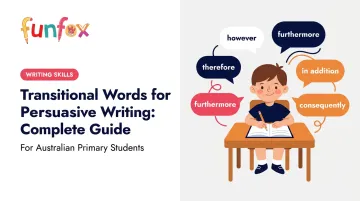
Transitional words — also called connectives or text connectives — are words and phrases that link ideas, sentences, and paragraphs so writing flows logically. They act as signposts: they tell the reader what to expect next, whether that's a new supporting point, a contrasting view, or a conclusion.
The Australian Curriculum glossary defines cohesion as "the grammatical and lexical relationships that link the different parts of a text and give it unity." Connectives are one of the main tools for achieving that unity — linking ideas through relationships of time, cause and effect, comparison, or addition.
Why Persuasive Writing Needs Them Most
In narrative writing, events carry the reader forward naturally. Persuasive writing doesn't have that luxury — it runs on logic. If a reader can't follow the reasoning chain, the argument collapses, no matter how strong the individual points are.
Transitions make the reasoning visible. They show the reader why one point follows from another, rather than leaving them to guess.
That visibility depends on word choice. "Therefore" signals a conclusion drawn from evidence. "However" signals a shift to a contrasting idea. The same transition used in the wrong spot can mislead a reader just as easily as no transition at all.
Why Transitional Words Matter More in Persuasive Writing
Consider two versions of the same argument:
- Without a transition: Dogs make great pets. They encourage their owners to exercise.
- With a transition: Dogs make great pets. As a result, owners tend to exercise more regularly, which benefits the whole family.
One word changes how the second sentence lands — it's no longer just an additional fact but a consequence of the first point. In persuasive writing, that logical link is exactly what separates a list of claims from a reasoned argument.
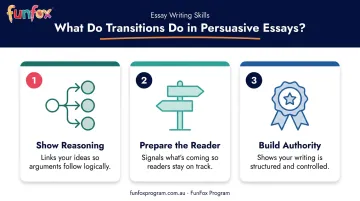
Three Jobs Transitions Do in a Persuasive Essay
Transitions do more than connect sentences — they shape how readers process your argument:
- They show reasoning, not just opinion — the argument is built on logic the reader can follow
- They prepare readers for what's next — signalling contrast, elaboration, or a conclusion before it arrives
- They build authority — writing that guides a reader confidently through a sequence feels more credible
What NAPLAN Says
The NAPLAN persuasive writing marking guide assesses 10 criteria, including Cohesion (scored 0–4) and Paragraphing (scored 0–3). A cohesion score of 4 requires a range of cohesive devices used correctly and deliberately to enhance reading. Lower scores reflect missing, incorrect, or hard-to-follow links.
The guide specifically names connectives such as "however," "although," "therefore," "additionally," and "finally" as examples — but it does not reward volume. What earns marks is correct, deliberate control — knowing which connective fits the moment and why.
Types of Transitional Words for Persuasive Writing
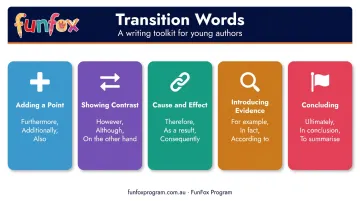
Not all transition words do the same job. In a persuasive essay, each category serves a specific argumentative purpose — choosing the right type for the right moment separates average writing from a genuinely convincing piece.
Adding a Point or Building Your Case
Use these to stack supporting arguments and signal that more evidence is coming:
- Furthermore
- In addition
- Additionally
- What is more
- Also
- Not only that
- Besides this
- Equally important
Example: Students need more sleep to perform well at school. Furthermore, research consistently links adequate rest to improved concentration and memory.
Showing Contrast or Addressing the Other Side
Good persuasive essays don't ignore the other side — they address it head-on. Contrast transitions let the writer introduce a counterargument and pivot back to their position.
- However
- On the other hand
- Although
- Even though
- Despite this
- While it may be true that
- Nevertheless
- In contrast
Example: Although some parents worry that later school start times would disrupt family routines, the evidence shows that students who sleep longer perform better and are absent less often.
Showing Cause and Effect
These transitions connect an argument to its consequence — showing why something matters, not just that it exists:
- Therefore
- As a result
- Consequently
- For this reason
- This means that
- Because of this
- Thus
Example: Many students arrive at school exhausted. As a result, they struggle to concentrate during the first two lessons of the day.
Introducing Evidence or Examples
Evidence transitions signal credibility. Rather than just asserting a point, the writer backs it up — and these words mark that shift:
- For example
- For instance
- As shown by
- In fact
- According to
- To illustrate
- This is evident in
Example: Schools that shifted to a later start time saw real improvements. For instance, attendance rates increased significantly within the first term of the change.
Concluding or Summarising
Conclusion transitions signal the final persuasive push — wrapping up the argument and bringing the reader to a clear endpoint:
- In conclusion
- To sum up
- Ultimately
- For these reasons
- All things considered
- It is clear that
- In summary
A note for young writers: The conclusion should restate the main argument, not introduce new points. Save new information for the body paragraphs.
How to Use Transitional Words Throughout a Persuasive Essay
Knowing the word categories is one thing. Knowing where to deploy each type is what makes the real difference. A persuasive essay has a predictable structure — introduction, body paragraphs, counterargument, conclusion — and each stage calls for different transitions.
In the Introduction
The introduction rarely needs heavy transition use. A brief phrase can signal the essay's position clearly: "There is no doubt that..." or "The evidence clearly shows that..."
Avoid using conclusion words ("in summary") or contrast words ("however") before any argument has been made — it confuses the reader before the case has even begun.
In the Body Paragraphs
The body is where most transitions live. Australian Curriculum Year 5 specifically asks students to use the starting point of a sentence or paragraph to give prominence to the message and guide the reader — meaning transitions at paragraph openings carry real curriculum weight.
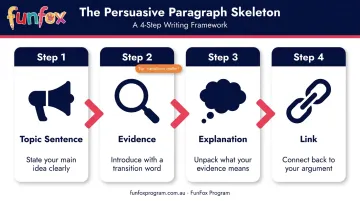
A simple paragraph skeleton to follow:
- Topic sentence — state the argument clearly
- Evidence — introduced with a transition ("for example" or "in fact")
- Explanation — show why this evidence supports the argument
- Link — connect to the next paragraph
When Addressing the Counterargument
The counterargument paragraph follows a reliable two-step pattern — one of the most powerful moves in persuasive writing:
- Acknowledge the opposing view: "While it is true that..." or "Admittedly..."
- Rebut it with evidence: "Nevertheless, the evidence suggests..." or "However, this concern overlooks..."
Not every essay needs a counterargument, but including one signals maturity in reasoning and is explicitly valued in Australian curriculum persuasive writing tasks.
In the Conclusion
Use a clear summary transition to signal the wrap-up. The final sentence can use an emphasis phrase to leave a strong impression — "Above all..." or "Most importantly..."
That said, opening every conclusion with "In conclusion" has become a cliché — most markers see it dozens of times per session. Stronger alternatives include:
- "Ultimately..."
- "For all these reasons..."
- "It is clear that..."
- "When all the evidence is considered..."
Common Mistakes Children Make with Transition Words
Overusing One Word
Starting every paragraph with "However" or "Also" is the most frequent error. Repetition makes transitions invisible — and if the reader stops noticing the signpost, it stops doing its job. A quick check: scan the essay and highlight every transition. If the same word appears more than twice, swap some out for alternatives from the same category.
Using the Wrong Type
"Therefore" implies cause and effect. If there's no logical connection between the two ideas, using "therefore" doesn't create one — it just confuses the reader. Before inserting a transition, ask: What is the actual relationship between these two ideas? Addition? Contrast? Consequence?
Contrast and cause-effect words like "although" and "despite" are genuinely harder for primary-age students to grasp than additive words like "also" or "furthermore." Check that children understand the logical relationship first — then choose the word.
Placing Transitions Awkwardly
Awkward mid-sentence: "Dogs are, however, better suited to active families."
Clearer at the start: "However, dogs are better suited to active families."
Putting transitions at the beginning of a sentence is usually the clearest choice. Some words — "also" and "too" — can naturally sit at the end, but most transition phrases work best leading the sentence.
How to Help Children Practise Using Transitional Words
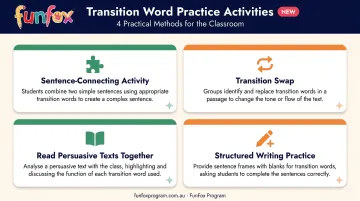
Children learn transition words most effectively through writing tasks, not by memorising lists. Here are four practical approaches:
Sentence-connecting activity — Give the child two related sentences with no transition and ask them to choose a connecting word, then explain why that word fits. This builds both vocabulary and reasoning at the same time.
Transition swap — Take a paragraph the child has already written and challenge them to replace every transition with a different word from the same category. Swapping "also" for "furthermore" or "however" for "on the other hand" builds vocabulary flexibility without starting from scratch.
Read persuasive texts together — Read opinion pieces from children's magazines or school debate resources and point out transitions as you go. Ask: "What job is this word doing? What does it tell you is coming next?" This develops reading-writing awareness that carries directly into their own work.
Structured writing practice with guided feedback — The FunFox Writers Club runs live, small-group online sessions (maximum 6 students, Years 2–6) where children write, revise, and refine persuasive pieces with direct teacher input. Weekly Zoom classes are supported by personalised written feedback between sessions, giving each child consistent, specific guidance on skills like transition use.
Frequently Asked Questions
What are good words for persuasive writing?
The most useful words cover five functions: adding points (furthermore, additionally), showing contrast (however, although), introducing evidence (for example, in fact), emphasising (above all, notably), and concluding (ultimately, for these reasons). The right word is whichever one accurately signals the relationship between the two ideas being connected.
What are 10 transition words in sentences?
Here are five in action: Furthermore, students who exercise regularly perform better in class. However, not all schools have the space for outdoor play. As a result, focus levels drop by mid-morning. For example, one school introduced a movement break and saw attendance improve. Above all, student wellbeing must come first. The main article body includes all 10 with full context.
What transition words work best to start a paragraph in a persuasive essay?
Strong paragraph-openers include: "Another key reason is...", "Furthermore...", "Perhaps most importantly...", and "While some may argue that..." The right choice depends on whether the paragraph is adding a point, introducing evidence, or addressing the counterargument.
Can you use too many transition words?
Yes. Overuse makes writing feel mechanical and repetitive. Transitions should appear when there is a genuine shift or connection to signal — not in every single sentence. NAPLAN rewards deliberate, controlled use, not volume.
How do transition words make persuasive writing more convincing?
They make the logic of an argument visible. Instead of leaving the reader to guess why one point follows another, a transition shows the relationship explicitly — making the argument feel reasoned and authoritative rather than like a list of opinions.
How do you teach children to use transition words?
Hands-on practice works best: sentence-connecting activities, swapping transitions in real paragraphs, and reading persuasive texts together to identify how connectives work. Practice inside authentic writing tasks builds the skill far faster than memorising a word list.