Here's the thing: creative writing isn't reserved for kids who love books or who ace every English assignment. The skills it builds — imagination, communication, the ability to organise thoughts clearly — benefit children across every subject and in everyday conversations.
This post shares 8 fun, low-pressure ways for primary school kids to get started with creative writing. No experience required. No red pen in sight.
Key Takeaways
- Creative writing covers any expressive writing that goes beyond facts — stories, poems, journals, and scripts all count.
- Starting small builds confidence; haikus and prompts are effective entry points.
- Kids learn best through play — the best activities feel like fun, not homework.
- Parents who act as enthusiastic audiences (not editors) boost their child's motivation and willingness to keep writing.
- Structured support, like a dedicated writing programme — such as FunFox's Writers Club — helps children develop faster and with greater confidence.
What Is Creative Writing?
Creative writing is any writing that uses imagination to express ideas, tell stories, or explore emotions — as opposed to factual reports or academic essays. Kids encounter it more than they realise.
Examples they'll recognise:
- A short story about a kid who discovers a secret door in the school library
- A poem about their dog's ridiculous fear of the vacuum cleaner
- A personal narrative about the best (or worst) holiday they've ever had
- A script for a play where two vegetables argue about who's more nutritious
Within the Australian primary school curriculum, creative writing sits across two core strands in the Australian Curriculum v9.0: Creating literature (using imagination to write texts with literary qualities) and Creating texts (producing written, spoken, and multimodal work for different audiences).
From Foundation year onwards, children are expected to compose short narratives and poems — making creative writing a core literacy skill, not an optional extra.
Those curriculum demands grow quickly. By Year 5, students are expected to experiment with figurative language, develop distinct character voices, and craft multi-layered stories. Children who practise regularly at home arrive at those expectations with confidence rather than anxiety.
Why Creative Writing Matters for Kids
It Builds Vocabulary and Thinking Skills
Every creative writing task is a vocabulary workout. The Australian Curriculum deliberately sequences this: Foundation students use familiar words, Year 3 students are expected to use topic-specific and precise vocabulary, and by Year 5 they're experimenting with figurative language.
Writing regularly gives children structured, enjoyable practice applying richer language — far more than a vocabulary worksheet ever could.
The Institute of Education Sciences also recommends that elementary students have daily writing time and be taught the full writing process — planning, drafting, sharing, revising, and editing — as an evidence-based practice for building strong writers.
It Supports Emotional Wellbeing
A 2020 Journal of Writing Research study of fifth-grade students found that expressive writing was associated with improved working memory, while all participants — writing group and control group alike — showed reduced anxiety and depression symptoms over the study period. Journaling and reflective writing give children a low-stakes space to process big feelings.
It Transfers to Other Subjects
The skills built through creative writing carry directly into schoolwork:
- Planning a story teaches sequencing and logical structure
- Writing from a character's perspective develops empathy and reasoning
- Crafting a narrative argument builds the same muscles needed for a persuasive essay in Year 6
Children who write regularly for pleasure tend to approach academic writing tasks with noticeably greater ease.
Reluctant Writers Are More Common Than You'd Think
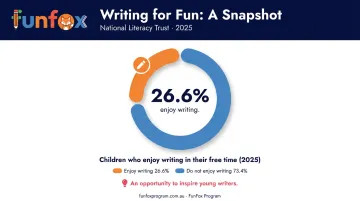
Research from the National Literacy Trust found that in 2025, only 26.6% of children and young people aged 8 to 18 said they enjoyed writing in their free time. That's a significant gap — and a clear opportunity. When writing feels like self-expression rather than a task, the dynamic shifts completely.
That shift is what FunFox's Writers Club is built around. Small groups of no more than 6 students, live weekly sessions, and a curriculum centred on creative exploration give children — including reluctant writers — a genuinely low-pressure environment to find their voice.
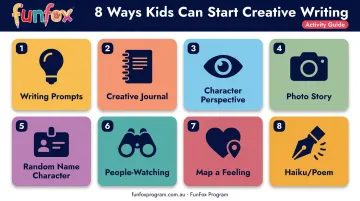
8 Fun Ways to Get Started with Creative Writing
These activities are designed to be imaginative, low-stakes, and genuinely enjoyable for primary school-aged kids.
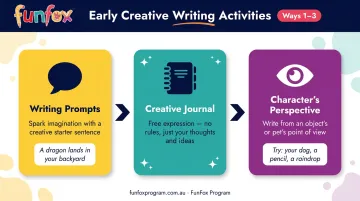
Way 1: Use Fun Writing Prompts Every Week
A writing prompt is a starting sentence, question, or scenario that hands a child the hardest part of writing on a silver platter: deciding what to write about.
Try prompts like these:
- What if your school had a secret underground world that only appeared on rainy days?
- Write a story from the perspective of your school bag. What has it seen this week?
- A dragon lands in your backyard and asks to borrow your Wi-Fi. What happens next?
Make it a weekly habit — Sunday evenings or Friday afternoons work well. Keep a jar of hand-written prompts on the kitchen bench and let your child draw one at random. The randomness is half the fun.
Way 2: Start a Creative Journal
A creative journal is not a school diary. There are no rules, no neat sentences required, and nothing ever needs to be finished.
Encourage your child to use it for:
- Snippets of dialogue they made up between two animals they spotted at the park
- "What if" questions that pop into their head
- Dream recordings from that morning, however strange
- A wish list for a fantasy world they'd want to live in
The goal is expression, not perfection. A page full of doodles with three scrawled sentences counts. So does a half-finished story that goes somewhere wonderful before stopping mid-sentence.
Way 3: Write from a Character's Perspective
Ask your child to pick any familiar object — their favourite toy, the family pet, the spoon in the kitchen drawer — and write a day in its life. What does the spoon see from inside the cutlery drawer? What does the dog think is happening when everyone leaves for school?
This mirrors formal Point of View (POV) exercises from the Australian Curriculum, but it feels like imaginative play. Research published by ASCD notes that role, audience, format, and topic tasks help students practise empathy, point of view, and authentic voice — all core storytelling skills.
The results are often surprisingly funny, and kids who struggle with "write about your weekend" frequently produce their most creative work from this exercise.
Way 4: Find an Old Photo and Tell Its Story
Pick an interesting photograph — from a family album, an op shop, or a free historical archive online — and ask your child to invent the story behind it.
Prompt them with questions like:
- Who are these people, and how do they know each other?
- What happened five minutes before this photo was taken?
- What is the person in the corner thinking?
Without realising it, children practising this activity are learning descriptive writing, character motivation, and scene-setting — three pillars of good storytelling — in a way that feels more like detective work than a lesson.
Way 5: Create a Character from a Random Name
Grab a baby name book, search a different language, or use an online fantasy name generator. Pick a name at random. Then set a timer for 10 minutes and free-write everything about that character.
Questions to get them going:
- How old are they, and where do they live?
- What's their biggest fear?
- What's their most prized possession?
- What problem are they facing right now?
The "timed free-write" technique is key: encourage your child not to stop writing until the timer goes off. There are no wrong answers.
The stranger and more specific the character, the better the story potential. A fearless 9-year-old who collects broken clocks and is terrified of butterflies is far more interesting than a generic hero.
Way 6: Build a Character by People-Watching
Sit somewhere with foot traffic — a café, the park, school pick-up — and quietly observe one interesting-looking person. Notice their shoes, how they hold their bag, whether they seem in a hurry or completely at ease.
Frame this as a detective game: What clues does this person give you about who they are?
Then go home and invent their backstory. Real-world observation teaches children something no writing lesson can manufacture: that specific, grounded details are what make fictional characters feel believable. It's the same habit working authors rely on — and it's one any child can practise anywhere.
Way 7: Map a Feeling into a Brand-New Story World
Take something your child feels strongly right now — the excitement before a birthday, frustration with a sibling, nerves about a school performance — and transplant that exact feeling into a completely different setting.
Examples:
- A space explorer who's excited but terrified on the morning of their first launch
- A medieval knight who's furious that their younger sibling keeps getting all the glory
- A talking cloud who's nervous about performing rain for the first time
This technique gives children permission to write about real, big emotions while keeping a safe fictional distance. It's also how many beloved children's books are created.
The result is stories that feel authentic rather than invented — because emotionally, they are.
Way 8: Write a Haiku or Short Poem
A haiku follows a simple structure: three lines with 5, 7, and 5 syllables respectively. That's it.
Example: Rain hits the window (5) Our dog refuses to move (7) Smart, honestly (5)
Because a haiku is short enough to feel achievable, it removes the overwhelm that stops many young writers before they start. It also teaches word choice — children quickly discover that every syllable counts, which is one of the most transferable writing skills there is.
Try a haiku-a-day challenge for one week: each morning, observe one thing in the world around them and write a single haiku. By Friday, they have a small collection of poems — a real confidence boost.
Tips for Parents to Support Creative Writing at Home
Be the Audience, Not the Editor
When your child shares their writing, lead with curiosity. "Tell me more about this character — where did she come from?" beats any correction. A single discouraging comment can shut down a young writer for weeks. Save editing for when they ask for it, or for when they're older and actively working toward improvement.
Create a Writing Corner
Set up a small, dedicated space with notebooks, coloured pens, stickers, and a jar of prompts. It doesn't need to be a whole desk — a shelf in their bedroom works. The physical signal matters: it tells your child that writing is a valued, enjoyable activity in your home, not just something that happens at school.
Read Aloud Together
The UK Department for Education's evidence summary on reading for pleasure identifies a positive relationship between reading frequency, reading enjoyment, and both text comprehension and writing ability. Children who are immersed in stories develop an intuitive sense of how good writing sounds — and that instinct carries directly into their own writing. When children hear vivid descriptions, strong dialogue, and well-paced stories, they start reaching for those same effects on the page.
Conclusion
Creative writing doesn't need to start with a masterpiece. It starts with curiosity, a blank page, and one of the eight activities in this post. Consistency and enjoyment matter far more than perfection — especially at primary school age.
For parents who want their child to take the next step with structured support, FunFox's Writers Club offers live online sessions in small groups of no more than 6 students, led by experienced teachers and aligned to the Australian curriculum. It's a structured program where reluctant writers genuinely start to enjoy the process — sessions are built around creative exploration, not rote exercises.
Explore the Writers Club at funfoxprogram.com.au.
Frequently Asked Questions
What is creative writing and examples?
Creative writing is imaginative, expressive writing that goes beyond facts or academic content. Examples include short stories, poems, personal narratives, play scripts, and journal entries — basically any writing where the author's voice, imagination, or emotion takes centre stage.
What are the 7 types of creative writing?
The main types relevant to school-age learners are:
- Short stories — fictional narratives with character and plot
- Poetry — structured or free verse
- Personal narrative — real experiences told with voice
- Descriptive writing — painting scenes with words
- Drama/scripts — dialogue and stage directions
- Journalling — reflective or imaginative entries
- Flash fiction — very short, complete stories
Is creative writing good for kids?
Yes. Research supports creative writing as beneficial for vocabulary growth, story comprehension, emotional processing, and academic literacy skills. It's also a core part of the Australian Curriculum from Foundation year onwards — not an optional enrichment activity.
At what age should kids start creative writing?
Children can start from Foundation year (age 4–5) through oral storytelling, drawing, and dictating stories to an adult. More structured written creative work typically develops from around ages 6–7 (Years 1–2), in line with Australian curriculum expectations.
How can I motivate my child to enjoy creative writing?
Start low-pressure — a fun prompt, a single haiku, or a journal with no rules — and let them choose the topic. Being an enthusiastic audience and asking questions rather than offering corrections goes further than corrections ever will.
What is the difference between creative writing and other types of writing?
Creative writing prioritises imagination, personal voice, and emotional engagement. Academic or technical writing prioritises facts, structure, and objectivity.